

Migration nightmare: how to define redirects at scale? - Antoine Eripret
- August 10, 2022
- General
AI Summary
Defining redirects for a large migration is a matching problem, not a manual one: you combine exact matches, pattern rules and similarity matching, then QA the result before launch. Antoine Eripret's write up shows how to build that map at scale without sending everything to the homepage or leaving orphans behind.
- Treat the redirect map as data: an old URL list and a new URL list you match by rules.
- Exact slug matches handle the bulk, patterns cover structured URLs, similarity matching mops up the rest.
- One 301 per old URL, straight to the final destination, with no chains and no loops.
- QA against staging and re-crawl after deploy, because most migration traffic loss comes from redirect gaps.
Migration nightmare: how to define redirects at scale?, Antoine Eripret provides valuable insights for SEO practitioners. This resource examines approaches and considerations that can improve organic search performance.
Key Concepts
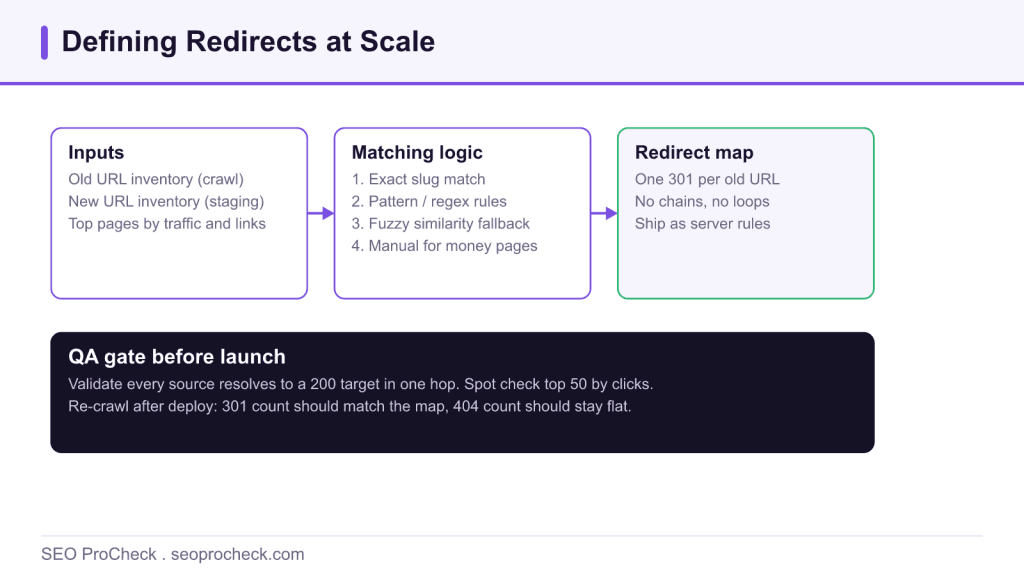
The mistake that sinks large migrations is treating redirects as a task to grind through by hand. At a few thousand URLs that does not scale, so the work becomes a data exercise. You start from two inventories: every old URL that will disappear or move, pulled from a crawl and from Search Console so you catch pages that still earn clicks, and every new URL from staging. The job is to map each old URL to the single most relevant new one. Eripret frames this as matching, and the framing matters because it turns an overwhelming manual list into a pipeline you can reason about.
Prioritise by value. A URL with traffic, backlinks or steady crawl demand deserves a precise destination. A parameter variant nobody links to can follow a broad rule. Sorting the inventory by clicks and referring domains first tells you where accuracy actually pays.
Implementation Considerations
Work through the matching in layers, easiest first. Exact matches on the slug resolve the majority when the path stays stable. Pattern rules, written as regular expressions, handle predictable transformations such as a category folder that changes name across the whole site. Similarity matching then tackles the leftovers by comparing the old URL, its title and its heading against candidate new pages and proposing the closest fit. Modern approaches use text embeddings for that similarity step, which is far more accurate than raw string distance. Whatever the old URL cannot be matched to with confidence goes to a manual queue, and your money pages always get a human decision.
The output is a flat map of source to destination. Enforce two rules on it: one hop only, so you map to the final live URL rather than another redirect, and no loops. Ship the map as server level 301 rules where possible, since server rules are faster and more reliable than a plugin holding thousands of entries.
Measuring Impact
Redirects are quiet when they work and expensive when they fail, so measure both before and after launch. Before: run the full source list through a crawler pointed at staging and confirm every URL returns a single 301 to a 200 target. After: re-crawl production and compare the 301 count against the map and watch the 404 count, which should stay flat rather than spike. In Search Console, keep an eye on the crawled and indexed counts for the migrated section over the following weeks. When migration traffic dips, the cause is usually a redirect gap, so this monitoring is what lets you catch and fix it fast. For the tags and headers involved, our meta robots and X-Robots-Tag reference is a useful companion.
| Matching method | When it applies | How to run it |
|---|---|---|
| Exact slug match | Path stays the same on the new site | Join old and new URL lists on the normalized path |
| Pattern / regex rules | Predictable, site wide structural change | Write rules per template, for example old category to new category |
| Similarity matching | Leftover URLs with no clean rule | Compare URL, title and headings using text embeddings, confirm top matches |
| Manual mapping | Money pages and high link URLs | Assign the destination by hand, always |
What Has Changed Since This Article
The core method is durable, but the similarity step has improved sharply. A few years ago fuzzy matching leaned on string distance, which struggled when a URL was reworded. Today you can embed the old page text and the candidate new pages with an off the shelf model and match on meaning, which raises the automatic match rate and shrinks the manual queue. If you write your own pipeline, our guide on Python for SEO covers the data handling this needs.
Frequently Asked Questions
What counts as a redirect at scale?
Any migration where the number of URLs makes a hand written map impractical, often from a few thousand pages upward. At that point you match programmatically and reserve manual work for the highest value URLs.
Should every old URL get its own redirect?
Yes, every removed or moved URL that had traffic, links or crawl demand should point to the closest relevant live page with a single 301. Sending everything to the homepage wastes the signal and frustrates users.
How do I avoid redirect chains?
Map old URLs to their final destination, not to an intermediate URL that itself redirects. After launch, re-crawl and flatten any chain so each source reaches a 200 target in one hop.
Can I match URLs automatically?
Largely, yes. Exact slug matches handle the bulk, pattern rules cover predictable structures, and similarity matching on the remaining URLs suggests a best guess that a human confirms for important pages.
How do I test redirects before launch?
Run the source list through a crawler against staging, confirm each returns a single 301 to a 200 target, and spot check your top pages by clicks and links by hand before you ship the rules.
What happens if I get redirects wrong?
Broken or missing redirects produce 404s that drop rankings and lose link equity, while chains and loops slow crawling. Most migration traffic losses trace back to redirect gaps rather than the new design itself.
Source: https://www.aeripret.com/redirects-at-scale/?utm_source=substack&utm_medium=email
Take this with you
The assistant links open with a question about this page already written. Nothing is sent until you press enter.
Claude Vincent is a technical SEO consultant focused on crawlability, rendering, and AI-search visibility. He writes the field guides and case studies at SEO ProCheck, with a bias toward the durable, unglamorous work that decides whether search engines and AI answer engines can actually read and cite a site.
About SEO ProCheck
Technical SEO consulting and GEO strategy with 20 years of enterprise experience. Case studies, resources, and tools for search and AI visibility.
Work With Me
Technical SEO audits, GEO strategy, site migrations, and international SEO. Hourly consulting for teams who need hands-on support, not just reports.
Subscribe to our newsletter!








Recent Posts
- Most Top Sites Never Say Who They Are in Structured Data October 14, 2026
- Homepage Titles Are Mostly Too Short, Not Too Long October 8, 2026
- Who Actually Serves an llms.txt? 184 Top Sites Measured September 29, 2026