


AI Summary
Python lets an SEO practitioner automate the repetitive parts of the job: pulling data from APIs, cleaning large exports, and running analysis that would take hours by hand. JC Chouinard's nine chapter guide is one of the better free routes from a blank notebook to working scripts.
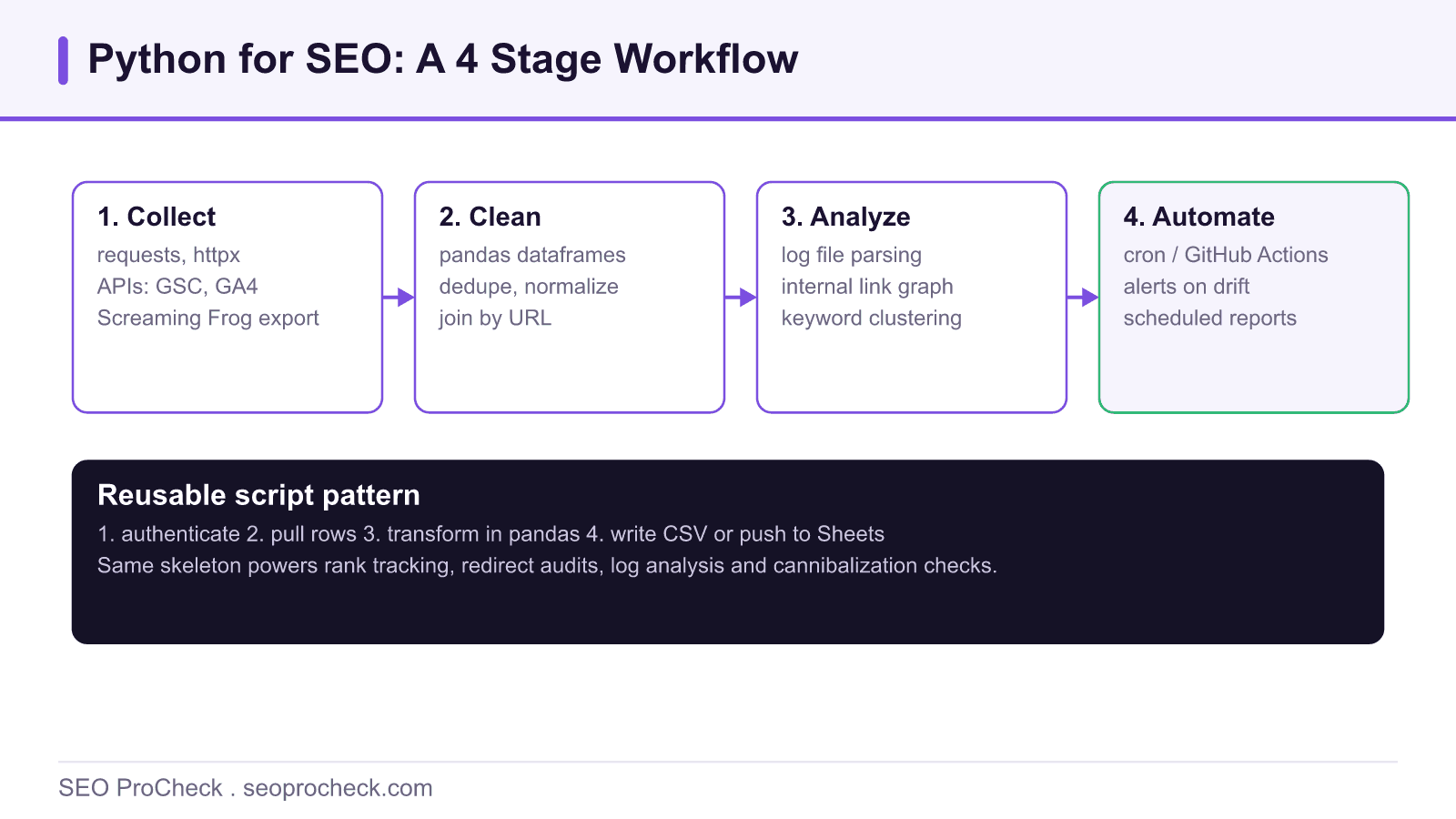
- The core loop rarely changes: authenticate, pull rows, transform with pandas, then export or push to a sheet.
- High value tasks include Search Console API pulls, server log parsing, redirect map building, and keyword clustering.
- You do not need a computer science background; a notebook and a handful of libraries cover most SEO work.
- Finished scripts can run on a schedule with cron or GitHub Actions so reports refresh without you.
Python for SEO: Complete Guide (in 9 Chapters), JC Chouinard provides valuable insights for SEO practitioners. This resource examines approaches and considerations that can improve organic search performance.
Key Concepts
The reason Python earns a place in an SEO toolkit is scale. A spreadsheet is fine for a few hundred rows, but it stalls on a million line log file or a crawl of a large ecommerce catalogue. Python handles that volume in seconds and, more importantly, it is repeatable: the same script produces the same output next month with one command. The libraries you meet first are requests or httpx for talking to APIs, pandas for tabular data, and a notebook environment such as Jupyter for exploring results interactively. Chouinard's guide walks through these in order, so you build a mental model rather than copying snippets blind.
For SEO specifically, the data sources that repay automation are the Google Search Console API, the GA4 Data API, an export from a crawler such as Screaming Frog, and raw server logs. Once any of these lands in a pandas dataframe you can join them on the URL, filter, group, and spot patterns that a manual review would miss.
Implementation Considerations
Before the first useful script there are a few practical constraints worth knowing. Set up an isolated environment with venv so project dependencies do not collide. For the Search Console API, authenticate with a Google service account and grant it access to the property, which avoids the fragile browser login flow. Respect rate limits: the GSC API caps rows per request, so you page through results in batches of 25000 and stitch them together. Handle errors defensively, because an API will occasionally return a timeout and a good script retries rather than crashing halfway through a report.
It is equally useful to know when not to reach for Python. A one off question about a single page is faster answered in the browser. Python pays off when a task is repetitive, large, or needs to run unattended on a schedule. That is the line to watch.
Measuring Impact
The return on learning Python for SEO shows up in three ways. First, time saved: a redirect audit that took an afternoon of copy and paste becomes a two minute script run. Second, reproducibility: because the logic lives in code, a colleague can rerun it and trust the numbers. Third, earlier detection: a scheduled script that watches for a spike in noindex tags or a drop in indexed URLs surfaces a problem days before it would show up in a monthly report. Track your own before and after on these to justify the time investment.
A Starter Task List
If you want concrete first projects, these four map neatly onto the four stages in the diagram above. Pull your top queries from the Search Console API and export them to CSV. Parse a week of server logs to see which URLs Googlebot actually crawls. Build a redirect map by matching an old URL list against a new one, which connects directly to our guide on defining redirects at scale. Finally, cluster a keyword list by intent, which feeds the kind of structure we describe in topic clusters.
| Library | What it does | Typical SEO use |
|---|---|---|
| requests / httpx | HTTP calls to APIs and pages | Pull GSC and GA4 data, check status codes |
| pandas | Tabular data handling | Join crawl, GSC and log data on the URL |
| Beautiful Soup | HTML parsing | Extract titles, headings, canonical tags at scale |
| advertools | SEO specific helpers | Sitemap parsing, robots.txt, log analysis |
| scikit-learn | Machine learning | Cluster keywords or pages by similarity |
What Has Changed Since This Guide
The fundamentals in Chouinard's guide hold up, but the surrounding stack has moved. Universal Analytics is gone, so any script that touched the old Analytics API now targets the GA4 Data API instead. Assistants that write code have also lowered the barrier: describing a task in plain language and refining the generated script is now a realistic way to learn, as long as you read and test what comes back rather than trusting it. The pandas and Search Console patterns in the guide remain the right foundation for both.
Frequently Asked Questions
Do I need to know how to code before starting?
No. The guide assumes no prior programming and introduces each concept as you need it. A working knowledge of spreadsheets is enough to start, and you learn the Python by doing small SEO tasks.
Is Python better than a spreadsheet for SEO?
For small one off jobs a spreadsheet is often faster. Python wins when the data is large, the task repeats, or you want it to run automatically on a schedule without manual steps.
Which library should I learn first?
Start with pandas, because almost every SEO task ends with tabular data you need to filter, join and export. Add requests next so you can pull that data from APIs directly.
How do I connect to Google Search Console?
Use the Search Console API with a Google service account that has access to your property. This is more stable for scripts than a browser login and lets you pull far more rows than the interface exports.
Can I automate my reports?
Yes. Once a script works, schedule it with cron on your own machine or a workflow such as GitHub Actions in the cloud, so the report refreshes on its own and can alert you when something changes.
Source: https://www.jcchouinard.com/python-for-seo
Take this with you
The assistant links open with a question about this page already written. Nothing is sent until you press enter.
Claude Vincent is a technical SEO consultant focused on crawlability, rendering, and AI-search visibility. He writes the field guides and case studies at SEO ProCheck, with a bias toward the durable, unglamorous work that decides whether search engines and AI answer engines can actually read and cite a site.
About SEO ProCheck
Technical SEO consulting and GEO strategy with 20 years of enterprise experience. Case studies, resources, and tools for search and AI visibility.
Work With Me
Technical SEO audits, GEO strategy, site migrations, and international SEO. Hourly consulting for teams who need hands-on support, not just reports.
Subscribe to our newsletter!








Recent Posts
- Most Top Sites Never Say Who They Are in Structured Data October 14, 2026
- Homepage Titles Are Mostly Too Short, Not Too Long October 8, 2026
- Who Actually Serves an llms.txt? 184 Top Sites Measured September 29, 2026