

AI Summary
Research shows you can improve your odds of being cited in AI search by applying a short list of credibility edits: add sourced statistics, include relevant quotations, lead each section with a direct answer, and write plainly, while skipping keyword stuffing which showed no benefit. Run it as a loop: pick a target question, edit the page, prompt the answer engines to see if you are cited, then iterate and log what works.
- AI search retrieves candidates with classic SEO, then cites the most credible and quotable ones.
- Effective edits: sourced statistics, real quotations, direct answers, and clearer writing.
- Keyword stuffing did not raise visibility, so spend the effort on substance.
- Measure by prompting engines for your target question and logging when your page is cited.
The headline that researchers discovered how to optimize for AI search sounds like hype, but the underlying work is practical and testable. As the source reports, academic research measured which content edits make a page more likely to be used and cited by AI answer engines, and the results give content teams a concrete playbook rather than guesswork. This page turns those findings into a workflow you can run against your own pages, one target question at a time.
How AI search decides what to cite
Most AI search experiences work in two stages. First a retrieval step gathers candidate pages, often from a conventional search index, which means classic SEO still governs whether you are even in the running. Second a generation step reads those candidates and composes an answer, attributing the sources it found most credible and quotable. The research focuses on that second stage: given that your page is retrieved, what makes an engine actually use it. That is why the effective tactics center on trust and clarity rather than ranking signals alone.
The edits the research supports
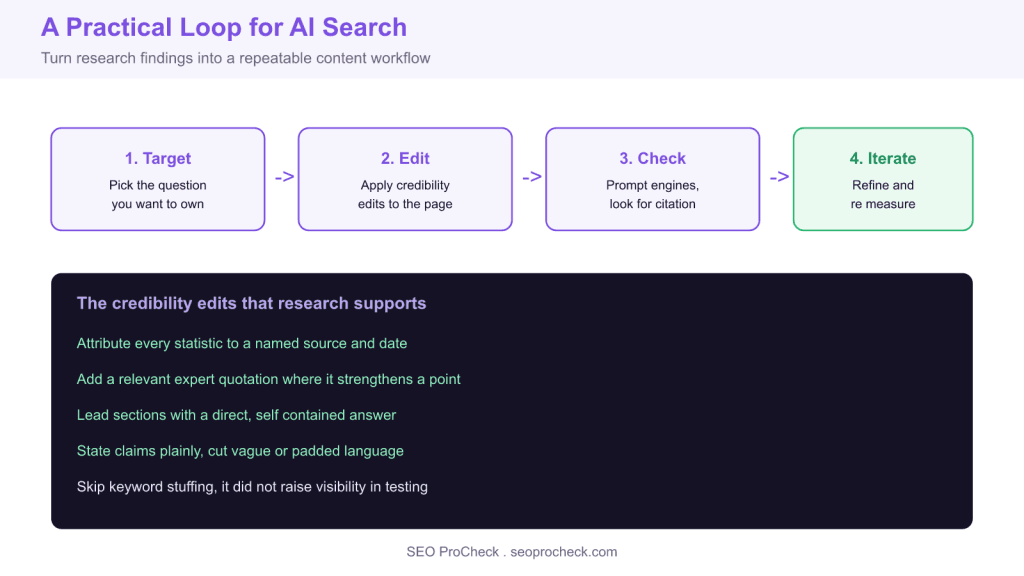
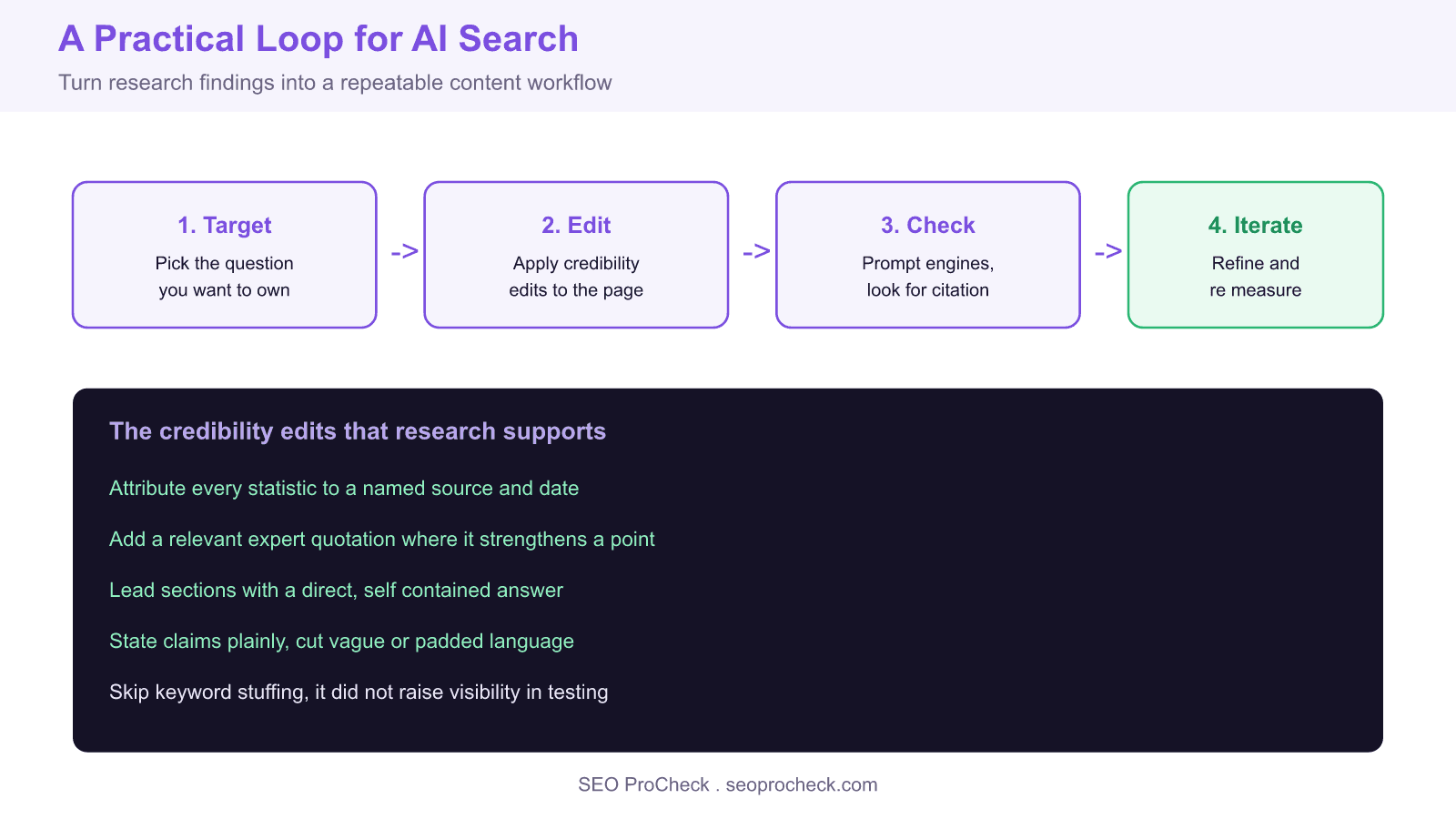
The findings point to a short list of high value edits. Support claims with concrete statistics that carry a named source and date. Add relevant quotations from credible voices where they genuinely strengthen a point. Lead each section with a direct, self contained answer to the question a user would type. State claims plainly and confidently rather than hedging or padding. Notably, the research found that keyword stuffing, repeating the target phrase to signal relevance, did not improve visibility, so it is effort better spent elsewhere.
A repeatable four step loop
Treat AI search visibility as an experiment you can run. Step one, pick a target question you want your page to own. Step two, apply the credibility edits above to the page that best answers it. Step three, prompt the answer engines your audience uses with that question and note whether your page appears as a cited source and how prominently. Step four, refine the weakest sections and re measure. Keep a simple log of query, edit, and outcome so you learn which changes move the needle for your topic, since results vary by subject and engine.
What to record when you check
Because AI answers are dynamic, capture evidence rather than relying on memory. Save the prompt you used, the date, the engine, whether your domain was cited, and the exact passage the engine appears to have drawn from. Over a handful of iterations this log tells you which credibility edit correlates with getting cited, and it protects you against the natural variation between runs. A short structured record turns a fuzzy goal into something you can actually manage.
query,date,engine,cited,passage_used,edit_applied
"how to fix crawl errors",2026-07-28,perplexity,yes,"intro answer","added sourced stat"
"best sitemap format",2026-07-28,ai_overview,no,"","tightened intro, added quote"
Keep it honest
The tactics that work all depend on genuine substance. Real statistics, real quotations, and clear writing are what earn trust from both an answer engine and a human reader. Fabricating a statistic to sound authoritative backfires: it undermines the credibility signal the research identifies, and it risks your page being distrusted when a model cross checks the claim. Optimize for AI search by being more verifiable, not by gaming a metric.
From research finding to page action
| Research finding | Page action | How to verify |
|---|---|---|
| Sourced statistics help | Add data with source and date | Every stat links to a primary source |
| Quotations help | Insert a relevant expert quote | Quote is real and attributed |
| Clear answers help | Lead sections with a direct answer | First two sentences stand alone |
| Fluency helps | Cut hedging and padding | Key claims stated plainly |
| Keyword stuffing does not help | Stop repeating the target phrase | Natural phrasing, no forced repeats |
Related reading
- The GEO research framework explained
- How to optimize content so LLMs cite it
- More SEO research and studies
Frequently asked questions
Can you really optimize for AI search?
Yes, within limits. Research shows that specific content edits make a page more likely to be used and cited by AI answer engines. You cannot control an engine directly, but you can make your page a stronger, more credible candidate, and you can measure whether it starts appearing as a cited source.
What is the single most effective change?
There is no one setting, but attributing claims to concrete, sourced statistics is consistently among the highest value edits. It gives an answer engine verifiable material to quote and signals that the page is trustworthy, which is exactly what the generation step rewards.
Does classic SEO still matter for AI search?
Very much. Most AI search retrieves candidate pages from a conventional index before generating an answer, so a page that is not crawlable, fast, or relevant may never be a candidate. Treat technical SEO as the entry ticket and credibility edits as what wins the citation.
How do I know if my page is being cited?
Prompt the answer engines your audience uses with the target question and check whether your domain appears as a source and how prominently. Log the prompt, date, engine, and the passage used. Because answers vary between runs, a short record across several checks is more reliable than a single test.
Is keyword stuffing useful for AI search?
No. Research found that repeating the target phrase did not raise a page visibility in generated answers. Answer engines evaluate whether a passage credibly answers the question, so forced repetition wastes effort and can degrade the writing that actually earns citations.
How long until I see results?
It varies by topic, competition, and engine, so treat it as an iterative experiment rather than a one time fix. Apply the credibility edits, re prompt the engines over several checks, and refine the weakest sections. A simple log of query, edit, and outcome will show you what works for your subject.
Source: https://www.searchenginejournal.com/researchers-show-how-to-rank-in-ai-search/504260/
Claude Vincent is a technical SEO consultant focused on crawlability, rendering, and AI-search visibility. He writes the field guides and case studies at SEO ProCheck, with a bias toward the durable, unglamorous work that decides whether search engines and AI answer engines can actually read and cite a site.
About SEO ProCheck
Technical SEO consulting and GEO strategy with 20 years of enterprise experience. Case studies, resources, and tools for search and AI visibility.
Work With Me
Technical SEO audits, GEO strategy, site migrations, and international SEO. Hourly consulting for teams who need hands-on support, not just reports.
Subscribe to our newsletter!







Recent Posts
- Can AI Crawlers Actually Read Your Site? I Measured 400 of the Biggest September 5, 2026
- The Pre-Publish Quality Gate for AI-Assisted Content August 6, 2026
- AGENTS.md vs llms.txt vs llms-full.txt: Which Agent File Does What July 18, 2026