

AI Summary
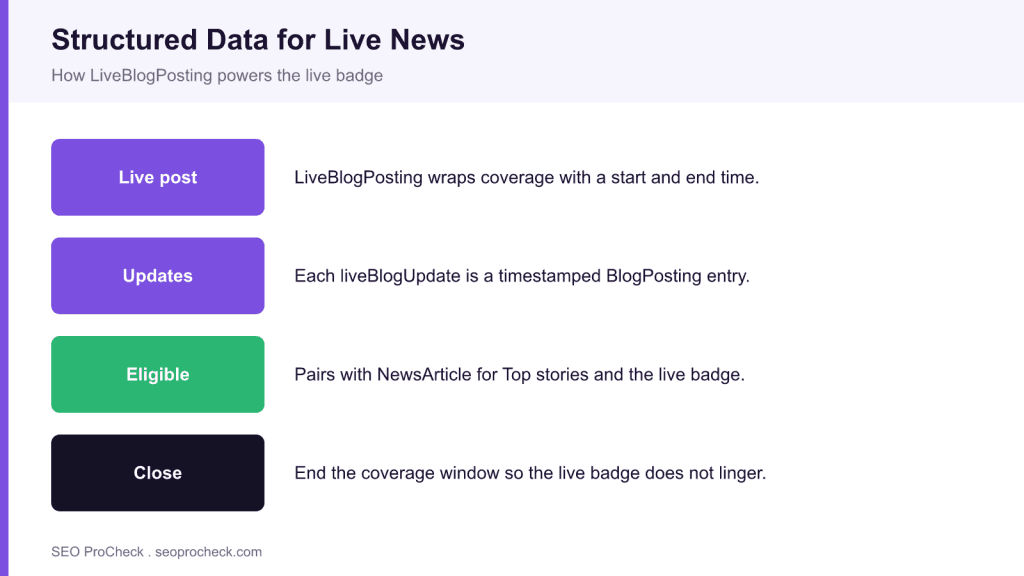
Live coverage uses LiveBlogPosting schema, often paired with NewsArticle, so Google can surface a continuously updated post with a live badge and the latest entries. Each update is a nested liveBlogUpdate item with its own timestamp, so the newest addition can appear directly in results.
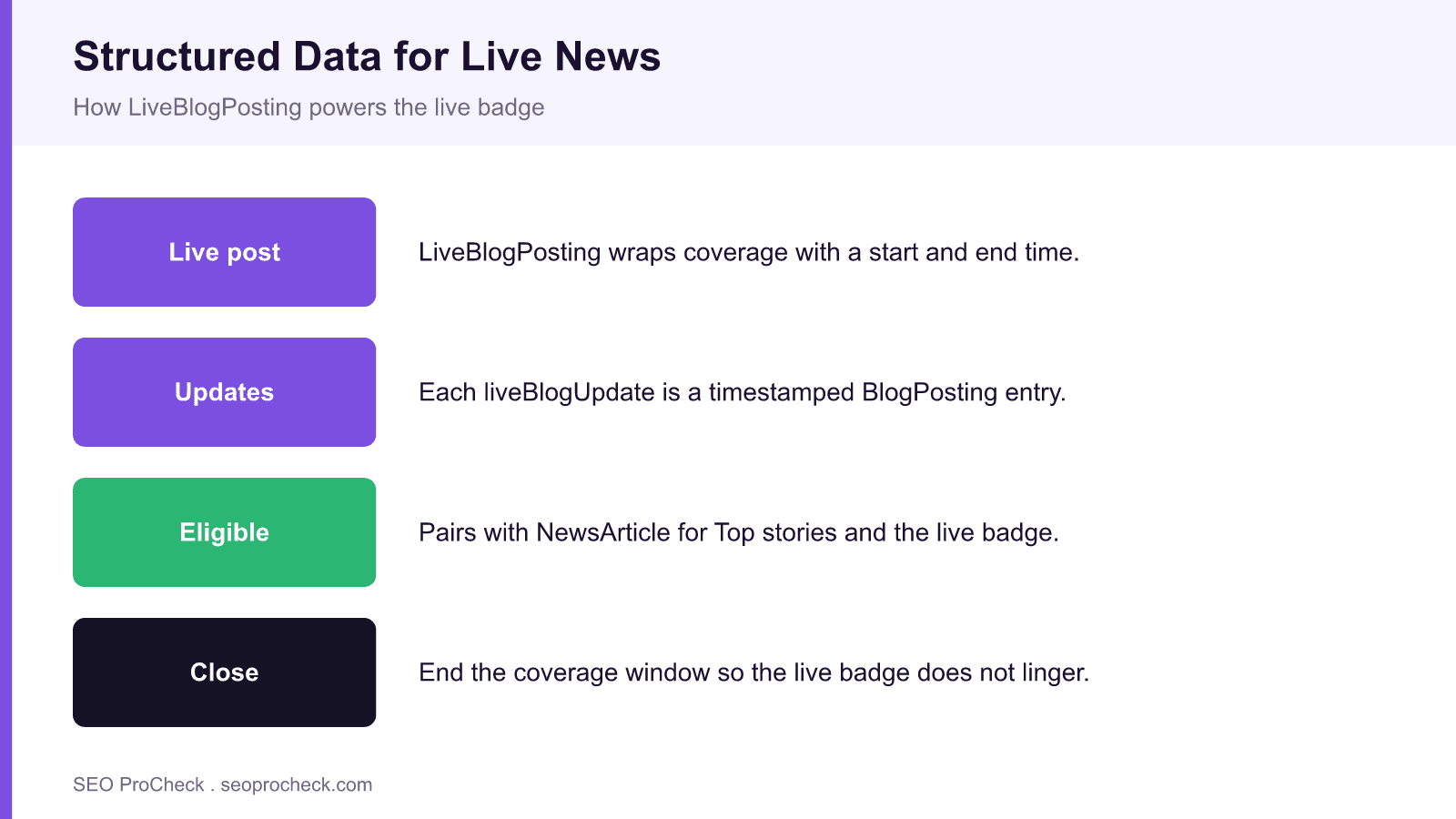
- LiveBlogPosting uses coverageStartTime and coverageEndTime to mark the live window.
- Each update is a nested liveBlogUpdate BlogPosting with its own datePublished.
- Combine it with NewsArticle to be eligible for Top stories and the live badge.
- Close the coverage window when the event ends so the badge does not linger.
Structured data helps search engines understand content context and enables rich results in search listings. This resource covers schema implementation strategies and best practices for maximizing structured data benefits.
Schema Types and Applications
Different schema types serve different purposes. Article, Product, LocalBusiness, FAQ, HowTo, and other schemas each provide specific functionality, though Google no longer shows HowTo or FAQ rich results. Selecting appropriate schema types for your content enables relevant rich results and improves search engine understanding.
Implementation Best Practices
JSON-LD provides the recommended format for schema implementation. Proper nesting, complete required fields, and accurate data all contribute to schema effectiveness. Testing with Google's Rich Results Test ensures proper implementation before deployment.
Rich Results Impact
While schema isn't a direct ranking factor, rich results improve click-through rates. Review stars, recipe cards, and other rich results make listings more prominent and informative, while FAQ accordions stopped appearing in Google for every site on May 7, 2026. This visibility advantage can significantly impact traffic from search.
This resource provides practical guidance for implementing structured data that improves search presence.
Source: https://wtfseo.substack.com/p/structured-data-for-live-blogs-and
How LiveBlogPosting works
Breaking coverage is different from a normal article: the page keeps changing, and readers want the newest line first. LiveBlogPosting is the schema.org type built for that. You wrap the page in a single LiveBlogPosting entity, declare when the live window opens and closes, and add each new development as a nested liveBlogUpdate. Google can then show a live badge and pull the most recent update straight into the result. If the vocabulary is new to you, start with our introduction to structured data markup before wiring up this type.
A minimal LiveBlogPosting example
<script type="application/ld+json">
{
  "@context": "https://schema.org",
  "@type": "LiveBlogPosting",
  "headline": "Product launch, live updates",
  "coverageStartTime": "2026-07-27T14:00:00Z",
  "coverageEndTime": "2026-07-27T16:00:00Z",
  "liveBlogUpdate": [
    {
      "@type": "BlogPosting",
      "headline": "Keynote begins",
      "datePublished": "2026-07-27T14:05:00Z"
    }
  ]
}
</script>
Add a new object to liveBlogUpdate for every development, newest first in your visible page, each with an accurate datePublished.
Key LiveBlogPosting properties
| Property | Purpose | Notes |
|---|---|---|
| coverageStartTime | Marks when live coverage opens | Use ISO 8601 with a time zone |
| coverageEndTime | Marks when coverage closes | Set it once the event ends |
| liveBlogUpdate | Holds each timestamped update | Array of BlogPosting items |
| headline | Names the coverage and updates | Keep concise and accurate |
| datePublished | Timestamps each update | Must match the visible entry |
What's changed since
Google still supports live blog structured data, and the live badge remains, but eligibility leans on trust: you generally need to be an established news or authoritative publisher, and thin pages that add the markup will not earn Top stories on schema alone. Two practical notes for today. Push updates promptly, because the value is freshness, and let Google know the page changed through your normal sitemap or indexing signals. And when coverage ends, set coverageEndTime so the live treatment retires cleanly rather than leaving a stale badge. For a broader map of where schema pays off, see underused ecommerce schemas.
Frequently asked questions
What schema do I use for a live blog?
Use LiveBlogPosting, usually combined with NewsArticle. It wraps the whole page as live coverage and holds each development as a nested liveBlogUpdate with its own timestamp.
Do I need to be a news publisher to use LiveBlogPosting?
The markup is open to anyone, but the live badge and Top stories placement generally favor established or authoritative publishers. A brand can still use it for launches, though visibility depends on Google's trust in the site.
How does Google show the live badge?
When it recognizes valid LiveBlogPosting markup on a page with an open coverage window and fresh updates, it can attach a live label and surface the newest entry in the result. It is not guaranteed and depends on quality and relevance.
How often should I add updates?
As often as there is genuine news, and promptly. The whole point of a live blog is freshness, so add each timestamped update as events happen rather than batching them later.
What happens when the event ends?
Set coverageEndTime to close the live window. This tells Google the coverage is complete so the live badge retires and the page settles into a normal article state.
Can I use this for sports or product launches?
Yes. LiveBlogPosting fits any event with rolling updates: matches, keynotes, elections, or product reveals. Use accurate coverage times and post updates in real time as the event unfolds.
Take this with you
The assistant links open with a question about this page already written. Nothing is sent until you press enter.
Claude Vincent is a technical SEO consultant focused on crawlability, rendering, and AI-search visibility. He writes the field guides and case studies at SEO ProCheck, with a bias toward the durable, unglamorous work that decides whether search engines and AI answer engines can actually read and cite a site.
About SEO ProCheck
Technical SEO consulting and GEO strategy with 20 years of enterprise experience. Case studies, resources, and tools for search and AI visibility.
Work With Me
Technical SEO audits, GEO strategy, site migrations, and international SEO. Hourly consulting for teams who need hands-on support, not just reports.
Subscribe to our newsletter!








Recent Posts
- Most Top Sites Never Say Who They Are in Structured Data October 14, 2026
- Homepage Titles Are Mostly Too Short, Not Too Long October 8, 2026
- Who Actually Serves an llms.txt? 184 Top Sites Measured September 29, 2026