

![What kind of content appears in google discover [case study]](https://seoprocheck.com/wp-content/uploads/content-that-earns-google-discover-1024x576.png "What kind of content appears in google discover [case study] 3")
AI Summary
Google Discover favors fresh, visually rich content on topics people already follow, backed by clear trust signals and a fast mobile page. Studies of Discover results point to timely angles, high resolution images at least 1200px wide, strong entity relevance, and credible authorship as the traits that surface content in the feed.
- Discover is a feed, not a search results page, so it rewards interest not queries.
- Fresh, timely, and newsworthy angles perform best in the feed.
- Large high resolution images, ideally 1200px wide or wider, are strongly associated with Discover reach.
- Entity relevance and clear E-E-A-T trust signals help content qualify.
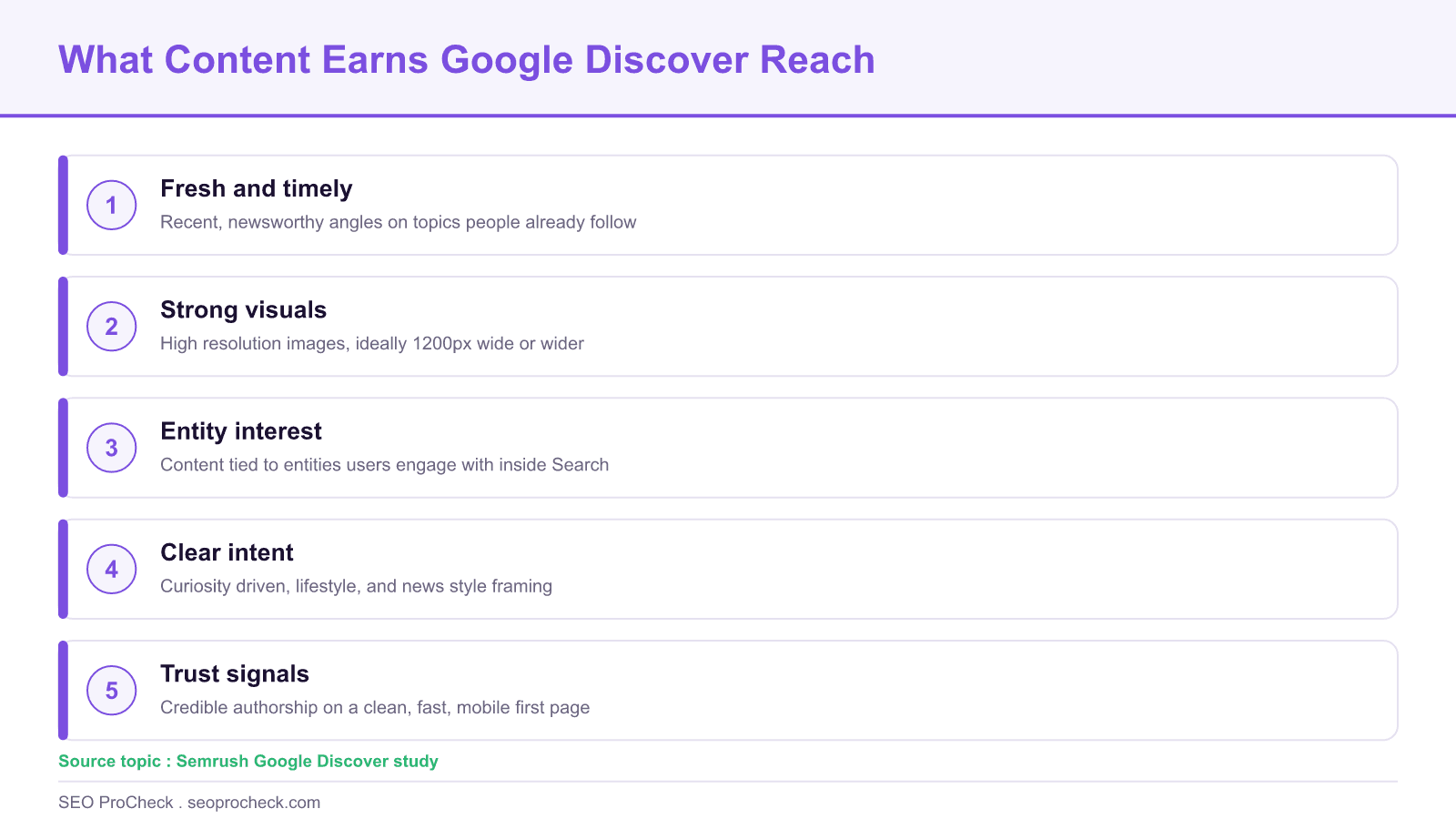
Google Discover is not search. There is no query. Google decides what to show each user based on the topics and entities they have engaged with, then surfaces content it predicts they will want. That changes what wins: instead of matching a search string, you are matching an interest. Case studies of Discover traffic keep pointing at the same content traits.
What tends to appear in Discover
Freshness and timeliness. Discover skews toward recent, newsworthy, or trend aligned content. Evergreen pages can appear, but a timely angle on a topic people follow has the best odds.
Strong visuals. Large, high quality images are consistently linked to Discover performance. Google recommends enabling large images and using ones at least 1200px wide, since the feed is visual by design.
Entity relevance. Because Discover is built around user interests, content tied to entities a user already engages with in Google Search and its surfaces is more likely to be shown to them.
Clear intent and framing. Curiosity driven, lifestyle, and news style headlines that promise value without clickbait fit how people browse the feed.
Trust signals. Credible authorship, a clean fast mobile page, and solid E-E-A-T help content qualify and keep appearing.
Content traits and how to act on them
| Trait | Why Discover rewards it | What to do |
|---|---|---|
| Freshness | The feed favors timely interest | Publish timely angles and keep key pages updated |
| Large images | Discover is a visual feed | Add images at least 1200px wide, enable large image markup |
| Entity relevance | Discover matches user interests | Cover entities and topics your audience follows |
| Mobile speed | Discover is a mobile surface | Ship a fast, clean, mobile first page |
| Author trust | E-E-A-T supports eligibility | Use real bylines, bios, and author schema |
Practical steps to earn Discover traffic
- Enable large image previews. In practice this means a wide, high resolution featured image and, on many setups, the large image content setting.
- Write headlines that spark curiosity honestly, without overpromising, since clickbait can suppress Discover eligibility.
- Strengthen author and brand trust signals so Google treats the source as credible.
- Keep the page fast on mobile, because Discover traffic is overwhelmingly mobile.
- Focus on topics your audience genuinely follows rather than chasing unrelated trends.
Discover traffic is famously volatile, so treat it as an upside channel on top of search, not a replacement. Watch it in the dedicated Discover report in Search Console, and keep your indexable content healthy by avoiding index bloat that buries your best pages.
What has changed since this study
The visual and freshness signals have held up, but the surrounding context has moved. Google has folded more AI features into its results, and the same trust and entity signals that help in Discover now also feed AI Mode and generative surfaces. Building genuine topical authority and clean authorship therefore pays off across Discover, classic search, and AI answers at once. The core content traits identified in the source below remain the right targets.
Related content strategy principles
Content strategy determines what you create, why, and how it serves both users and business objectives. This resource examines approaches for developing content that performs well in search while delivering genuine value.
Understanding User Intent
Effective content addresses what users actually need when they search. Analyzing search intent, understanding user questions, and mapping content to the user journey ensures content serves real needs. Intent alignment has become as important as keyword targeting.
Quality and Comprehensiveness
Search engines increasingly reward comprehensive, authoritative content over thin pages targeting specific keywords. Building topical depth through thorough coverage of subjects establishes expertise. Quality signals including E-E-A-T factors influence how content is evaluated.
Content Lifecycle Management
Content requires ongoing maintenance to remain competitive. Regular audits identify content needing updates, consolidation, or removal. Fresh, accurate content maintains rankings while outdated content decays. Building content refresh into ongoing processes sustains performance.
This resource provides strategic guidance for content programs that drive sustainable organic growth.
Source: https://www.semrush.com/blog/google-discover-result-study/
Frequently Asked Questions
What kind of content appears in Google Discover
Discover favors fresh, timely, visually rich content on topics a user already follows. Large high resolution images, strong entity relevance, credible authorship, and a fast mobile page are the traits most associated with appearing in the feed. Because Discover has no search query, it matches interests rather than keywords.
How do I get my content into Google Discover
Publish timely, high quality content on topics your audience follows, add a large image at least 1200px wide, and enable large image previews. Strengthen author and brand trust signals and keep the page fast on mobile. There is no way to submit to Discover, so eligibility comes from meeting these signals over time.
What image size does Google Discover need
Google recommends large images that are at least 1200px wide, and enabling large image previews rather than a small thumbnail. The feed is visual, so a wide, high resolution image is one of the strongest levers for Discover performance. Make sure your markup or settings allow the large preview.
Why is my Google Discover traffic so inconsistent
Discover is a feed driven by shifting user interests and trends, so traffic naturally spikes and fades as topics rise and cool. Individual articles can get large bursts and then drop off. Treat Discover as an upside channel on top of stable search traffic rather than a reliable baseline.
Does E-E-A-T matter for Google Discover
Yes. Discover applies content quality and trust standards, so credible authorship, clear bylines and bios, and a trustworthy site all help content qualify and keep appearing. Weak trust signals or clickbait can suppress eligibility. The same E-E-A-T work that supports search rankings supports Discover.
Where can I track Google Discover performance
Search Console has a dedicated Discover report that appears once your site receives Discover impressions. It shows impressions, clicks, and which pages surfaced in the feed. Use it to learn which topics and formats your audience responds to, then produce more of what works.
Take this with you
The assistant links open with a question about this page already written. Nothing is sent until you press enter.
Claude Vincent is a technical SEO consultant focused on crawlability, rendering, and AI-search visibility. He writes the field guides and case studies at SEO ProCheck, with a bias toward the durable, unglamorous work that decides whether search engines and AI answer engines can actually read and cite a site.
About SEO ProCheck
Technical SEO consulting and GEO strategy with 20 years of enterprise experience. Case studies, resources, and tools for search and AI visibility.
Work With Me
Technical SEO audits, GEO strategy, site migrations, and international SEO. Hourly consulting for teams who need hands-on support, not just reports.
Subscribe to our newsletter!








Recent Posts
- Most Top Sites Never Say Who They Are in Structured Data October 14, 2026
- Homepage Titles Are Mostly Too Short, Not Too Long October 8, 2026
- Who Actually Serves an llms.txt? 184 Top Sites Measured September 29, 2026