


AI Summary
Structured data is a standardized vocabulary, usually schema.org, that labels the meaning of content so search engines can parse entities like products, articles, and events. Add it as JSON-LD and the page becomes eligible for rich results, but the markup must describe content the visitor can actually see.
- schema.org is the shared vocabulary; JSON-LD, microdata, and RDFa are the three syntaxes.
- Google recommends JSON-LD because it sits in one script block and is easy to maintain.
- Rich result eligibility is the benefit; schema itself is not a direct ranking factor.
- Start with the type that matches your page: Article, Product, LocalBusiness, or FAQPage.
Structured data helps search engines understand content context and enables rich results in search listings. This resource covers schema implementation strategies and best practices for maximizing structured data benefits.
Schema Types and Applications
Different schema types serve different purposes. Article, Product, LocalBusiness, FAQ, HowTo, and other schemas each provide specific functionality, though Google no longer shows HowTo or FAQ rich results. Selecting appropriate schema types for your content enables relevant rich results and improves search engine understanding.
Implementation Best Practices
JSON-LD provides the recommended format for schema implementation. Proper nesting, complete required fields, and accurate data all contribute to schema effectiveness. Testing with Google's Rich Results Test ensures proper implementation before deployment.
Rich Results Impact
While schema isn't a direct ranking factor, rich results improve click-through rates. Review stars, recipe cards, and other rich results make listings more prominent and informative, while FAQ accordions stopped appearing in Google for every site on May 7, 2026. This visibility advantage can significantly impact traffic from search.
This resource provides practical guidance for implementing structured data that improves search presence.
Source: https://webdesign.tutsplus.com/articles/an-introduction-to-structured-data-markup--webdesign-8577
The three ideas behind structured data
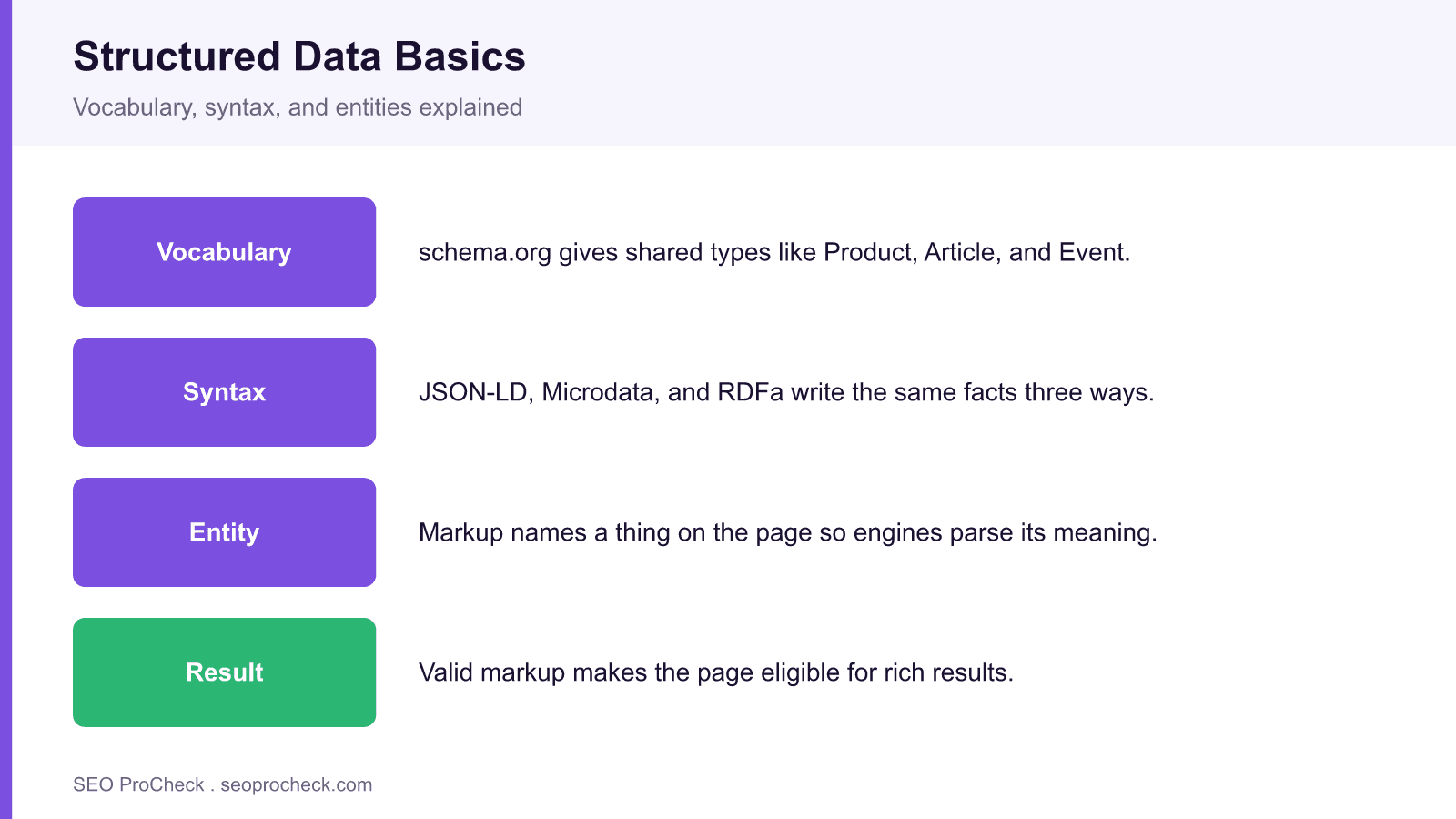
Structured data feels abstract until you separate it into three parts. The vocabulary is the agreed list of types and properties; for search that means schema.org, a shared standard backed by Google, Microsoft, Yahoo, and Yandex. The syntax is how you write that vocabulary into a page: JSON-LD, microdata, or RDFa. The entity is the actual thing you are describing, a specific product, a specific article, a specific business. Get those three straight and every schema decision becomes easier. When you are ready to produce your first block, our structured data generator workflow walks through it field by field.
Reading a JSON-LD block
Here is a minimal Article block. Notice that it is a single script element, kept separate from the visible HTML, which is exactly why JSON-LD is the format Google recommends.
<script type="application/ld+json">
{
  "@context": "https://schema.org",
  "@type": "Article",
  "headline": "An introduction to structured data",
  "image": "https://example.com/cover.png",
  "author": { "@type": "Person", "name": "Jane Doe" },
  "datePublished": "2026-07-27"
}
</script>
The @context tells parsers you are using schema.org, @type names the entity, and the remaining keys are properties. Every value here should match something a reader can see on the page.
The three syntaxes compared
| Syntax | Where it lives | Ease of maintenance | Google preference |
|---|---|---|---|
| JSON-LD | One script block, separate from HTML | High: edit in one place | Recommended |
| Microdata | Inline attributes on visible tags | Low: tangled with markup | Supported |
| RDFa | Inline attributes, richer model | Low: verbose | Supported |
What's changed since this introduction
The fundamentals are stable, but three things have moved. JSON-LD is now the clear default, and most guides that still teach microdata first are dated. Google also consolidated its structured data documentation and retired some rich results: Google removed HowTo in 2023 and stopped showing FAQ rich results for every site on May 7, 2026, so a beginner should not expect those to appear at all. Finally, entities matter more than ever because AI powered results and knowledge panels lean on the same schema.org signals, and properties like sameAs help connect your entity to known references. Once the basics click, see structured data for live news for a specialized type in action.
Frequently asked questions
What is structured data in simple terms?
It is a standardized way to label what content means, so a search engine knows a number is a price, a name is an author, and a block of text is a review. You add hidden labels using an agreed vocabulary, and machines read them even though visitors only see the normal page.
Is schema.org the same as structured data?
Not exactly. Structured data is the general concept; schema.org is the specific vocabulary almost everyone uses for search. You express schema.org types using a syntax such as JSON-LD.
Which syntax should a beginner use?
JSON-LD. It lives in a single script block, stays separate from your page markup, and is the format Google recommends. Microdata and RDFa work but are harder to write and maintain.
Does adding schema guarantee rich results?
No. Valid markup makes a page eligible, but Google decides when to show a rich result based on quality, relevance, and its own policies. Some result types are also limited to certain kinds of sites.
Can structured data hurt my SEO?
It can if the markup describes content that is not visible on the page or misrepresents it, which can trigger a manual action. Accurate markup that matches the page carries no such risk.
How do I test my first markup?
Paste the page URL or the code into Google's Rich Results Test and the Schema Markup Validator. They report eligibility, errors, and warnings so you can fix issues before publishing.
Take this with you
The assistant links open with a question about this page already written. Nothing is sent until you press enter.
Claude Vincent is a technical SEO consultant focused on crawlability, rendering, and AI-search visibility. He writes the field guides and case studies at SEO ProCheck, with a bias toward the durable, unglamorous work that decides whether search engines and AI answer engines can actually read and cite a site.
About SEO ProCheck
Technical SEO consulting and GEO strategy with 20 years of enterprise experience. Case studies, resources, and tools for search and AI visibility.
Work With Me
Technical SEO audits, GEO strategy, site migrations, and international SEO. Hourly consulting for teams who need hands-on support, not just reports.
Subscribe to our newsletter!








Recent Posts
- Most Top Sites Never Say Who They Are in Structured Data October 14, 2026
- Homepage Titles Are Mostly Too Short, Not Too Long October 8, 2026
- Who Actually Serves an llms.txt? 184 Top Sites Measured September 29, 2026