

AI Summary
Ed Zitron's April 2024 essay argues that Google Search quality declined after 2019 when, in his reading of emails surfaced by the US antitrust trial, revenue and engagement goals won out over search quality, and it centres that account on Prabhakar Raghavan. For a practitioner the lasting lesson is not the personality dispute but the incentive one: when a ranking system can be pushed by business pressure, any tactic that games it is fragile, so build a brand and genuinely helpful content instead.
- The essay reads the trial emails as a quality versus revenue conflict inside Google.
- It is an argument, not a verdict: treat its narrative as one interpretation of the record.
- The durable takeaway is to stop optimising for a system and start optimising for people.
- Since April 2024, AI Overviews and answer engines have accelerated the shift the essay describes.
The Man Who Killed Google Search provides valuable insights for SEO practitioners. This resource examines approaches and considerations that can improve organic search performance.
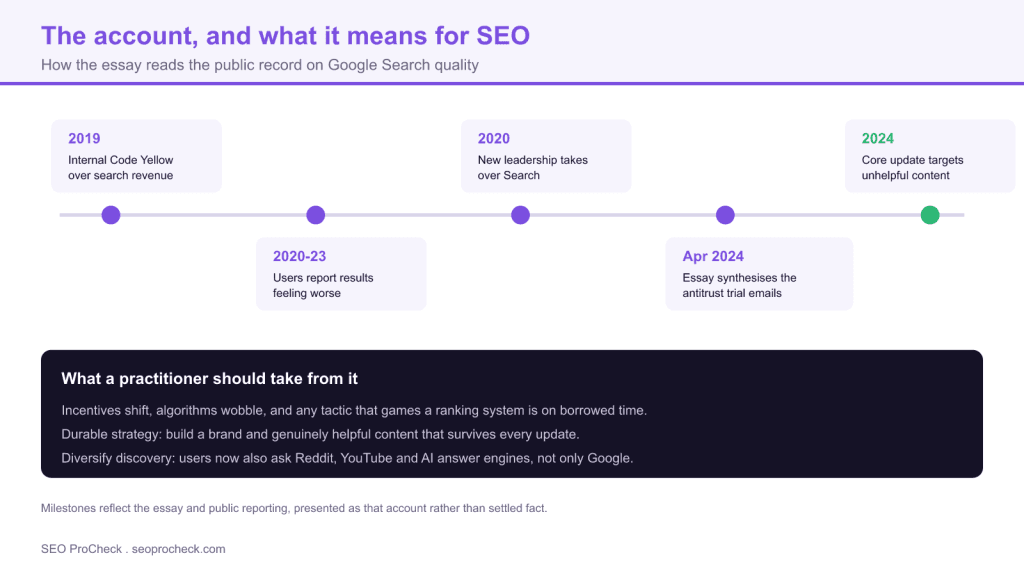
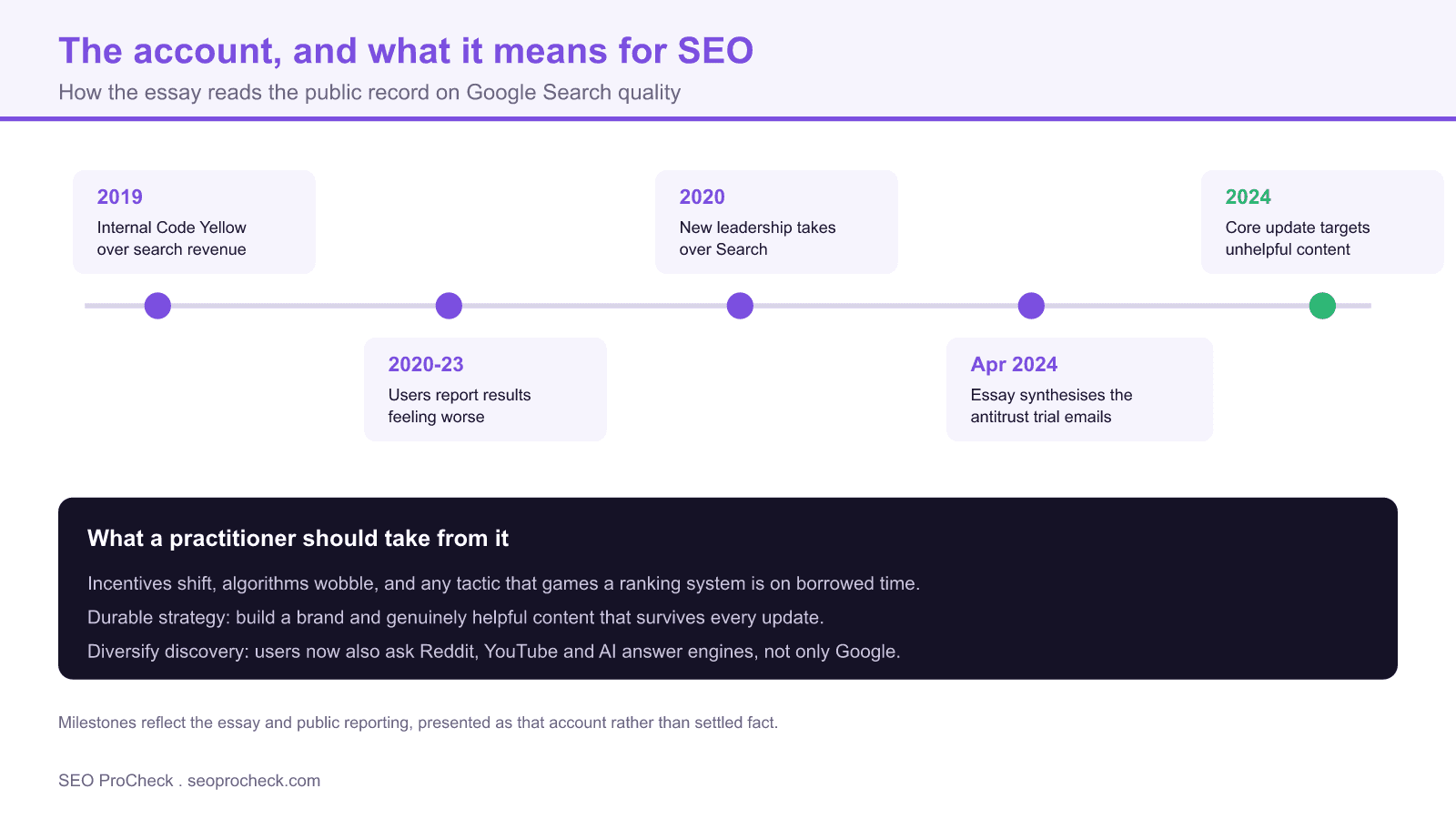
Ed Zitron's essay struck a nerve because it put a narrative to something many people had felt for years: that Google results had quietly gotten worse. Published in April 2024 and drawing on internal emails released during the United States antitrust case against Google, it argues that a 2019 internal episode, known as a Code Yellow over sluggish search revenue, marked a turn where growth and engagement targets began to outweigh result quality. The essay centres this account on Prabhakar Raghavan, whose background was in advertising, and contrasts him with the search quality leadership he succeeded. It is a pointed piece of opinion, and the useful way to read it as a practitioner is to separate the personality story, which is contested, from the structural lesson, which is not.
What the essay actually claims
Stripped to its argument, the essay makes three moves. It uses the trial emails to show internal pressure to lift search revenue and query volume. It links that pressure to a leadership change in which an advertising oriented executive took charge of Search. And it reads the subsequent years, when users increasingly complained about spammy, low value results, as the downstream effect of prioritising monetisable engagement over answer quality. Whether you accept that causal chain in full, the raw materials underneath it, the emails and the widely shared user experience, are real. The honest framing is that the essay is a strong interpretation of a genuine record, not a proven verdict, and it should be cited that way.
Why this matters to an SEO, beyond the drama
The reason this belongs on an SEO site is not gossip. It is that the essay is a case study in incentives, and incentives are what actually move a search engine over time. If a ranking system can be nudged by internal business pressure, then it can also be nudged by external manipulation, and both mean the same thing for your strategy: anything that depends on the current shape of the algorithm is on borrowed time. The practitioners who were quietly building brand, authority and genuinely useful pages came through the turbulence of recent years far better than those who had industrialised thin content to exploit whatever the algorithm rewarded that quarter.
| What the essay describes | The durable SEO takeaway |
|---|---|
| Revenue pressure can shape a ranking system | Do not build a business on the current algorithm's quirks |
| Result quality can slip while engagement rises | Optimise for the searcher's satisfaction, not just the click |
| Users noticed and started going elsewhere | Diversify discovery beyond Google search alone |
| Trust in the default engine is not permanent | Invest in brand so people seek you out by name |
This is also why Google's own guidance moved toward experience and trust. The E-E-A-T framework and the helpful content thinking are Google's attempt to reward exactly the durable qualities the essay says were neglected. Aligning with real expertise and genuine usefulness is not just ethical, it is the low risk bet, because it is what survives when the system corrects.
What has changed since April 2024
The essay landed at the start of a fast moving stretch, and three developments since have sharpened its themes rather than dated them.
First, AI in the results page went mainstream. Google began rolling out AI Overviews broadly in May 2024, which answer many queries directly on the search results page and reduce clicks to sites. That intensifies the exact tension the essay describes between what serves Google's surface and what serves publishers. Second, the antitrust story advanced: in August 2024 a US court ruled that Google had unlawfully maintained a monopoly in search, giving the essay's backdrop legal weight. Third, user behaviour kept diversifying. People increasingly append Reddit to queries, ask questions on YouTube and TikTok, and turn to answer engines such as ChatGPT and Perplexity, so Google is no longer the single default for finding things.
For an SEO the response to all three is the same, and it is the opposite of chasing loopholes. Understand the search intent behind each query and satisfy it completely, so your page is worth citing whether the surface is a blue link or an AI answer. Build a brand people search for by name, since branded demand is the one signal manipulation cannot fake. And treat Google as one channel among several rather than the whole strategy. The related pieces in our articles library go deeper on the individual tactics.
Reading it well
Take the essay as a provocation to pressure test your own dependence on Google, not as licence to declare search dead. Search still sends enormous traffic, and it will for years. The point is that the ground can move, driven by incentives you do not control, and the only hedge that consistently pays off is being genuinely useful to a real audience that knows your name. That is a less exciting strategy than a clever exploit, and it is the one still standing after every update.
Frequently asked questions
It is an April 2024 essay by Ed Zitron arguing that Google Search quality declined after a 2019 internal push to grow search revenue, which he ties to a leadership change toward an advertising focused approach. It draws on emails released during the US antitrust trial. It is a strongly argued opinion piece, so it is best read as one interpretation of a real record rather than as established fact.
Many users and SEO professionals report that results felt more cluttered with ads and low value pages over recent years, and Google itself responded with updates aimed at unhelpful and scaled content. Whether that amounts to a deliberate decline, as the essay argues, is contested. What is clear is that perceived quality became a real enough problem that Google publicly acted on it.
The lasting lesson is about incentives, not personalities. A ranking system that can be pushed by business pressure is one you should not build your livelihood on top of. The safe strategy is to create genuinely helpful content, earn real authority, and build a brand people search for by name, because those hold value through algorithm changes while exploits do not.
AI Overviews, which Google began rolling out broadly in May 2024, answer many queries directly on the results page and can reduce clicks to publisher sites. That deepens the same tension the essay highlights between what benefits Google's own surface and what benefits the sites it ranks. It makes being genuinely worth citing, rather than merely ranking, even more important.
No. Google still drives enormous search traffic and will for the foreseeable future. The sensible reading is to reduce over reliance on it, not abandon it. Keep earning organic search visibility while also building branded demand and presence on other channels such as YouTube, communities and answer engines, so no single platform shift can wipe out your audience.
The essay centres on Prabhakar Raghavan, who led Google Search and came from an advertising background, framing him as emblematic of the shift it describes. That framing is the author's interpretation, and reasonable people disagree with pinning a complex outcome on one person. Cite the essay as an argument about incentives and leadership priorities rather than as a settled account of any individual's intent.
Source: https://www.wheresyoured.at/the-men-who-killed-google
Take this with you
The assistant links open with a question about this page already written. Nothing is sent until you press enter.
Claude Vincent is a technical SEO consultant focused on crawlability, rendering, and AI-search visibility. He writes the field guides and case studies at SEO ProCheck, with a bias toward the durable, unglamorous work that decides whether search engines and AI answer engines can actually read and cite a site.
About SEO ProCheck
Technical SEO consulting and GEO strategy with 20 years of enterprise experience. Case studies, resources, and tools for search and AI visibility.
Work With Me
Technical SEO audits, GEO strategy, site migrations, and international SEO. Hourly consulting for teams who need hands-on support, not just reports.
Subscribe to our newsletter!








Recent Posts
- Most Top Sites Never Say Who They Are in Structured Data October 14, 2026
- Homepage Titles Are Mostly Too Short, Not Too Long October 8, 2026
- Who Actually Serves an llms.txt? 184 Top Sites Measured September 29, 2026