

AI Summary
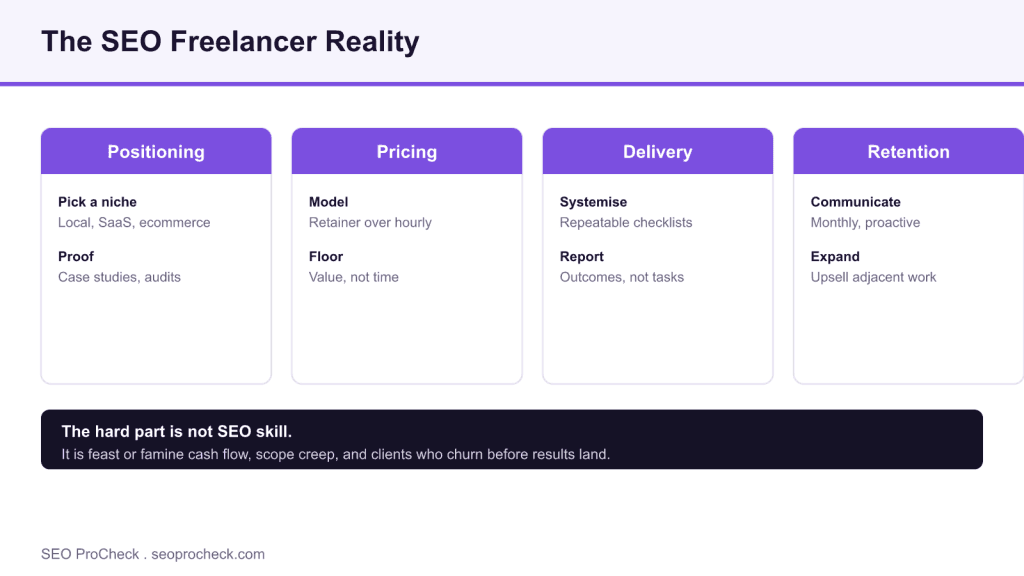
An SEO freelancer sells search results as an independent contractor, and the technical work is often the easy part. The real challenges are positioning against agencies, pricing for value instead of hours, smoothing feast or famine cash flow, and keeping clients long enough for results to show.
- Niche positioning, such as local, SaaS, or ecommerce, wins more work than being a generalist.
- Retainers beat hourly billing for cash flow and perceived value.
- Systemised, repeatable deliverables protect your margin and your sanity.
- Client churn before results land is the single biggest revenue risk.

Ultimate SEO Freelancer Guide: The Reality! Must Read provides valuable insights for SEO practitioners. This resource examines approaches and considerations that can improve organic search performance.
What the job really involves
An SEO freelancer runs a one person business that happens to sell search visibility. The SEO itself, audits, on page work, content, links, and reporting, is only part of it. The rest is sales, scoping, invoicing, expectation management, and the constant work of finding the next client before the current one ends.
That gap between the skill and the business is where most freelancers struggle. You can be excellent at SEO and still fail commercially if your pricing, positioning, or client selection is weak.
Positioning and finding clients
Generalists compete on price against everyone. Specialists compete on fit. Picking a niche, whether an industry like SaaS or a service like technical audits, makes your marketing sharper and your referrals more likely, because people remember what you are known for.
Proof matters more than promises. Case studies, before and after screenshots, and a clear method win trust faster than a list of tactics. A simple portfolio page with a couple of real results, plus solid title tags and meta descriptions on your own site, quietly demonstrates that you practice what you sell.
Pricing that survives
Hourly billing punishes you for getting faster and caps your income at your available hours. Retainers give you predictable monthly revenue and let you price on the value of the outcome rather than the time spent. Project fees suit one off audits or migrations.
Whatever the model, anchor the price to the result the client cares about, not to your effort. The table below compares the common models and where each fits.
| Pricing model | Pros | Cons | Best for |
|---|---|---|---|
| Hourly | Simple to quote, low risk | Caps income, penalises speed | Small, undefined, or first tasks |
| Project fee | Clear scope, defined outcome | Scope creep eats margin | Audits, migrations, one off builds |
| Monthly retainer | Predictable cash flow, value based | Needs ongoing results to justify | Long term SEO programs |
| Performance based | Aligns with client goals | Risky, hard to attribute | Mature clients with clean tracking |
Delivery and retention
Systemise everything you do more than once. Repeatable checklists, templated audits, and a fixed reporting cadence turn one off heroics into a reliable service you can deliver at a healthy margin. Tools like a configured site crawler cut hours off recurring work.
Retention beats acquisition on economics every time. Communicate proactively, report outcomes rather than task lists, and flag wins early. Clients churn when they feel uninformed, not only when results are slow, so managing the relationship is as important as managing the rankings.
What has changed since
- AI search is shifting some deliverables from classic rankings toward answer and generative visibility, so freelancers now sell AEO and GEO alongside SEO.
- Commodity content is cheap to generate, so freelancers win by offering strategy, technical depth, and measurable outcomes rather than word count.
- Buyers expect clearer attribution, so tie your reporting to revenue or lead metrics, not just keyword positions.
Key Concepts
Understanding the fundamental principles behind this topic helps inform strategic decisions. Whether optimizing for traditional search or emerging AI platforms, foundational concepts remain relevant. This resource covers the essential knowledge practitioners need.
Implementation Considerations
Moving from concept to execution requires understanding practical constraints and opportunities. Different situations call for different approaches. This resource provides guidance for applying concepts in real-world contexts.
Measuring Impact
SEO efforts require measurement to demonstrate value and guide optimization. Identifying appropriate metrics, establishing baselines, and tracking progress enables data-driven improvement. This resource addresses how to evaluate success.
This resource contributes to the knowledge base SEO practitioners need for effective optimization in an evolving search landscape.
Source: https://www.markapreston.com/seo-freelancer-guide
Frequently asked questions
How much can an SEO freelancer earn?
It varies widely by niche, location, and pricing model. The bigger lever is not the hourly rate but moving from hourly work to value based retainers, which smooths income and rewards efficiency instead of penalising it.
Should I charge hourly or a retainer?
Retainers are usually better for ongoing SEO because they give predictable cash flow and let you price on outcomes. Reserve hourly or project fees for small, one off, or poorly defined work where scope is unclear.
How do SEO freelancers find clients?
Referrals, a focused niche, visible case studies, and a search optimized site of your own do most of the heavy lifting. Specialising makes you memorable, which is what turns a past client or peer into a referral source.
What is the hardest part of SEO freelancing?
Usually the business side: feast or famine cash flow, scope creep, and clients who leave before results land. The SEO work is the part most freelancers are already good at, so the growth comes from fixing pricing, positioning, and retention.
Do I need to niche down as an SEO freelancer?
You do not have to, but it helps. A niche sharpens your marketing, raises perceived expertise, and increases referrals. You can start broad and narrow as you learn which clients you serve best and enjoy most.
How do I keep SEO clients longer?
Communicate proactively, report on outcomes rather than tasks, and surface early wins so clients see momentum. Most churn comes from clients feeling uninformed, so a steady reporting rhythm protects the relationship even when rankings take time.
Claude Vincent is a technical SEO consultant focused on crawlability, rendering, and AI-search visibility. He writes the field guides and case studies at SEO ProCheck, with a bias toward the durable, unglamorous work that decides whether search engines and AI answer engines can actually read and cite a site.
About SEO ProCheck
Technical SEO consulting and GEO strategy with 20 years of enterprise experience. Case studies, resources, and tools for search and AI visibility.
Work With Me
Technical SEO audits, GEO strategy, site migrations, and international SEO. Hourly consulting for teams who need hands-on support, not just reports.
Subscribe to our newsletter!







Recent Posts
- Can AI Crawlers Actually Read Your Site? I Measured 400 of the Biggest September 5, 2026
- The Pre-Publish Quality Gate for AI-Assisted Content August 6, 2026
- AGENTS.md vs llms.txt vs llms-full.txt: Which Agent File Does What July 18, 2026