

What People Don't Tell You About Webpage Schema - Get Cleaning Clicks - Blog
- January 23, 2022
- General
AI Summary
WebPage schema earns no rich result of its own, which is why it gets dismissed and why most advice about it is either overselling or absent. Its actual job is structural: it is the node that every other entity on the page attaches to, and on a local service page it is what ties the business, the service and the site together into one coherent statement.
- WebPage has no snippet treatment in Google Search. Expect entity clarity, not a visual upgrade.
- Most SEO plugins already emit a WebPage node, so the common mistake is adding a duplicate rather than missing one.
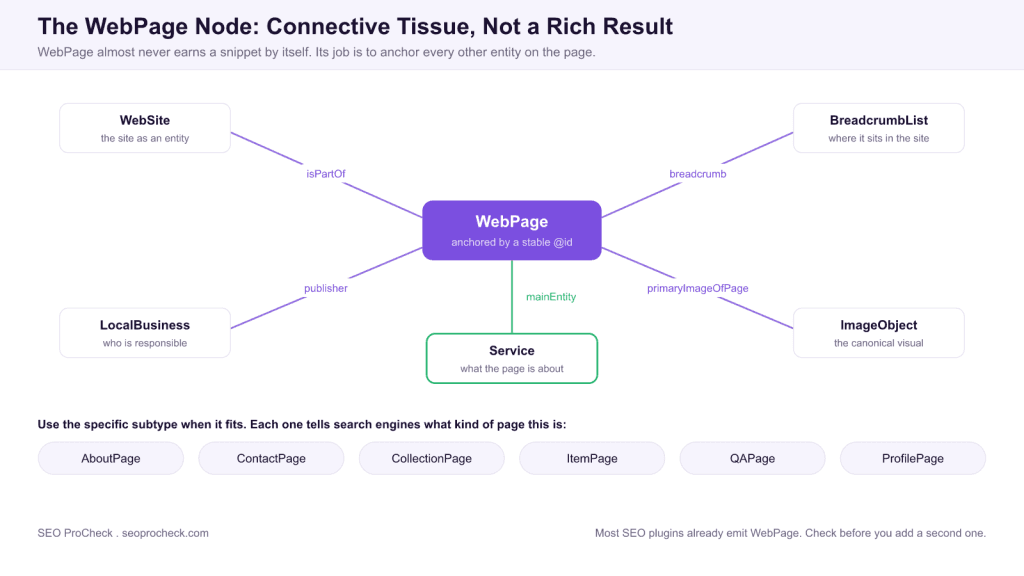
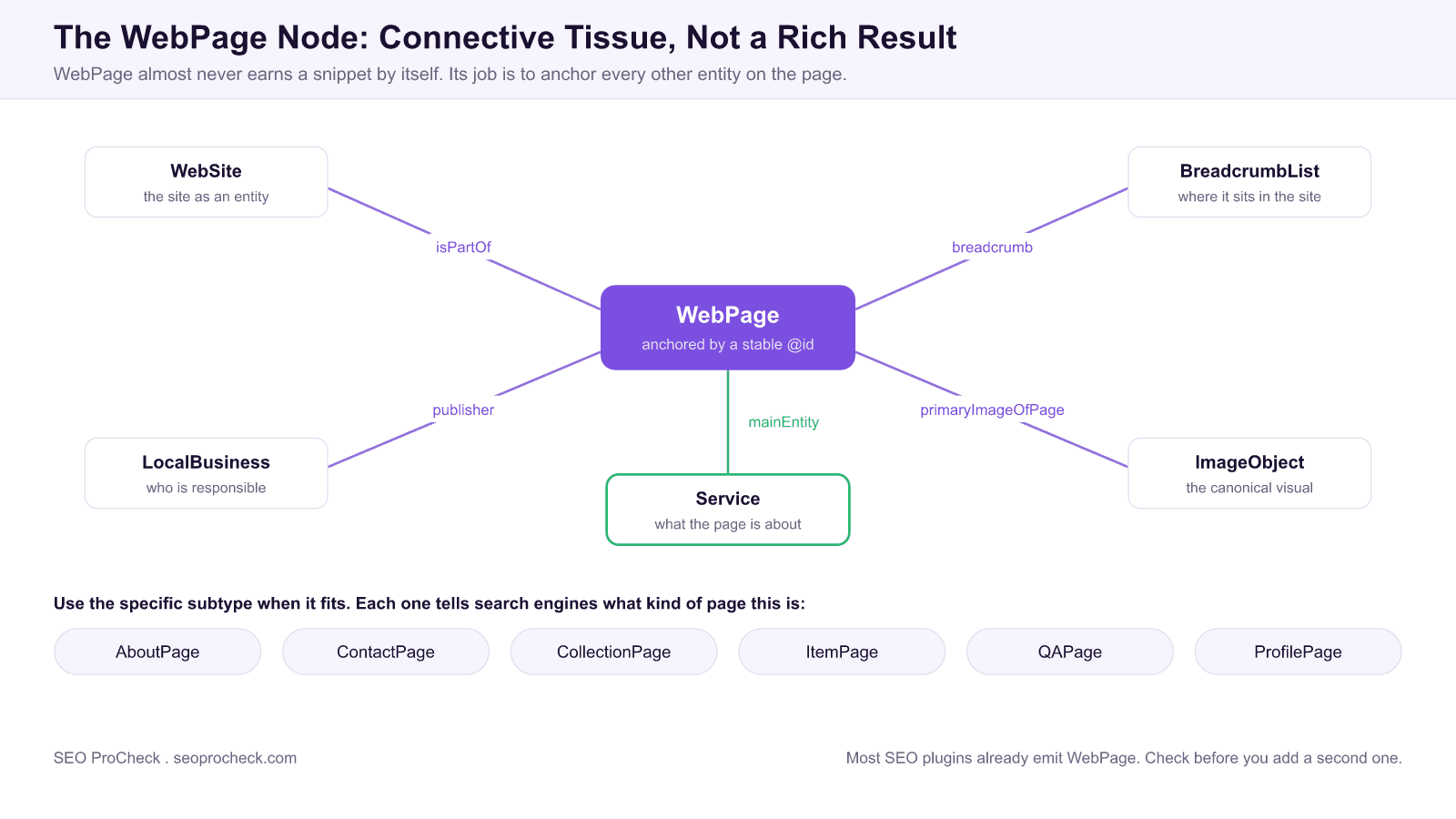
- The value lives in the relationships: isPartOf, publisher, breadcrumb, primaryImageOfPage and mainEntity.
- Use a specific subtype such as ContactPage or CollectionPage whenever one honestly fits the page.
WebPage is the schema type that gets skipped. It has no star ratings, no price display, no carousel entry, so it never appears on a list of markup that will visibly change your listing. Guides mention it in passing and move on to the types with pictures attached.
That framing misses what WebPage is for. It is not a snippet generator and it was never going to be one. It is the connective tissue of a page level graph, and on a local service page it is the difference between four disconnected assertions and one coherent statement about who does what, where, and on which page. This piece covers what the type actually does, what nobody bothers to warn you about, and how to check whether your site is already emitting it.
Schema Types and Applications
WebPage sits near the top of the schema.org hierarchy and comes with a family of subtypes that carry more specific meaning. Choosing the right one costs nothing and communicates more, so the working rule is simple: use the most specific subtype that is honestly true, and fall back to plain WebPage when none fits.
| Subtype | Use it when | What it signals | Rich result? |
|---|---|---|---|
| AboutPage | The page describes the organisation itself | Reinforces the entity behind the brand | No, supports knowledge panel understanding |
| ContactPage | Contact details, form, phone, service area | Marks the canonical contact surface | No |
| CollectionPage | A listing of services, locations or posts | Prevents a listing being read as a single item | No, but avoids a misread |
| ItemPage | The page is about one specific thing | Focuses the page on a single entity | No, the nested item may qualify |
| QAPage | A single user question with answers | Distinct from FAQPage, which is your own list | Yes, for genuine question and answer pages |
| ProfilePage | A profile for a person or organisation | Identifies author and staff pages | No, supports author entity understanding |
| WebPage | Nothing more specific is genuinely true | Still anchors the graph correctly | No |
The distinction between QAPage and FAQPage catches people out regularly. QAPage describes a page built around one question asked by a user, with community answers. FAQPage describes a list of questions you wrote and answered yourself. Using the wrong one misrepresents the page, and the FAQ treatment in particular has been heavily restricted since 2023, which the FAQ schema guide covers in detail.
Implementation Best Practices
JSON-LD in a single graph is the format, and for WebPage specifically the identifier discipline matters more than for any other type, because the whole purpose of the node is to be referenced by other nodes.
Give each node a stable identifier built from the canonical URL with a fragment suffix, then reference those identifiers rather than repeating data. The pattern is consistent: the WebPage is part of the WebSite, the WebSite is published by the Organization or LocalBusiness, the WebPage carries the breadcrumb, and mainEntity states what the page is actually about. Here is a working graph for a local service page.
<script type="application/ld+json">
{
  "@context": "https://schema.org",
  "@graph": [
    { "@type": "LocalBusiness", "@id": "https://example.com/#business",
      "name": "Example Cleaning Co",
      "telephone": "+44 20 7000 0000",
      "areaServed": { "@type": "City", "name": "Bristol" },
      "address": { "@type": "PostalAddress",
        "streetAddress": "12 High Street", "addressLocality": "Bristol",
        "postalCode": "BS1 1AA", "addressCountry": "GB" } },
    { "@type": "WebSite", "@id": "https://example.com/#website",
      "url": "https://example.com/",
      "publisher": { "@id": "https://example.com/#business" } },
    { "@type": "WebPage", "@id": "https://example.com/office-cleaning/#webpage",
      "url": "https://example.com/office-cleaning/",
      "name": "Office Cleaning in Bristol",
      "isPartOf": { "@id": "https://example.com/#website" },
      "primaryImageOfPage": { "@id": "https://example.com/office-cleaning/#image" },
      "breadcrumb": { "@id": "https://example.com/office-cleaning/#breadcrumb" },
      "mainEntity": { "@id": "https://example.com/office-cleaning/#service" } },
    { "@type": "Service", "@id": "https://example.com/office-cleaning/#service",
      "name": "Office Cleaning",
      "serviceType": "Commercial cleaning",
      "provider": { "@id": "https://example.com/#business" },
      "areaServed": { "@type": "City", "name": "Bristol" } }
  ]
}
</script>
Read what that graph states. There is one business, it operates in Bristol, this specific page is about one service, that service is provided by that business, and the page belongs to this site. None of that is inferable from a pile of unconnected blocks. The identifier pattern is worth learning properly, and the guide to JSON-LD graph nesting works through how the references resolve. For the business node itself, the LocalBusiness property guide sets out which properties are required against merely recommended, and breadcrumb markup has its own documented treatment in the SERP.
Rich Results Impact
Be straightforward internally about what this type does. WebPage does not generate a rich result. If someone has been promised a visual change in the search listing from adding WebPage markup, that promise was wrong and the project will be judged a failure on a criterion it was never able to meet.
What it does deliver is comprehension. Search engines get an explicit statement of page identity, page subject and page ownership instead of having to infer all three from the HTML. Two things follow from that. Nested entities that do have treatments, such as the Service or the BreadcrumbList, are better contextualised. And answer engines parsing the page get an unambiguous account of who is responsible for the content, which matters more each year.
What People Actually Do Not Tell You
Five things that rarely make it into the guides, in rough order of how much trouble they cause.
| Common belief | What is actually true |
|---|---|
| Adding WebPage schema will improve my listing | It will not change the listing at all. The benefit is entity clarity, and it should be briefed that way |
| My site does not have WebPage markup | It almost certainly does. Major SEO plugins emit a full graph, so check the source before adding a second one |
| More schema on a page is better | Duplicate nodes describing the same page produce contradictory claims and are worse than one clean graph |
| The @id can be any unique string | It should be a stable absolute URL with a fragment. Random or changing identifiers break every reference to them |
| WebPage is too generic to bother with | Generic is the point. It is the attachment surface for the types that do earn treatments |
The duplication problem is the one that actually costs sites something. A theme emits its own graph, an SEO plugin emits another, and a reviews or booking plugin adds a third. Each one claims to describe the same page, and they disagree about the name, the image and the publisher. Nobody notices because the page looks fine and the validator reports no errors.
Checking What Your Site Already Emits
Before writing a single line of markup, find out what is already there. View the rendered source of a live page and search for the ld+json blocks, counting how many exist and which types each declares. If you find two nodes both typed WebPage, or two typed Organization, you have a consolidation job rather than an implementation job.
Then confirm what Google actually sees by testing the live production URL rather than the source, because plugin and JavaScript injected markup will not appear in the raw HTML you first inspected. When markup is present and valid but nothing is being picked up as expected, the sequence in the guide to validating and debugging structured data separates implementation faults from eligibility conditions no validator can test for you.
Fix duplication by choosing one source of truth. On most WordPress sites that means letting the SEO plugin own the core graph, disabling competing output in the theme, and extending the plugin's graph with the nodes it does not provide, such as Service. Two systems emitting half a graph each is the worst of both options.
Frequently Asked Questions
Does WebPage schema produce a rich result?
No, and anyone promising otherwise is selling something. WebPage has no rich result treatment of its own in Google Search. Its value is structural: it gives every other entity on the page something to attach to, which helps search engines and AI answer engines work out what the page is and who is behind it.
Is WebPage schema worth adding if my SEO plugin already outputs it?
Usually not, and adding a second copy actively hurts. Yoast, Rank Math and several themes already emit a connected WebPage node as part of their graph. Adding your own creates two competing descriptions of the same page, so inventory what is already in the source before writing anything new.
What is the difference between WebPage and its subtypes?
Subtypes such as AboutPage, ContactPage and CollectionPage are more specific versions of WebPage that tell search engines what kind of page they are looking at. Use the subtype whenever one genuinely fits, because a specific type carries more information than a generic one. When nothing fits cleanly, plain WebPage is the correct answer rather than a forced match.
What does the @id property actually do?
It gives a node a stable identifier so other nodes can reference it instead of repeating its data. Without identifiers you get a page full of disconnected islands that each describe something in isolation. With them, you can state that this WebPage is part of that WebSite and published by that LocalBusiness, which is the entire point of using a graph.
Should a local service business use WebPage or LocalBusiness?
Both, connected to each other. LocalBusiness describes the company, including address, service area and opening hours. WebPage describes the specific page the user is on, and the Service node describes what that page is actually about. The relationships between them carry as much meaning as the nodes themselves.
Can WebPage schema help with AI search visibility?
It helps indirectly by making the page's subject and ownership explicit rather than implied. Answer engines that parse structured data benefit from a clearly stated relationship between the page, the organisation responsible for it and the topic it covers. That is a comprehension benefit rather than a ranking one, and it should be described that way internally.
WebPage will never be the markup that makes a listing look better. It is the markup that makes the rest of your graph mean something, and on a local service site it is what turns a set of pages into a statement about one business, its services and the places it works. That is worth doing properly, and worth briefing honestly.
Source: https://getcleaningclicks.com/what-people-dont-tell-you-about-webpage-schema/
Take this with you
The assistant links open with a question about this page already written. Nothing is sent until you press enter.
Claude Vincent is a technical SEO consultant focused on crawlability, rendering, and AI-search visibility. He writes the field guides and case studies at SEO ProCheck, with a bias toward the durable, unglamorous work that decides whether search engines and AI answer engines can actually read and cite a site.
About SEO ProCheck
Technical SEO consulting and GEO strategy with 20 years of enterprise experience. Case studies, resources, and tools for search and AI visibility.
Work With Me
Technical SEO audits, GEO strategy, site migrations, and international SEO. Hourly consulting for teams who need hands-on support, not just reports.
Subscribe to our newsletter!








Recent Posts
- Most Top Sites Never Say Who They Are in Structured Data October 14, 2026
- Homepage Titles Are Mostly Too Short, Not Too Long October 8, 2026
- Who Actually Serves an llms.txt? 184 Top Sites Measured September 29, 2026