


AI Summary
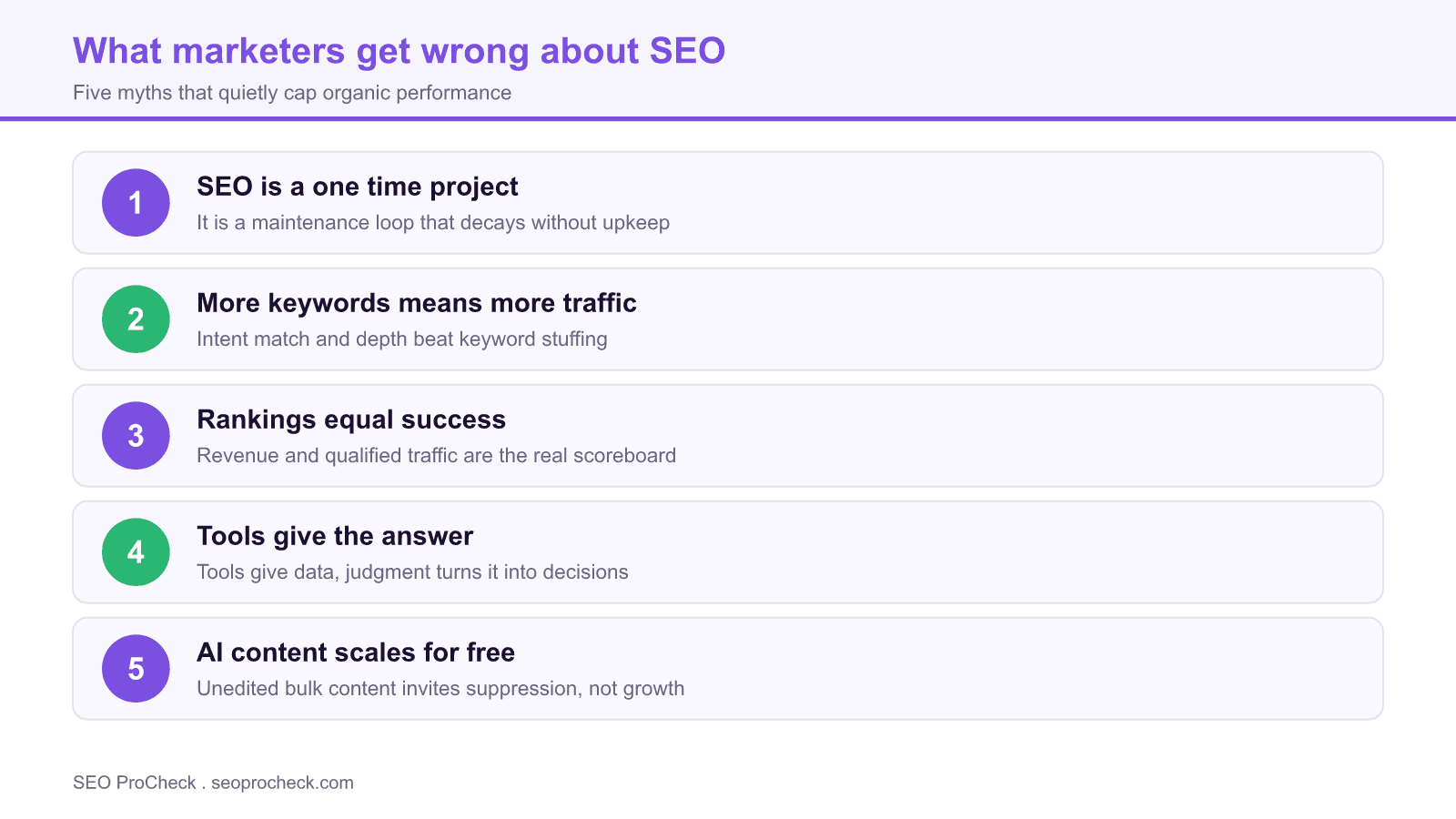
Most SEO mistakes are not technical, they are beliefs: that SEO is a one time project, that more keywords mean more traffic, or that rankings alone prove success. This guide keeps the original SEO Theory reference and adds a practitioner breakdown of five myths that quietly cap organic performance, with the reality behind each.
- SEO is a maintenance loop, not a one time project: rankings decay without upkeep.
- Intent match and depth beat keyword volume every time.
- Rankings are a means, revenue and qualified traffic are the real scoreboard.
- Tools produce data, judgment turns data into decisions.
What Thousands of Web Marketers Get Wrong about SEO provides valuable insights for SEO practitioners. This resource examines approaches and considerations that can improve organic search performance.
Why beliefs, not tactics, hold most sites back
Teams rarely fail at SEO because they cannot add a meta description. They fail because a founder or marketer holds a belief that quietly steers every decision. Surfacing those beliefs is often more valuable than any audit, because a wrong assumption compounds across every page.
Five myths and the reality
Myth 1: SEO is a one time project
Search results are competitive and content decays. Competitors publish, intent shifts and algorithms update. SEO is a maintenance loop, and the moment you stop, rankings begin to slide. Budget for upkeep, not just a launch.
Myth 2: More keywords mean more traffic
Stuffing more terms onto a page or spinning up dozens of thin pages does not add traffic, it dilutes relevance. One page that fully answers a clear intent outperforms ten shallow pages targeting slight variations. This is the same logic behind the striking distance keyword workflow, which focuses effort where demand already exists.
Myth 3: Rankings equal success
Ranking first for a term nobody converts on is a vanity result. The scoreboard is qualified traffic and revenue. Always connect a ranking goal to a business outcome, which is also how you diagnose ranking drops without panicking over a metric that never mattered.
Myth 4: The tool gives you the answer
Crawlers and rank trackers give you data. They do not tell you which of fifty issues actually matters for your business this quarter. Judgment, context and prioritization are the human work no tool replaces.
Myth 5: AI content scales for free
Publishing unreviewed bulk content at scale is the fastest way to invite quality suppression, not growth. AI can accelerate research and drafting, but the edit, the expertise and the fact check are what keep a site trusted.
How to audit your own beliefs
Before your next campaign, write down what you assume is true about your traffic. Do you believe a page ranks because of its word count, or because it matches intent? Do you believe last month was a real decline, or a reporting quirk? Then check each assumption against data in Search Console and analytics rather than memory. This short exercise routinely uncovers a belief that has quietly shaped months of decisions, and correcting it is usually cheaper and faster than any technical fix. The practitioners who improve fastest are the ones who treat their own assumptions as hypotheses, hold them loosely, and update when the evidence disagrees. That habit, more than any single tactic, is what separates steady organic growth from stop and start effort.
SEO myth versus reality
| Common myth | Why it persists | The reality |
|---|---|---|
| SEO is a one time project | Launches feel like completion | Rankings decay without ongoing upkeep |
| More keywords, more traffic | Volume feels like progress | Intent match and depth win |
| Rankings equal success | Rank is easy to measure | Revenue and qualified traffic are the goal |
| The tool gives the answer | Dashboards look authoritative | Judgment turns data into decisions |
| AI content scales for free | Output feels cheap and fast | Unedited bulk content invites suppression |
What has changed and made these myths costlier
These misconceptions are old, but the penalty for holding them grew. The rise of AI generated content pushed search engines to lean harder on quality and helpfulness signals, so the myth that volume beats depth now does active damage. At the same time, answer engines and AI overviews reward pages that clearly satisfy intent, which rewards the practitioners who already treated SEO as ongoing, outcome driven work rather than a one time keyword exercise.
Key Concepts
Understanding the fundamental principles behind this topic helps inform strategic decisions. Whether optimizing for traditional search or emerging AI platforms, foundational concepts remain relevant. This resource covers the essential knowledge practitioners need.
Implementation Considerations
Moving from concept to execution requires understanding practical constraints and opportunities. Different situations call for different approaches. This resource provides guidance for applying concepts in real-world contexts.
Measuring Impact
SEO efforts require measurement to demonstrate value and guide optimization. Identifying appropriate metrics, establishing baselines, and tracking progress enables data-driven improvement. This resource addresses how to evaluate success.
This resource contributes to the knowledge base SEO practitioners need for effective optimization in an evolving search landscape.
Frequently asked questions
What is the biggest misconception about SEO?
That SEO is a one time project. In reality it is an ongoing maintenance loop, because competitors keep publishing and content decays, so rankings slide the moment you stop investing.
Does adding more keywords increase traffic?
No. Adding more keywords or thin pages usually dilutes relevance. One page that fully answers a clear intent outperforms many shallow pages chasing slight variations.
If rankings do not equal success, what does?
Qualified traffic and revenue. A first place ranking for a term that never converts is a vanity result, so tie every ranking goal to a business outcome.
Can SEO tools tell me what to fix?
Tools surface data and flag issues, but they cannot judge which of many problems matters most for your business right now. That prioritization is human work.
Is AI generated content bad for SEO?
Not inherently, but publishing unreviewed content at scale invites quality suppression. AI can speed research and drafting, while human editing, expertise and fact checking keep the site trusted.
How often should SEO work happen?
Continuously. Treat it as a recurring loop of monitoring, refreshing and improving rather than a project with an end date.
Source: https://www.seo-theory.com/what-thousands-of-web-marketers-get-wrong-about-seo
Take this with you
The assistant links open with a question about this page already written. Nothing is sent until you press enter.
Claude Vincent is a technical SEO consultant focused on crawlability, rendering, and AI-search visibility. He writes the field guides and case studies at SEO ProCheck, with a bias toward the durable, unglamorous work that decides whether search engines and AI answer engines can actually read and cite a site.
About SEO ProCheck
Technical SEO consulting and GEO strategy with 20 years of enterprise experience. Case studies, resources, and tools for search and AI visibility.
Work With Me
Technical SEO audits, GEO strategy, site migrations, and international SEO. Hourly consulting for teams who need hands-on support, not just reports.
Subscribe to our newsletter!








Recent Posts
- Most Top Sites Never Say Who They Are in Structured Data October 14, 2026
- Homepage Titles Are Mostly Too Short, Not Too Long October 8, 2026
- Who Actually Serves an llms.txt? 184 Top Sites Measured September 29, 2026