

AI Summary
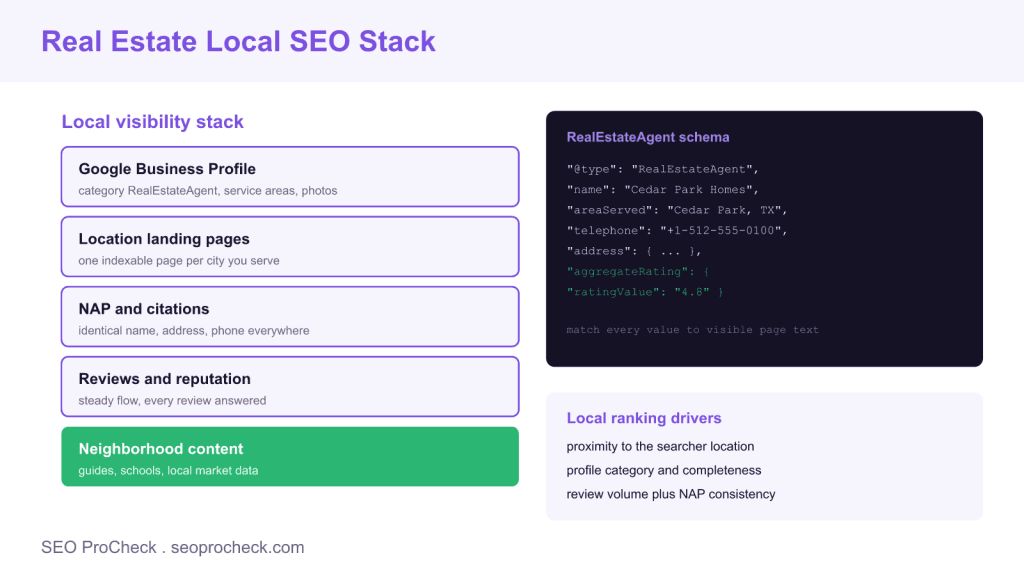
Real estate local SEO wins on two surfaces: the Google map pack, driven by an active business profile, reviews, and consistent NAP data, and organic search, driven by useful location landing pages and neighborhood content. Build both, mark up your pages with RealEstateAgent schema, and keep every citation identical.
- Optimize a complete Google Business Profile with the RealEstateAgent category and service areas.
- Build one useful, unique landing page per city or neighborhood you truly serve.
- Keep name, address, and phone identical across your site and every directory.
- Earn steady reviews and reply to each one, since response behavior is a visible signal.
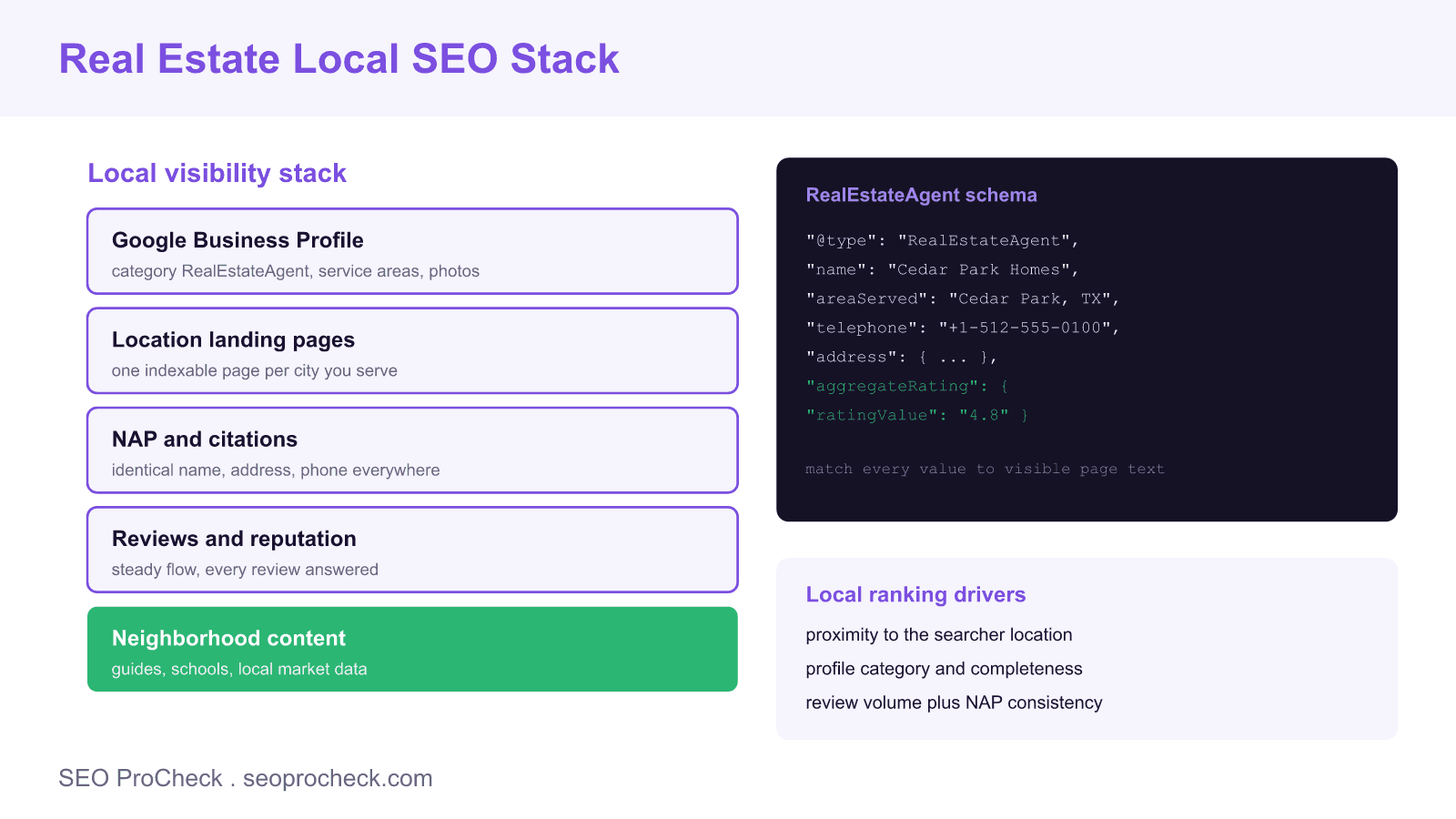
Real estate is one of the most local search categories there is. Buyers and sellers search by city, neighborhood, and school zone, and they decide fast. Winning that attention means ranking on two different surfaces at once: the Google map pack, where a business profile competes on proximity and reputation, and the classic organic results, where location pages and neighborhood content compete on relevance and depth. This guide covers both, plus the schema, citations, and reviews that tie them together.
Optimize the Google Business Profile
The map pack is often the first thing a local searcher sees, and it is powered by your Google Business Profile rather than your website. Choose RealEstateAgent as the primary category, define your service areas accurately, and complete every field: hours, phone, a keyword honest description, and real photos of your team and recent listings. Post updates regularly, because an active profile signals a live business. Keep the profile name exactly as it appears on your site and signage, with no added keywords, which is against Google guidelines and can trigger a suspension.
Build location landing pages that deserve to rank
For every city or neighborhood you truly serve, publish one indexable page with unique, useful content. A strong location page includes current market notes, typical price ranges, popular streets or subdivisions, school and commute detail, and a clear call to action. The failure mode is the doorway page: dozens of near identical templates with only the city name swapped. Those are thin content in Google eyes and rarely rank. If you cannot write something genuinely useful about an area, do not publish a page for it. Consistent, descriptive internal linking, backed by clear anchor text, helps both users and crawlers move between these pages.
Mark up pages with local schema
Structured data helps search engines resolve your business identity. Add RealEstateAgent or LocalBusiness schema to your profile and location pages with address, telephone, areaServed, and opening hours; aggregateRating about your own business is treated by Google as self-serving and is not eligible for review stars, however genuine the reviews. Every value in the markup must also appear in the visible page. Missing or mismatched markup is a common problem, and you can read more in our note on missing local schema. Pair it with correct review handling, covered in why local reviews matter.
Keep NAP and citations consistent
Name, address, and phone must be identical everywhere your business appears: your website footer, Google Business Profile, Zillow, Realtor, Yelp, and every local directory. Conflicting data, an old suite number here, a tracking phone number there, confuses the systems that decide which listing is authoritative and can quietly suppress your map pack presence. Audit your citations, fix mismatches at the source, and build new ones only on relevant, trusted directories. Our page on missing local citations explains the diagnostic in detail.
Local ranking factors at a glance
| Factor | Mostly affects | Agent action |
|---|---|---|
| Proximity to searcher | Map pack | Accurate service areas and address |
| Profile completeness | Map pack | Fill every field, post updates, add photos |
| Reviews and responses | Map pack and clicks | Earn steady reviews, reply to each |
| NAP consistency | Both surfaces | Identical citations across the web |
| Location page depth | Organic | Unique, useful content per area |
| Neighborhood content | Organic | Guides, schools, market data |
Win neighborhood searches with real local knowledge
The content that separates a local expert from a national portal is knowledge no template can fake. Write neighborhood guides that cover the streets buyers ask about, the schools that drive demand, commute times to the main job centers, and honest notes on current market conditions. Update them as the market moves. This content earns links, answers the questions buyers actually ask, and gives your location pages the depth that generic city pages lack. Combined with an active profile, consistent citations, and steady reviews, it is what moves an agent from invisible to the top of local results.
Frequently asked questions
What matters most for real estate local SEO?
For map pack visibility, a complete and active Google Business Profile, steady reviews, and consistent name, address, and phone data matter most. For organic search, indexable location landing pages and genuinely useful neighborhood content carry the weight. Agents who cover both surfaces win the most local traffic.
Should an agent use the RealEstateAgent schema type?
Yes. RealEstateAgent is a subtype of LocalBusiness, so it supports address, telephone, areaServed, opening hours, and aggregateRating, although Google treats ratings a business shows about itself as self-serving and not eligible for stars. Add it to your profile and location pages, and make sure every value in the markup also appears in the visible text of the page.
How many location pages should I build?
Build one substantive page for each city or neighborhood you genuinely serve, and only where you can write unique, useful content about that area. Do not spin near duplicate pages for dozens of zip codes, because thin doorway pages violate Google guidelines and rarely rank.
Do reviews affect real estate rankings?
Reviews influence both map pack ranking and the click decision. A steady flow of recent, detailed reviews with owner responses signals an active, trusted business. Never buy or gate reviews, and reply to every one, since response behavior is visible to both searchers and Google.
What is NAP consistency and why does it matter?
NAP means name, address, and phone. Consistency means those three appear identically across your website, Google Business Profile, and every directory citation. Conflicting data confuses the systems that resolve which listing is authoritative, which can suppress your visibility in the map pack.
How do I rank for neighborhood searches?
Publish content that only a local expert could write: market trends, school details, commute notes, and buyer guides for each area. Support it with internal links from your city pages and a few local citations. Depth and genuine local knowledge outrank generic copy that names the neighborhood a few times.
Take this with you
The assistant links open with a question about this page already written. Nothing is sent until you press enter.
Claude Vincent is a technical SEO consultant focused on crawlability, rendering, and AI-search visibility. He writes the field guides and case studies at SEO ProCheck, with a bias toward the durable, unglamorous work that decides whether search engines and AI answer engines can actually read and cite a site.
About SEO ProCheck
Technical SEO consulting and GEO strategy with 20 years of enterprise experience. Case studies, resources, and tools for search and AI visibility.
Work With Me
Technical SEO audits, GEO strategy, site migrations, and international SEO. Hourly consulting for teams who need hands-on support, not just reports.
Subscribe to our newsletter!








Recent Posts
- Most Top Sites Never Say Who They Are in Structured Data October 14, 2026
- Homepage Titles Are Mostly Too Short, Not Too Long October 8, 2026
- Who Actually Serves an llms.txt? 184 Top Sites Measured September 29, 2026