

AI Summary
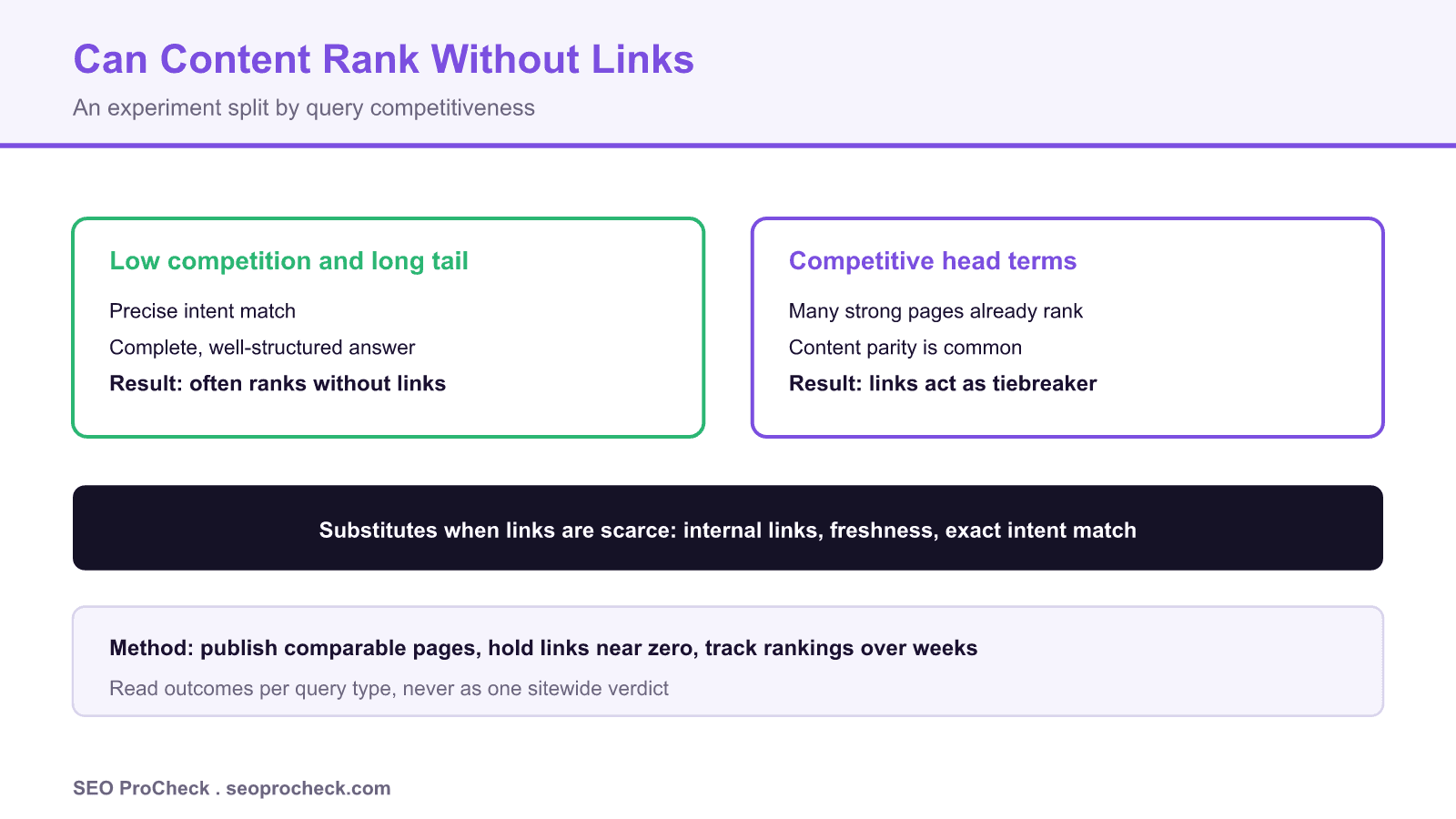
Quality content can rank without backlinks, but mostly for low competition and long tail queries where relevance and intent match do the heavy lifting. On competitive head terms, links still act as a tiebreaker, so the honest answer from controlled experiments is that it depends on the query.
- On low competition and long tail queries, well-matched content often ranks with few or no external links.
- On competitive head terms, backlinks still influence which strong page wins.
- Internal links, freshness, and precise intent matching are underrated substitutes when external links are scarce.
- Test on your own site before generalising, because niche competitiveness varies enormously.
Can quality content rank without backlinks? It is one of the most argued questions in SEO, and the honest answer from controlled experiments is that it depends on the query. Links remain a meaningful ranking input, but their importance is not uniform across every search. This piece unpacks what these experiments actually show, why the results split so cleanly by competitiveness, and how to read them without drawing a conclusion the data does not support.
What the experiment tests
A clean version of this test publishes genuinely useful pages, deliberately keeps external links at or near zero, and tracks where they land over several weeks. The point is to isolate content and on-page relevance from the confounding effect of an active link-building campaign. The recurring finding is not a single yes or no. Instead, outcomes divide by how competitive the target query is, which is exactly why blanket claims in either direction tend to be wrong.
Where content wins without links
On low competition and long tail queries, well-matched content frequently ranks with few or no external links. These searches often have thin competing results, so a page that matches intent precisely, answers the question completely, and is easy for a crawler to parse can rise on relevance alone. Long tail queries also carry clearer intent, which makes it easier to be the single best match rather than one of twenty near-identical pages. For anyone building a new site or a new topic area, this is the practical opening: earn early traffic on specific, underserved queries while authority builds.
Where links still decide
On competitive head terms the picture changes. When ten strong pages already cover a topic well, content quality reaches rough parity and search engines need other signals to break the tie. Backlinks, and the authority and trust they represent, are one of the clearest of those signals. This is why the same experiment that shows content ranking freely on long tail terms shows it stalling on money keywords. It is not that content stopped mattering, it is that everyone in the top ten already has good content, so the differentiator moves elsewhere. Our link building FAQ covers how to pursue those links without crossing into risky tactics.
| Query type | Competition | Typical result without links | What to lean on |
|---|---|---|---|
| Long tail question | Low | Often ranks | Intent match, structure |
| Niche topic | Low to medium | Ranks with strong content | Topical depth, internal links |
| Commercial head term | High | Usually stalls | Backlinks, brand signals |
| Broad informational | High | Mixed | Freshness, authority, links |
Underrated substitutes for external links
When you cannot easily earn external links, several on-site factors do real work. Internal linking channels authority from your stronger pages to the one you want to rank, and a deliberate structure multiplies that effect, which is why we point readers to our internal linking complete guide. Freshness and precise intent matching help too, as does building genuine topical coverage so the page sits inside a credible cluster rather than standing alone. There is also a shift worth watching: in AI search surfaces, brand mentions are emerging as a visibility signal alongside links, a pattern we explore in our research on brand mentions versus backlinks for AI visibility.
How to read the result honestly
The trap is generalising. A creator who ranks a long tail piece without links declares that links are dead, while an agency that fails to rank a competitive term without links declares content alone is hopeless. Both are overfitting to one query. The disciplined takeaway is to test on your own site, because niche competitiveness varies enormously, and to expect a split result: relevance and structure carry you a long way on specific queries, while links remain a deciding factor where strong pages already compete. Plan your content and link efforts around that reality rather than around a slogan.
A worked example
Say you publish two comparable guides on the same new site. The first targets a specific long tail query such as how to set a canonical tag on a paginated archive, which has three weak competing results. The second targets a broad head term such as SEO tools, where the top ten are established brands with large link profiles. With no external links to either, the long tail guide can reach the first page within a few weeks purely on relevance, structure, and a precise intent match, because nothing else is competing hard. The head term guide, by contrast, may never crack the first page without links, no matter how good the content is, because content quality is already saturated at the top. Same site, same author, same effort, opposite outcomes, and the only variable that changed is competitiveness. That is the entire lesson of the experiment in one comparison, and it is why the right question is never whether content can rank without links, but which of your target queries can.
Source: https://dejanmarketing.com/content-without-links/
Frequently asked questions
Can content rank without any backlinks?
Yes, often on low competition and long tail queries where a precise, complete answer matches intent better than the thin competition. On competitive head terms, links usually still decide the winner.
Are backlinks still a ranking factor?
Yes. Links remain a meaningful signal of authority and trust, and they act as a tiebreaker when many pages already have comparable content on a competitive query.
What can substitute for external links?
Internal linking, freshness, precise intent matching, and genuine topical depth all do real work. In AI search surfaces, brand mentions are also emerging as a visibility signal alongside links.
Why do experiments give different answers?
Because outcomes split by query competitiveness. The same test shows content ranking freely on long tail terms and stalling on competitive head terms, so a single sitewide verdict is misleading.
Should a new site chase head terms or long tail?
Start with specific long tail and niche queries where quality content can rank without links, then build authority and pursue competitive terms as your link profile and topical coverage grow.
How long should this kind of test run?
Give it several weeks at minimum so rankings can settle and any freshness boost fades, and read results per query type rather than as one average.
Take this with you
The assistant links open with a question about this page already written. Nothing is sent until you press enter.
Claude Vincent is a technical SEO consultant focused on crawlability, rendering, and AI-search visibility. He writes the field guides and case studies at SEO ProCheck, with a bias toward the durable, unglamorous work that decides whether search engines and AI answer engines can actually read and cite a site.
About SEO ProCheck
Technical SEO consulting and GEO strategy with 20 years of enterprise experience. Case studies, resources, and tools for search and AI visibility.
Work With Me
Technical SEO audits, GEO strategy, site migrations, and international SEO. Hourly consulting for teams who need hands-on support, not just reports.
Subscribe to our newsletter!








Recent Posts
- Most Top Sites Never Say Who They Are in Structured Data October 14, 2026
- Homepage Titles Are Mostly Too Short, Not Too Long October 8, 2026
- Who Actually Serves an llms.txt? 184 Top Sites Measured September 29, 2026