

Cats Vs Dogs - The Google Image Reading Experiment | Reboot Online
- December 6, 2021
- Content
AI Summary
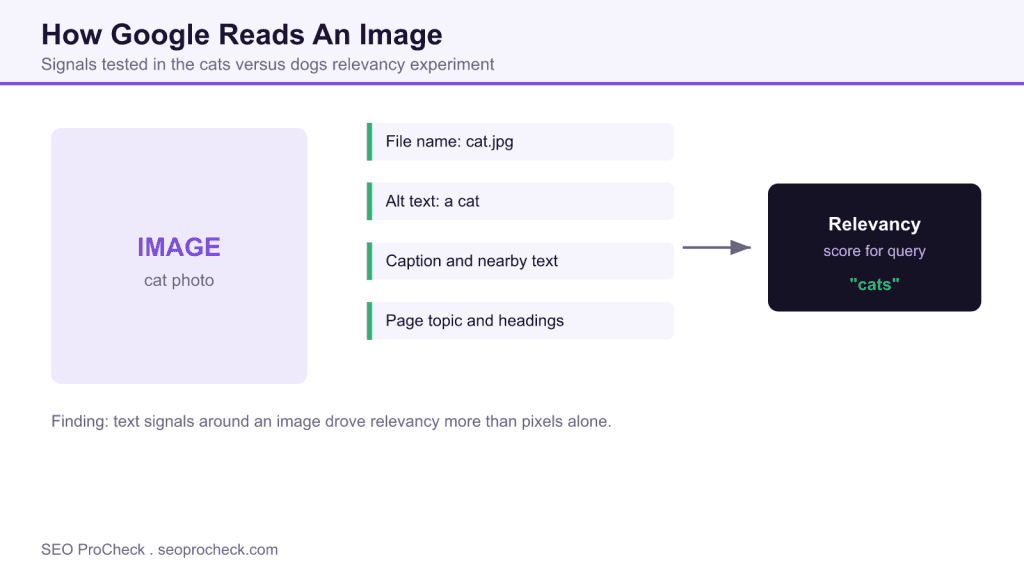
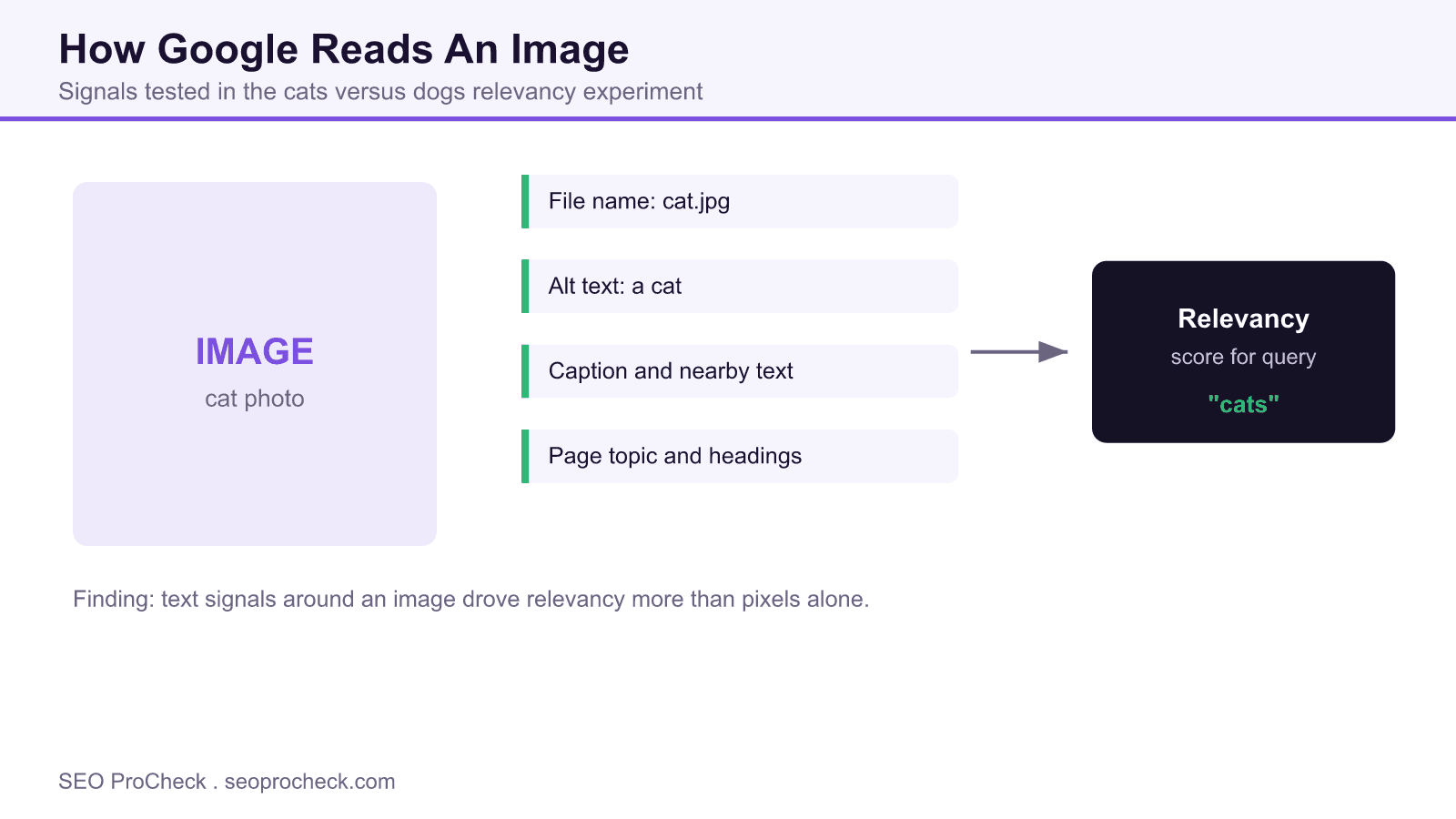
The cats versus dogs experiment tested whether Google understands what an image depicts and uses it for relevancy, and the practical lesson is that the text around an image, its file name, alt text, caption and page topic, does most of the heavy lifting today. Describe images accurately and match them to the surrounding content rather than relying on the pixels alone.
- Google reads file name, alt text, caption and nearby copy to decide what an image is about.
- Machine vision is improving, but text signals remain the most reliable lever a publisher controls.
- Mismatched images, a dog photo on a page about cats, send a conflicting relevancy signal.
- Accurate alt text also serves accessibility and image search at the same time.
What the experiment set out to prove
The original Reboot Online study, linked in the source below, asked a simple question: does Google actually interpret the content of an image, or does it lean on the words a publisher wraps around it? The setup pitted image relevancy signals against each other to see which moved rankings and image visibility. It is a useful reference point because it forces a distinction practitioners often blur, between what Google can see in a picture and what Google can read about it.
Our guidance on image alt text and the broader view in image SEO beyond alt text both start from the same premise the experiment reinforces: the text layer is where you have the most direct control.
The signals Google reads around an image
Four inputs consistently shape how an image is understood. The file name is the first: a descriptive slug such as tabby-cat-on-windowsill.jpg tells the crawler more than IMG_4821.jpg ever will. The alt attribute is the second, describing the image for screen readers and for search at once. The caption and the sentences immediately surrounding the image form the third, because proximity implies relevance. The page topic and headings form the fourth, setting the context the image is expected to support. When these agree, the relevancy signal is strong; when they contradict each other, the engine has to guess.
Where machine vision fits now
Since experiments of this kind first ran, Google has grown considerably better at recognizing objects in images through its vision models. That does not make the text signals obsolete. Vision tells Google that a photo contains a cat; the file name, alt text and caption tell Google that this cat photo belongs on a page about, say, feline nutrition rather than pet insurance. The reliable strategy is redundancy: let the pixels and the words tell the same story. If your images are being flagged because they need alt text, you are leaving the most dependable signal on the table.
Practitioner checklist
Name image files descriptively before upload, using hyphens between words. Write alt text that states what the image shows in a natural sentence, without stuffing keywords. Add a caption when it helps the reader, since captions are read closely. Place images next to the copy they illustrate, not in a random gallery detached from context. Finally, never ship a mismatched image; a picture that contradicts the page topic confuses both users and crawlers and can undercut the relevance you built elsewhere.
Image relevancy signals at a glance
| Signal | Who controls it | Weak example | Strong example |
|---|---|---|---|
| File name | Publisher | IMG_4821.jpg | tabby-cat-on-windowsill.jpg |
| Alt text | Publisher | image | A tabby cat sitting on a sunny windowsill |
| Caption and nearby text | Publisher | none | caption plus a relevant paragraph |
| Page topic and headings | Publisher | off topic page | image matches the H1 subject |
| Machine vision | Search engine | ambiguous stock photo | clear, well lit subject |
What has changed since
Since the original experiment, Google's image understanding has improved markedly through Lens and multimodal models, so object recognition in pixels is stronger than it was. Even so, the text signals a publisher controls, file name, alt text, caption and surrounding copy, remain the most reliable way to tie an image to a topic.
Case summary and source
The original third-party summary and attribution for this page are preserved below.
Content-driven SEO success requires strategic approaches to creation, optimization, and management. This case study demonstrates how content strategy directly drives organic growth when aligned with user needs and search behavior.
Content Strategy Framework
Effective content strategy begins with understanding target audiences, their questions, and the competitive content landscape. This case study outlines the strategic framework that guided content decisions, from topic selection to format choices.
Content Development Process
Moving from strategy to published content requires efficient processes for research, creation, and optimization. This case study documents workflows, quality standards, and production approaches that enabled consistent, high-quality output.
Optimization and Distribution
Published content requires ongoing optimization based on performance data. This case study covers how content was refined post-publication, how internal linking supported content performance, and how distribution amplified content reach.
Results and Attribution
Measuring content ROI requires connecting content efforts to business outcomes. This case study demonstrates the traffic, engagement, and business results achieved through strategic content investment. Attribution methodology helps validate content strategy effectiveness.
Content SEO case studies help practitioners build cases for content investment with documented results.
Source: https://www.rebootonline.com/blog/cats-vs-dogs-google-image-relevancy-experiment/
Frequently asked questions
Does Google understand what is in an image?
Increasingly yes, thanks to vision models that recognize objects and scenes. Even so, the text signals around an image, file name, alt text, caption and page context, remain the most reliable way to tell Google how an image relates to your topic.
What is the single most important image signal for SEO?
Accurate alt text is usually the highest leverage signal because it serves search, image search and accessibility at once. Pair it with a descriptive file name and relevant surrounding copy for the strongest result.
Will a mismatched image hurt my rankings?
It can weaken them. An image that contradicts the page topic sends a conflicting relevancy signal and can confuse users, which is why matching images to content is a baseline quality practice.
Should I keyword stuff alt text?
No. Write a natural sentence describing what the image shows. Stuffing keywords reads poorly for screen reader users and offers no ranking benefit.
Do captions matter for SEO?
Captions are often read closely by users and are parsed by search engines as text near the image. A helpful caption reinforces relevance, though it is not mandatory for every image.
How do file names affect image SEO?
A descriptive, hyphenated file name gives the crawler an early, honest hint about the image subject. Generic camera names such as IMG_4821.jpg waste that opportunity.
Take this with you
The assistant links open with a question about this page already written. Nothing is sent until you press enter.
Claude Vincent is a technical SEO consultant focused on crawlability, rendering, and AI-search visibility. He writes the field guides and case studies at SEO ProCheck, with a bias toward the durable, unglamorous work that decides whether search engines and AI answer engines can actually read and cite a site.
About SEO ProCheck
Technical SEO consulting and GEO strategy with 20 years of enterprise experience. Case studies, resources, and tools for search and AI visibility.
Work With Me
Technical SEO audits, GEO strategy, site migrations, and international SEO. Hourly consulting for teams who need hands-on support, not just reports.
Subscribe to our newsletter!








Recent Posts
- Most Top Sites Never Say Who They Are in Structured Data October 14, 2026
- Homepage Titles Are Mostly Too Short, Not Too Long October 8, 2026
- Who Actually Serves an llms.txt? 184 Top Sites Measured September 29, 2026