

Content Pruning Efforts Help Reverse Traffic Loss & Lead to +23% increase in Traffic YoY
- August 24, 2023
- Content
AI Summary
Content pruning means systematically deciding whether each URL should be kept, improved, merged, or removed so the site as a whole looks stronger to search engines. Done well it can reverse a traffic decline, and the case study preserved below reports a plus 23 percent year over year gain.
- Pruning is a decision process, not just deleting pages.
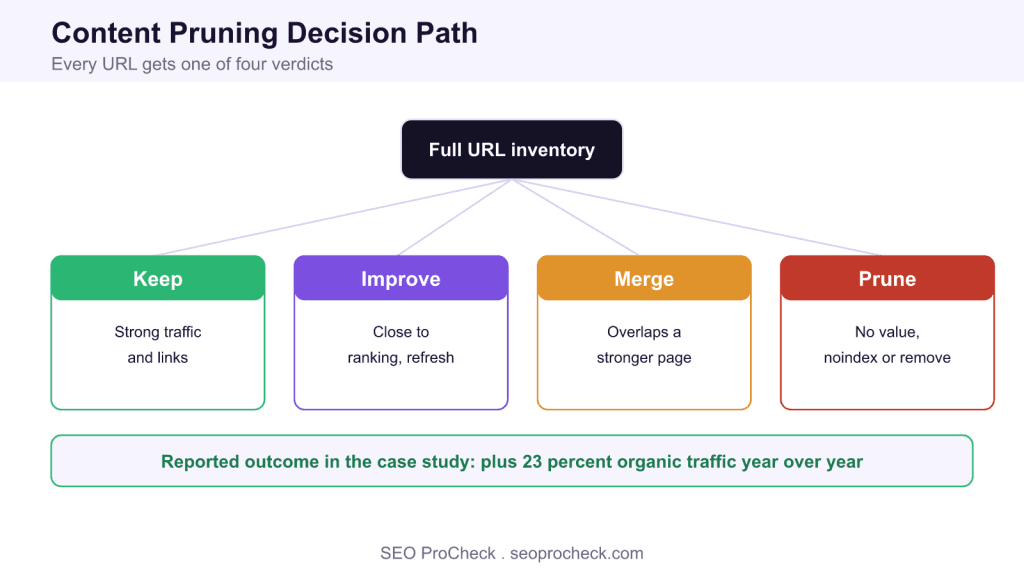
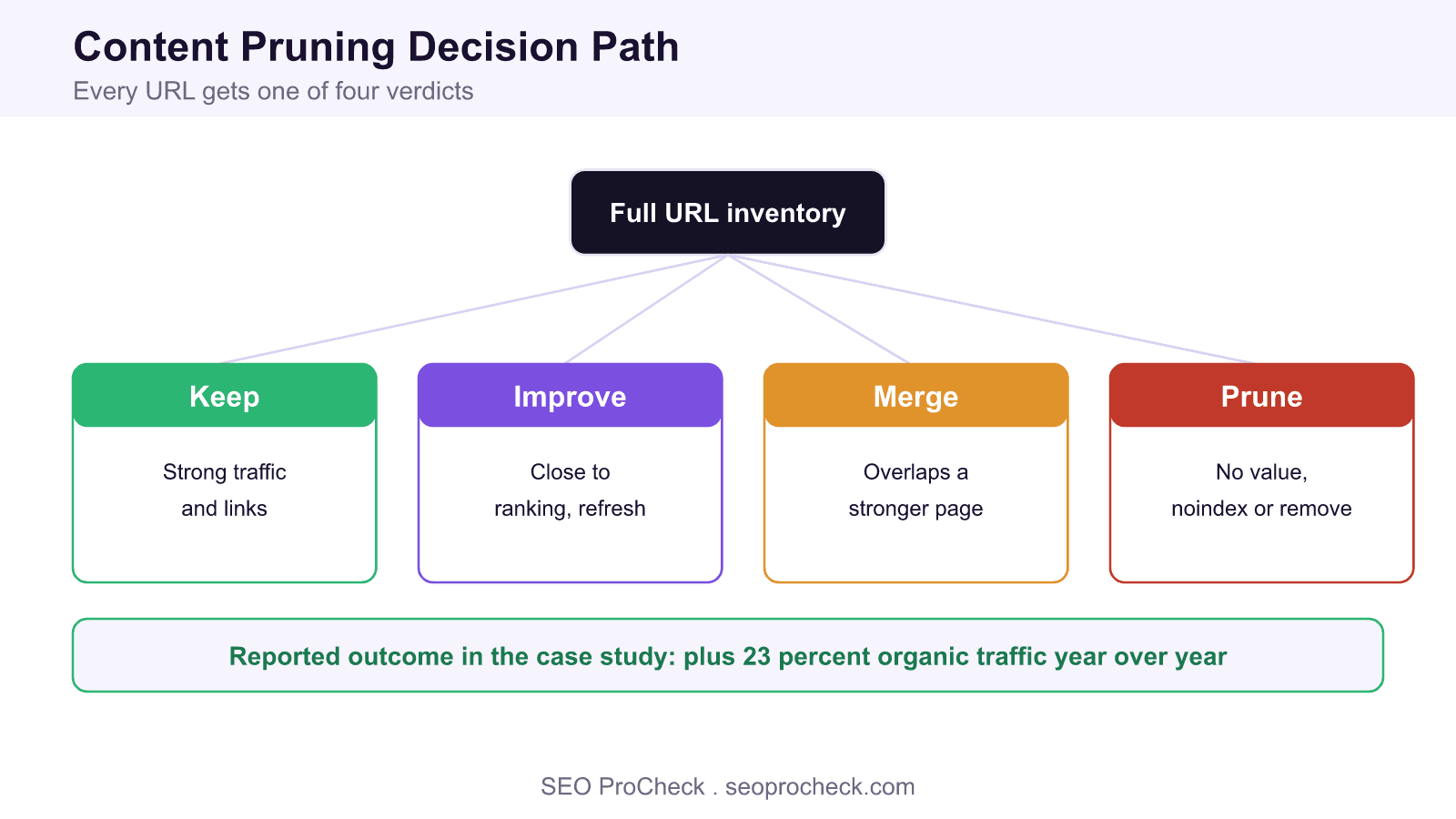
- Every URL gets one of four verdicts: keep, improve, merge, or prune.
- Removing or noindexing weak pages can lift the pages that remain.
- The referenced case study reports a plus 23 percent year over year traffic increase.
When a site loses organic traffic, the instinct is to publish more. Often the better move is the opposite: reduce the number of weak URLs so the strong ones carry more weight. The case study referenced below reports that disciplined content pruning helped reverse a decline and produced a plus 23 percent year over year traffic increase. The source is preserved at the foot of this page, and around it we lay out the exact decision process that makes pruning safe and repeatable.
Why pruning can lift traffic
Search systems assess quality at the site level, so a large tail of low value pages can hold back the whole domain. Removing or improving that tail concentrates crawl attention, internal link equity, and topical focus onto the pages that deserve to rank. This is the same mechanism behind index bloat, where too many low value indexed URLs dilute how a site is understood. Pruning is how you reverse that dilution on purpose.
Start with a full inventory
You cannot prune what you have not measured. Build a single sheet of every indexable URL with organic clicks, impressions, backlinks, last updated date, and conversions. Pull clicks and impressions from Search Console, links from your link tool, and combine them so each row tells a story. This inventory is the backbone of a proper content audit process, and it is what turns pruning from guesswork into a defensible decision.
Assign one of four verdicts
Every URL gets exactly one verdict. Keep the pages with strong traffic, links, or conversions. Improve the pages that are close to ranking and just need depth, freshness, or better intent match. Merge pages that overlap a stronger page, redirecting the weaker into the better. Prune the pages with no traffic, no links, and no strategic role by removing or noindexing them. Forcing a single verdict per URL prevents the paralysis that stalls most audits.
Prune without losing equity
Deletion is not the only tool, and it is the riskiest if done carelessly. If a page has links or lingering value, redirect it to the most relevant survivor rather than returning a dead end. If a page must exist for users but should not compete in search, noindex it instead of deleting it. The distinction between these choices mirrors the lineage of site wide quality signals like Panda, which first showed that trimming weak content can help the rest of a domain recover.
Measure across a full cycle
Pruning results are rarely instant. Search engines need to recrawl, drop removed URLs, and reassess the site. Track organic clicks and impressions year over year rather than week over week, and expect the payoff to appear over one or more core update cycles. The plus 23 percent figure in the referenced study is a year over year comparison, which is the right horizon for judging this kind of work.
| Verdict | When to use it | Action to take |
|---|---|---|
| Keep | Strong traffic, links, or conversions | Leave as is, refresh on schedule |
| Improve | Close to ranking, lacks depth | Expand, update, sharpen intent match |
| Merge | Overlaps a stronger page | Redirect weaker into stronger |
| Prune | No traffic, links, or strategic role | Remove and redirect, or noindex |
Frequently asked questions
What is content pruning?
It is the process of reviewing every URL on a site and deciding whether to keep, improve, merge, or remove it, so the overall site looks stronger and more focused to search engines.
Does deleting pages really increase traffic?
It can. Because quality is assessed site wide, removing or improving a large tail of weak pages can lift the pages that remain. The referenced case study reports a plus 23 percent year over year increase after pruning.
Should I delete or noindex a weak page?
Delete and redirect pages that have links or residual value into a stronger page. Noindex pages that users still need but that should not compete in search. Avoid returning dead ends for URLs that others link to.
How do I decide which pages to prune?
Build an inventory with clicks, impressions, links, and conversions, then assign each URL a single verdict of keep, improve, merge, or prune based on its value and overlap with stronger pages.
How long before pruning shows results?
Usually across one or more core update cycles, not days. Search engines must recrawl and reassess the site, so measure year over year rather than week over week.
Is pruning risky?
It is risky only if you delete pages that hold links or value without redirecting them. Following a verdict framework and preserving equity through redirects or noindex keeps the process safe.
Source: https://www.seerinteractive.com/work/case-studies/content-pruning-efforts-help-reverse-traffic-loss
Take this with you
The assistant links open with a question about this page already written. Nothing is sent until you press enter.
Claude Vincent is a technical SEO consultant focused on crawlability, rendering, and AI-search visibility. He writes the field guides and case studies at SEO ProCheck, with a bias toward the durable, unglamorous work that decides whether search engines and AI answer engines can actually read and cite a site.
About SEO ProCheck
Technical SEO consulting and GEO strategy with 20 years of enterprise experience. Case studies, resources, and tools for search and AI visibility.
Work With Me
Technical SEO audits, GEO strategy, site migrations, and international SEO. Hourly consulting for teams who need hands-on support, not just reports.
Subscribe to our newsletter!








Recent Posts
- Most Top Sites Never Say Who They Are in Structured Data October 14, 2026
- Homepage Titles Are Mostly Too Short, Not Too Long October 8, 2026
- Who Actually Serves an llms.txt? 184 Top Sites Measured September 29, 2026