

Finding Subject-Matter Experts to Review Your Content: The Ultimate Guide
- October 26, 2023
- Content
AI Summary
Subject matter expert review means having a qualified practitioner check your content for accuracy before you publish, then crediting them visibly. It is one of the most practical ways to raise the experience and expertise signals that quality systems and readers both reward.
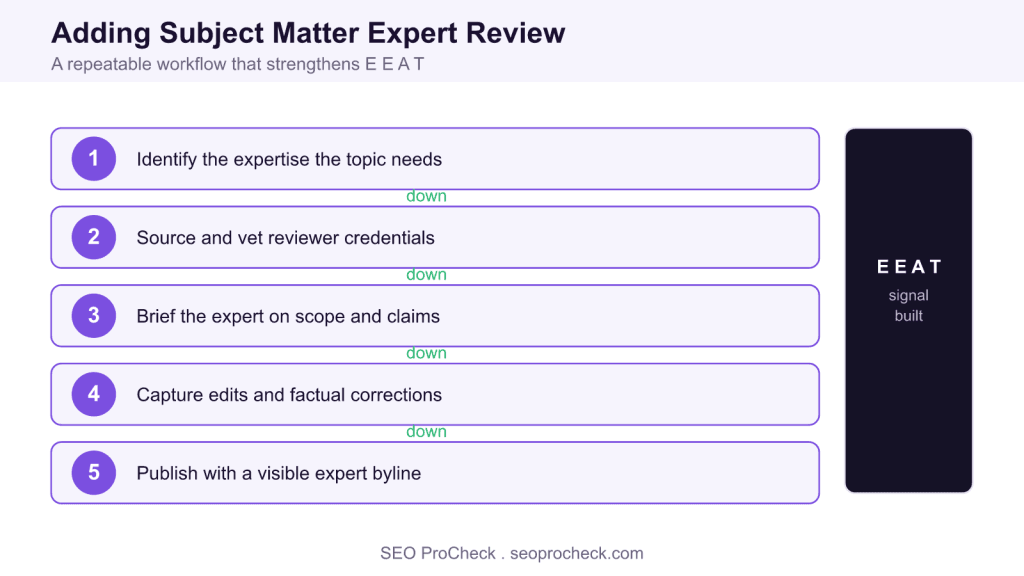
- Match the reviewer to the exact claims on the page, not just the broad topic.
- Vet credentials with primary sources such as licenses, publications, or verifiable roles.
- Give the expert a scoped brief so review is fast and focused on factual risk.
- Publish the reviewer name, credentials, and a dated review note so the signal is visible.
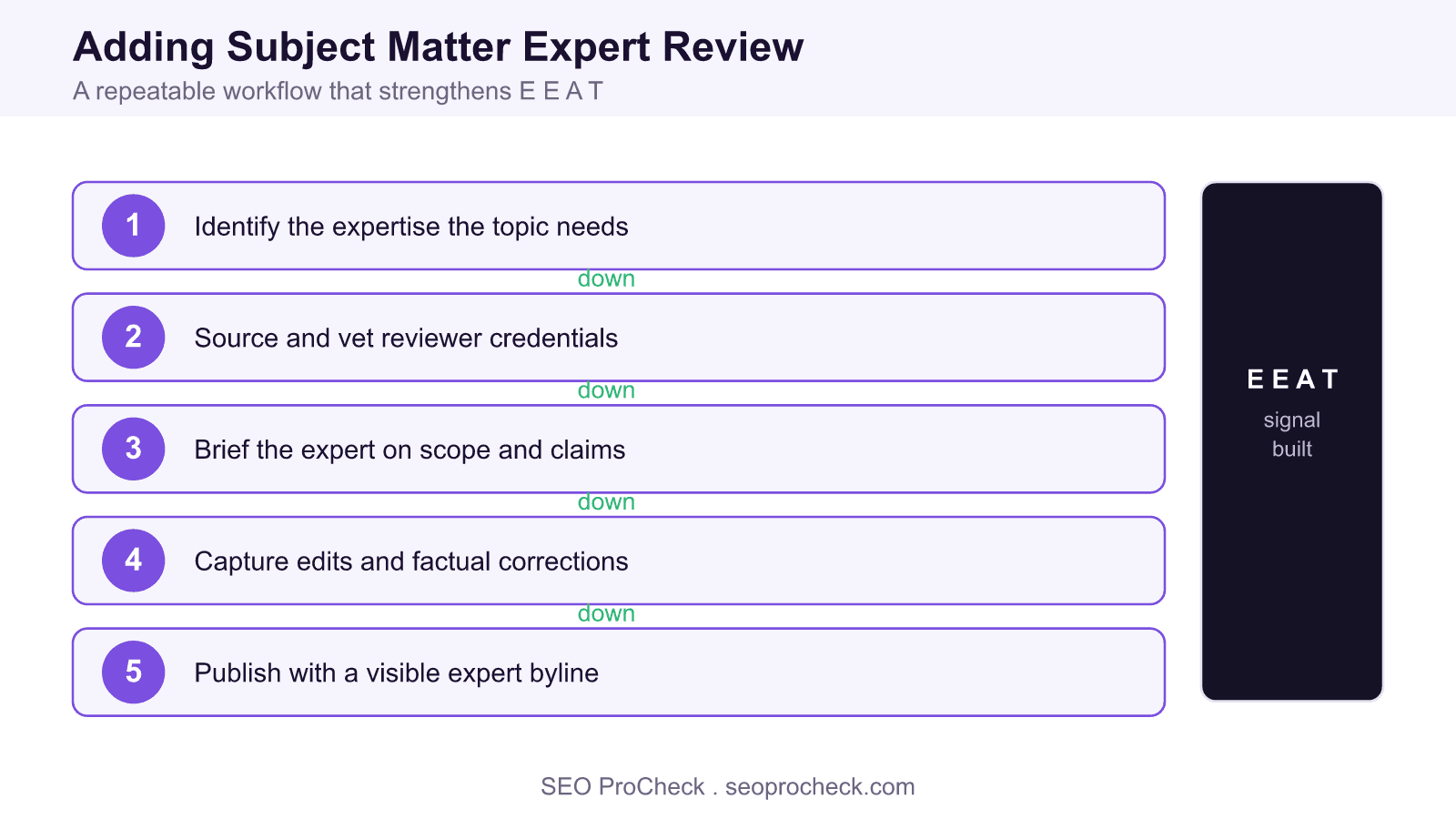
Search quality guidance keeps pushing the same idea: content about topics that affect health, money, or safety needs demonstrable expertise behind it. The cleanest way to add that expertise to work your team already produces is a structured subject matter expert review step. This guide keeps the original source below and adds a working process for finding, vetting, and crediting reviewers so the effort shows up both to readers and to the systems that assess quality.
Decide what expertise the page actually needs
Start from the claims, not the topic label. A single article on retirement accounts might contain tax claims, legal claims, and product claims that call for different reviewers. List the sentences that carry real world consequence if they are wrong, then define the credential that qualifies someone to confirm each one. This keeps you from hiring a generalist for a page that needs a specialist, and it makes the review itself faster because the expert knows exactly what to check.
Where to source qualified reviewers
Good reviewers come from professional associations, university faculty directories, industry certification registries, and author bylines on reputable publications. Freelance marketplaces work if you verify credentials yourself rather than trusting a profile. When you evaluate a candidate, look for the same qualities you would want in a citation: a verifiable track record, current standing in the field, and no undisclosed conflict of interest. A page that is thin on genuine expertise reads the same way a thin content page does, and no amount of formatting hides it.
Vet credentials with primary sources
Confirmation matters more than a claimed title. Check a license number against the issuing board, confirm a named role on the employer site, or find the peer reviewed work a person cites. Record where you verified each credential so you can defend the reviewer choice later. This verification is also what makes the reviewer worth citing, and being cited by others is increasingly how you earn visibility in AI answers, which is covered in the guide to optimizing for AI Overview citations.
Brief the expert and capture the review
Send a scoped brief: the specific claims to check, the sources you used, and a simple way to flag corrections. Ask for factual accuracy first and readability second. Capture the outcome as a dated note that names the reviewer and their credentials, and store the correspondence in case you need an audit trail. Then surface that note on the page itself.
Make the review visible
A review that no one can see does little for trust. Publish the reviewer name, credentials, and the date reviewed near the byline, and link the reviewer to a real profile. Pair this with the wider quality signals that broad assessments look at, which the analysis of the recent core update describes in more detail. Visible, verifiable expertise is the payoff for all the vetting work upstream.
| Step | What to confirm | Primary source to use |
|---|---|---|
| Credential | Title or license is real and current | Issuing board or licensing registry |
| Relevance | Expertise matches the page claims | Publications, role history, specialty |
| Independence | No undisclosed conflict of interest | Disclosure request, employer check |
| Track record | History of accurate public work | Peer reviewed or reputable bylines |
| Attribution | Consent to be named and dated | Signed brief or written agreement |
Frequently asked questions
What is a subject matter expert review?
It is a step where a qualified practitioner checks your content for factual accuracy before publication, then is credited on the page. It raises the expertise and trust signals that both readers and quality systems assess.
How do I find a subject matter expert to review content?
Use professional associations, certification registries, university faculty pages, and bylines on reputable publications. Verify each candidate credential against a primary source rather than trusting a self reported profile.
Does expert review actually help SEO?
It does not add a magic ranking factor, but it improves accuracy and lets you show verifiable expertise, which supports the experience and trust signals that quality assessments reward, especially on topics affecting health, money, or safety.
Where should the reviewer credit appear?
Near the byline, with the reviewer name, credentials, a link to a real profile, and the date reviewed. Visible attribution is what turns private vetting into a trust signal readers and crawlers can see.
How much should I pay a reviewer?
It varies by field and depth, from a modest per article fee for a quick accuracy check to a retainer for ongoing specialist review. Scope the brief tightly so you pay for focused factual review rather than open ended editing.
Can one reviewer cover a whole site?
Only if every page falls within their expertise. Most sites need different reviewers for different claim types, so match the reviewer to the specific claims on each page rather than assigning one person to everything.
Source: https://www.trusthetics.com/finding-3rd-party-expert-reviewers/
Take this with you
The assistant links open with a question about this page already written. Nothing is sent until you press enter.
Claude Vincent is a technical SEO consultant focused on crawlability, rendering, and AI-search visibility. He writes the field guides and case studies at SEO ProCheck, with a bias toward the durable, unglamorous work that decides whether search engines and AI answer engines can actually read and cite a site.
About SEO ProCheck
Technical SEO consulting and GEO strategy with 20 years of enterprise experience. Case studies, resources, and tools for search and AI visibility.
Work With Me
Technical SEO audits, GEO strategy, site migrations, and international SEO. Hourly consulting for teams who need hands-on support, not just reports.
Subscribe to our newsletter!








Recent Posts
- Most Top Sites Never Say Who They Are in Structured Data October 14, 2026
- Homepage Titles Are Mostly Too Short, Not Too Long October 8, 2026
- Who Actually Serves an llms.txt? 184 Top Sites Measured September 29, 2026