AI Summary
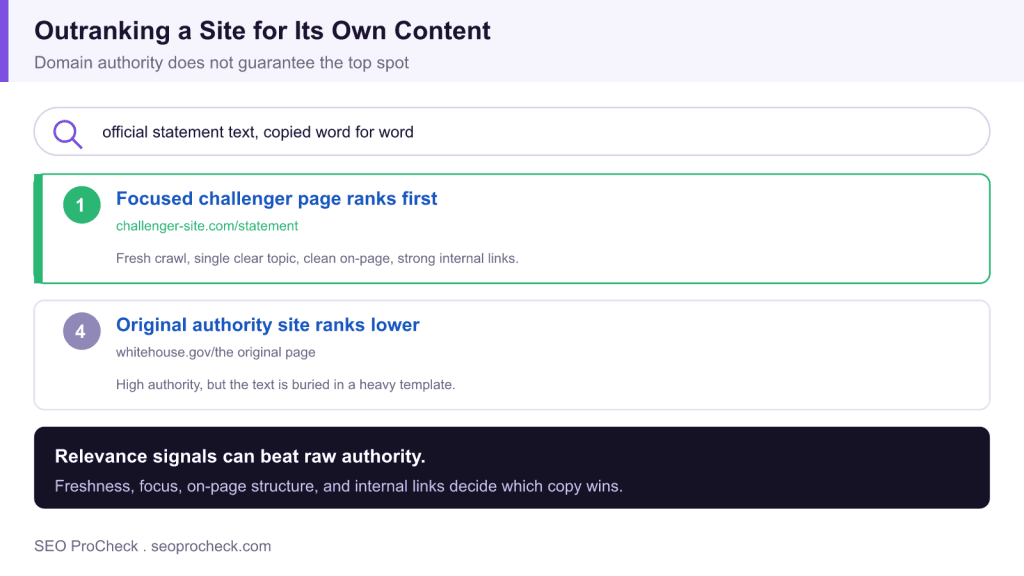
You can outrank a far more authoritative site for its own text because Google ranks individual pages by relevance signals, not by a single site-wide authority score. A focused, cleanly built page that is indexed quickly and linked well can beat the original when that original buries the same words inside a heavy template.
- Google has no public domain authority metric that guarantees a ranking; it evaluates each page per query.
- Duplicate content is not penalized. Google canonicalizes and picks one version to show based on signals.
- Freshness, topical focus, clean on-page structure, and internal links often decide which copy ranks.
- To defend your own content: index it first, set canonicals, avoid burying it, and link to it internally.
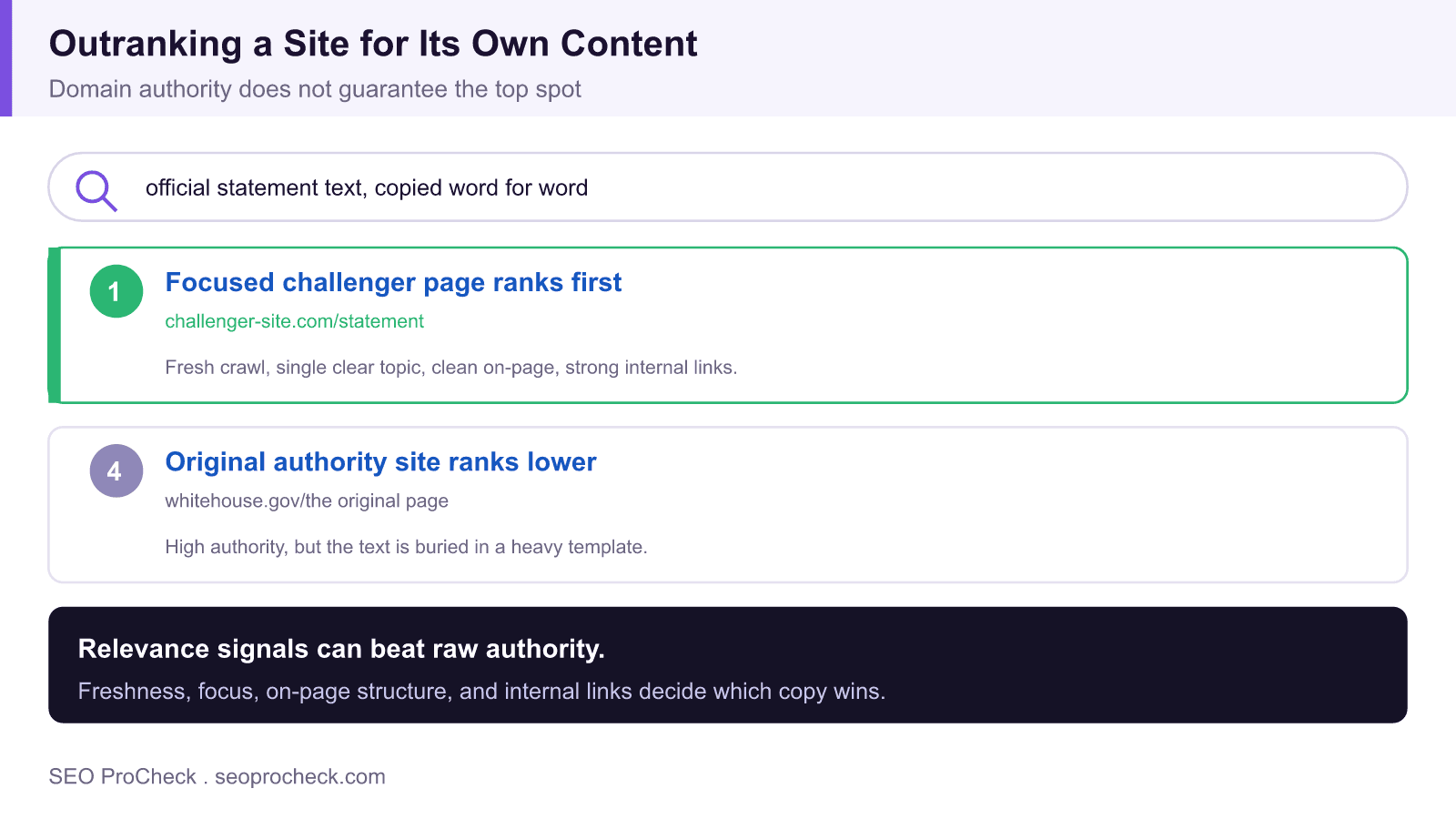
The headline sounds impossible: a small independent page outranking an official government site for that government's own words. It is a real, repeatable outcome, and it exposes one of the most persistent myths in search, that a big trusted domain automatically wins for any content it publishes. It does not. Google ranks pages, not brands, and the signals that decide a single query can favor a focused challenger over a sprawling authority.
There is no magic domain authority dial inside Google
Third party tools publish scores like Domain Authority and Domain Rating, and they are useful for comparing link profiles. Google does not use any of them. Google evaluates the relevance of a specific page to a specific query using hundreds of signals. Site level trust matters, but it is one input among many, and it does not override a page that is simply a better, cleaner, more focused answer for the exact words a user typed.
Why duplicate content did not stop the challenger
Publishing the same text as another site does not trigger a penalty. Google deduplicates: when it finds the same content on several URLs, it clusters them and selects one canonical version to display for a given query. The version it picks is not always the original author. Selection leans on signals such as which URL was crawled and indexed in a useful state, which page presents the content most clearly, internal and external links, and the canonical hints each page sends. If the challenger page is the tidiest, fastest, best linked home for those words, Google may choose it as the one to surface.
What tilts the result toward the smaller page
Authority sites frequently defeat themselves. The same paragraph that stands alone on a challenger page might be wrapped in a giant navigation shell, pushed below press boilerplate, or split across a template that dilutes topical focus. A challenger can win by doing four unglamorous things well:
- Index fast. Being crawled and indexed quickly, sometimes before the original refreshes, establishes the page as a live answer.
- Stay focused. One page, one topic, the target text as the main content rather than a buried fragment.
- Clean on-page structure. A clear title, a single H1, tight headings, and readable HTML the crawler parses without friction.
- Link internally. A few contextual internal links tell Google the page matters and how it fits the site.
How to defend content that is yours
The same mechanics let others outrank you for your material, so treat protection as a workflow, not a reaction. Make sure your version is indexed first by submitting it and requesting indexing. Set a self referencing canonical on the page so your URL is the declared source. When you syndicate to a partner, require a canonical back to your original or at minimum a clear credit link. Do not bury important passages inside heavy templates; give flagship content its own focused page. Finally, build internal links to that page so your own site reinforces which URL is authoritative.
What has changed since: scraping and AI answers
This test predates the current wave of automated scraping and AI generated answers, and those trends make the lesson sharper. Content is copied faster and at larger scale, and answer engines may summarize whichever copy they index, not necessarily yours. The defenses are the same fundamentals, applied with more urgency: publish and index first, declare canonicals, and keep your original page the cleanest and best linked home for its content.
Which copy of identical content tends to win
| Signal | Large authority site | Focused challenger |
|---|---|---|
| Site trust | Very high | Lower |
| Topical focus of the page | Often diluted by template | Tight, single topic |
| Indexing speed | Can lag on updates | Fast when submitted |
| On-page clarity | Buried in navigation | Content is the page |
| Internal links to the page | Spread thin | Concentrated |
| Canonical clarity | Sometimes ambiguous | Self referencing and clear |
Related reading
- The complete canonical tag reference shows how to declare which URL is the source of your content.
- The duplicate content guide explains how Google clusters and chooses a version to show.
- SEO vs AEO vs GEO covers how answer engines pick which copy of your content to cite.
Case study summary and source
Content-driven SEO success requires strategic approaches to creation, optimization, and management. This case study demonstrates how content strategy directly drives organic growth when aligned with user needs and search behavior.
Content Strategy Framework
Effective content strategy begins with understanding target audiences, their questions, and the competitive content landscape. This case study outlines the strategic framework that guided content decisions, from topic selection to format choices.
Content Development Process
Moving from strategy to published content requires efficient processes for research, creation, and optimization. This case study documents workflows, quality standards, and production approaches that enabled consistent, high-quality output.
Optimization and Distribution
Published content requires ongoing optimization based on performance data. This case study covers how content was refined post-publication, how internal linking supported content performance, and how distribution amplified content reach.
Results and Attribution
Measuring content ROI requires connecting content efforts to business outcomes. This case study demonstrates the traffic, engagement, and business results achieved through strategic content investment. Attribution methodology helps validate content strategy effectiveness.
Content SEO case studies help practitioners build cases for content investment with documented results.
Source: https://dejanmarketing.com/whitehouse-seo-test/
Frequently asked questions
How can a small site outrank a government or brand site for its own words?
Google ranks pages, not domains. A focused page that is indexed quickly, structured cleanly, and linked well can be judged the most relevant result for the exact query, even when a more authoritative site published the text first.
Does copying content trigger a duplicate content penalty?
No. There is no duplicate content penalty. Google clusters identical pages and picks one canonical version to display. The risk is not a penalty; it is that Google may choose someone else's copy over yours.
Why would Google show a copy instead of the original?
Because canonical selection depends on signals, not authorship. Crawl and index timing, page clarity, internal and external links, and canonical hints all feed the choice. If the copy sends stronger signals, it can be selected.
How do I make sure I rank for my own content?
Get it indexed first, set a self referencing canonical, keep the content on a focused page rather than buried in a template, and build internal links to it. When you syndicate, require a canonical or clear credit back to your original.
Does high domain authority guarantee top rankings?
No. Site trust helps, but it is one input among many and does not override a page that is a cleaner, more focused answer to the specific query. Authority sites often lose because their template dilutes the target content.
What should I do if someone outranks me for my own article?
Confirm your page is indexed and canonical, strengthen its internal links, improve its on-page focus, and if a syndication partner is involved, ask them to add a canonical or credit link back to your original.
Claude Vincent is a technical SEO consultant focused on crawlability, rendering, and AI-search visibility. He writes the field guides and case studies at SEO ProCheck, with a bias toward the durable, unglamorous work that decides whether search engines and AI answer engines can actually read and cite a site.
About SEO ProCheck
Technical SEO consulting and GEO strategy with 20 years of enterprise experience. Case studies, resources, and tools for search and AI visibility.
Work With Me
Technical SEO audits, GEO strategy, site migrations, and international SEO. Hourly consulting for teams who need hands-on support, not just reports.
Subscribe to our newsletter!