

Here's what happened when I followed Googlebot for 3 months
- November 28, 2018
- Crawling and Indexing
AI Summary
Following verified Googlebot through three months of server logs shows where crawl effort really goes, and it is rarely where you assume. Segmenting hits by template, status code and parameter exposes crawl waste on redirects, error pages and low value URLs that you can then steer back toward pages that earn revenue.
- Verified Googlebot hits in raw logs are the ground truth for crawl behaviour, ahead of any tool estimate.
- Most sites leak crawl on redirect chains, soft 404s, faceted parameters and near duplicate URLs.
- You steer the bot with internal links, clean sitemaps, canonical tags and correct status codes.
- Improvements show up as a shifting crawl mix over weeks, not as an overnight change.
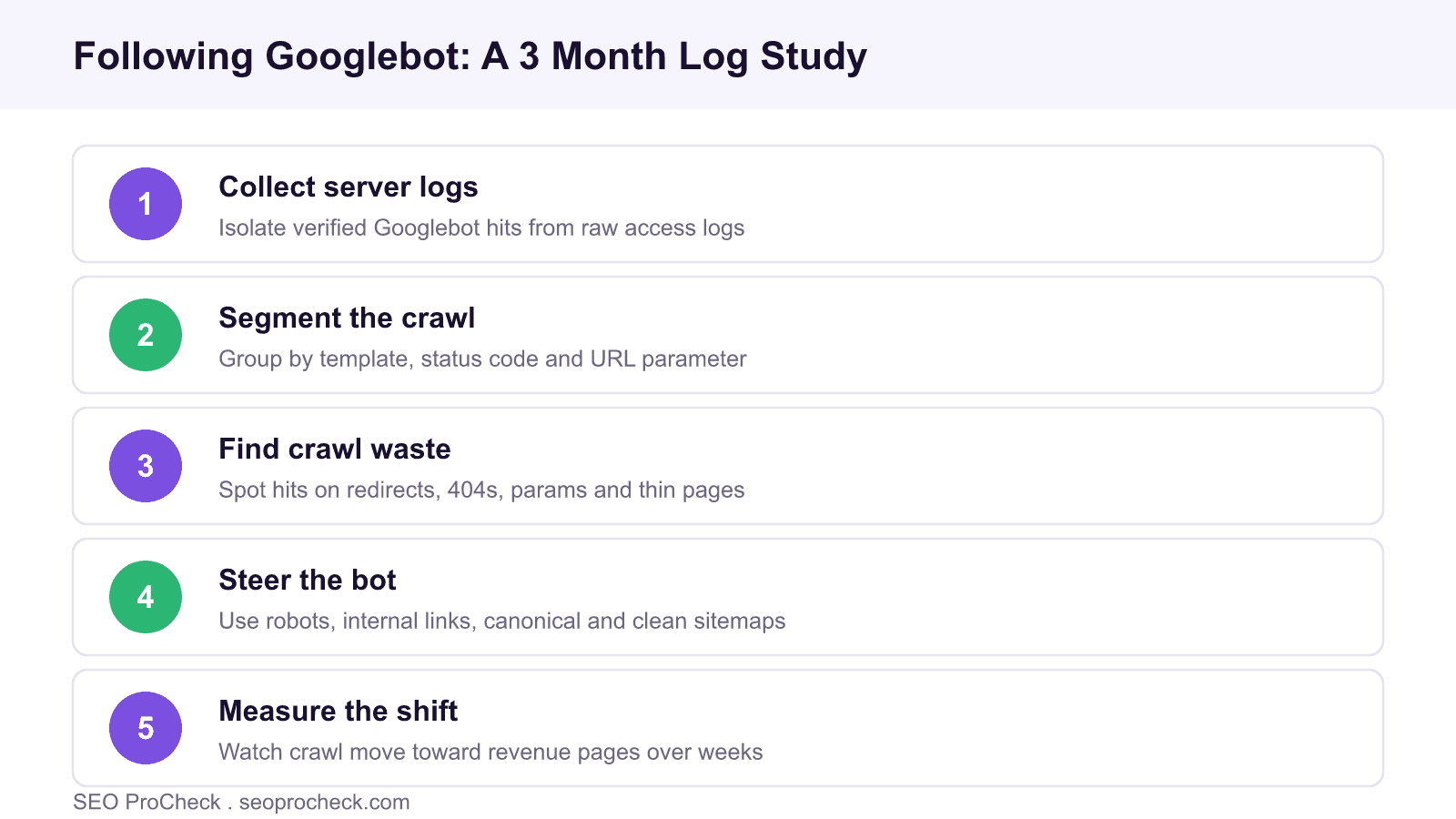
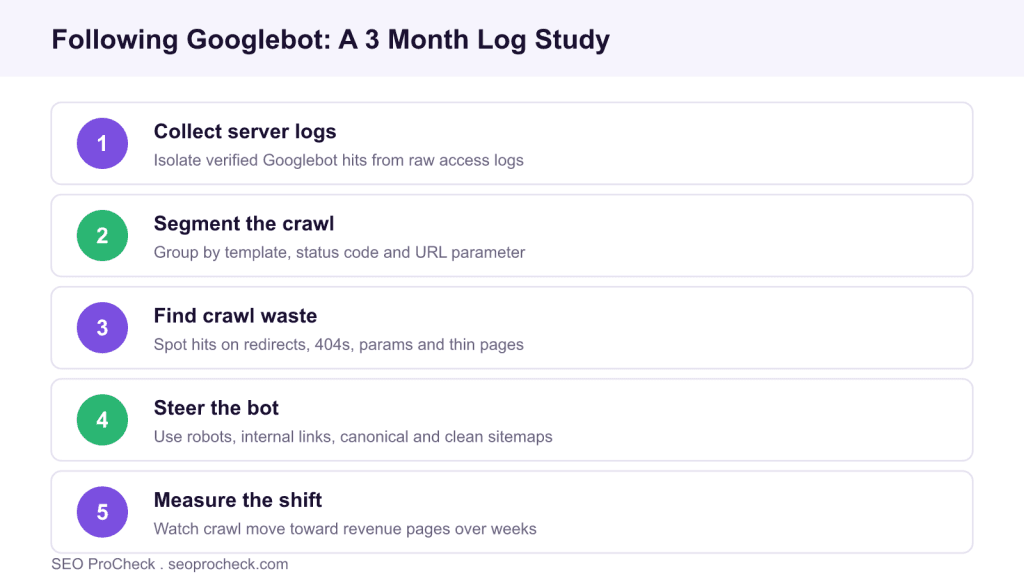
This case study, originally shared on Search Engine Land, records what the author learned after watching Googlebot in server logs for three months. We keep the original summary and source below, then add a repeatable framework so you can run the same investigation on your own site.
This SEO case study documents a successful optimization initiative, providing actionable insights for practitioners. The documented approach demonstrates how strategic SEO implementation drives measurable results.
Initial Situation
Understanding the starting point is essential context for evaluating any case study. This documentation covers the initial challenges, competitive position, and business objectives that shaped the SEO strategy.
Strategy and Approach
The strategic approach combined multiple SEO disciplines to address identified opportunities. Key decisions around prioritization and resource allocation provide a template for similar initiatives.
Implementation
Moving from strategy to execution required specific technical implementations, content development, and process changes. This case study documents the practical steps that translated strategy into action.
Results and Learnings
The outcomes demonstrate effectiveness through measurable improvements in rankings, traffic, and business metrics. Analysis of successes and challenges provides learning value for practitioners.
Case studies like this contribute to the SEO knowledge base, helping practitioners learn from documented real-world experiences.
Source: https://searchengineland.com/heres-what-happened-when-i-followed-googlebot-for-3-months-308674
Why raw logs beat every estimate
Crawl reports and third party tools model crawl behaviour, but your server logs record exactly which URL Googlebot requested, when, with which user agent and what status code came back. That is the only fully reliable source. The first step is verification: confirm each Googlebot hit by reverse DNS on the requesting IP, then a forward lookup back to a googlebot.com or google.com host, so you exclude spoofed agents that inflate the numbers.
Segment the crawl before you judge it
Raw counts mean little until you group them. Parse the log into fields, then segment by template or path pattern, by response status, and by whether a URL carries query parameters. This is where the surprises appear: a large share of crawl often lands on redirects, parameter permutations, paginated tails and pages that return 404. Understanding what crawl budget really is keeps expectations realistic, because for most sites the goal is not more crawl but better distributed crawl.
| Log segment | What Googlebot is doing | Action if the share is high |
|---|---|---|
| 3xx redirects | Following hops instead of reaching content | Repoint internal links to the final URL |
| 404 and 410 | Requesting URLs that no longer exist | Fix bad internal links, retire stale sitemap entries |
| Parameter URLs | Crawling filter and sort permutations | Canonicalise, and constrain crawlable facets |
| Near duplicates | Refetching thin or templated variants | Consolidate and strengthen the canonical set |
| Money templates | Crawling pages that convert | Protect and grow this share with internal links |
Steer, then measure
Once you can see the waste, the levers are familiar: repoint internal links to canonical destinations, remove dead URLs from XML sitemaps and keep lastmod honest, return the right status codes, and disallow only genuinely infinite parameter spaces. Validation caching also matters, because when Googlebot can confirm an unchanged page with a cheap 304 it spends the saved capacity elsewhere, as explained in whether Googlebot uses ETag headers. For a worked example of moving crawl toward priority pages, see how one team optimised its crawl budget. Give it a few weeks, then rerun the same segmentation and compare: success looks like a rising share of crawl on revenue templates and a shrinking share on redirects, errors and parameters.
What has changed since this case study
Log analysis is more accessible than it was, with pipelines that stream logs into a warehouse or a dedicated crawl analytics tool rather than one off spreadsheet parsing. Search Console Crawl Stats now offers a by response and by purpose view that echoes what logs show, though it samples and aggregates rather than listing every hit. The method itself has not aged: verify the bot, segment the crawl, find the waste, steer with links and status codes, then measure the shift. That loop still outperforms guesswork on any large site.
Frequently asked questions
How do I verify a hit is really Googlebot?
Do a reverse DNS lookup on the requesting IP, confirm it resolves to a googlebot.com or google.com host, then run a forward lookup on that host name back to the same IP. Anything that fails this check is likely a spoofed user agent.
What counts as crawl waste in the logs?
Repeated hits on redirects, 404 and 410 responses, endless parameter combinations and near duplicate URLs. These consume crawl capacity without adding anything indexable, so they are the first things to reduce.
How long before changes show up in the crawl mix?
Usually a few weeks. Googlebot revisits URLs at different frequencies, so you need enough time for it to recrawl the areas you changed before the segmentation reliably reflects your fixes.
Should I block parameter URLs in robots.txt?
Only truly infinite or valueless spaces such as session identifiers or unbounded filter combinations. Blocking useful parameter pages can strand signals, so prefer canonical tags and sensible internal linking first.
Do I need logs if I already have Search Console Crawl Stats?
Crawl Stats is a helpful summary, but it samples and groups the data. Raw logs give you the complete, URL level record, which you need to trace specific waste and to verify individual bot behaviour.
What is the single most useful log field for SEO?
The response status code, grouped by URL pattern. It instantly shows whether Googlebot is reaching real content or burning effort on redirects and errors.
Take this with you
The assistant links open with a question about this page already written. Nothing is sent until you press enter.
Claude Vincent is a technical SEO consultant focused on crawlability, rendering, and AI-search visibility. He writes the field guides and case studies at SEO ProCheck, with a bias toward the durable, unglamorous work that decides whether search engines and AI answer engines can actually read and cite a site.
About SEO ProCheck
Technical SEO consulting and GEO strategy with 20 years of enterprise experience. Case studies, resources, and tools for search and AI visibility.
Work With Me
Technical SEO audits, GEO strategy, site migrations, and international SEO. Hourly consulting for teams who need hands-on support, not just reports.
Subscribe to our newsletter!








Recent Posts
- Most Top Sites Never Say Who They Are in Structured Data October 14, 2026
- Homepage Titles Are Mostly Too Short, Not Too Long October 8, 2026
- Who Actually Serves an llms.txt? 184 Top Sites Measured September 29, 2026