

AI Summary
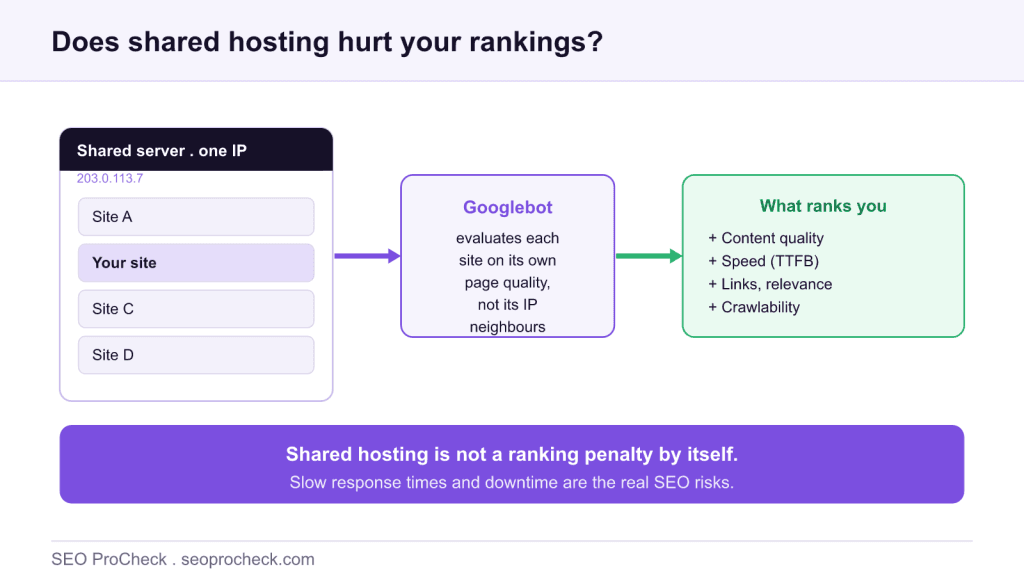
Shared hosting does not hurt your search rankings by itself. Google ranks each website on its own content, links and speed, so the sites that share your server or IP address do not drag you down, but a slow or unreliable host will.
- Google does not use your IP neighbours as a ranking signal for normal sites.
- The real hosting risks are slow response times (TTFB), downtime, and 5xx errors during crawls.
- A long-term experiment by Reboot Online tested the shared-hosting question directly; see the source below.
- Diagnose your host with the Search Console Crawl stats report and log-file analysis, not with hosting-plan labels.

Few pieces of hosting advice are repeated as confidently, or as wrongly, as the claim that shared hosting quietly caps your rankings. The worry usually runs like this: if dozens of sites share one server and one IP address, and some of them are low quality, then Google must be tarring you with the same brush. It is an intuitive fear, and it is almost entirely unfounded. This page explains what the evidence actually shows, what a long-term hosting experiment set out to test, and where hosting genuinely does affect SEO so you spend your budget on the parts that matter.
What the experiment set out to test
The case study linked at the foot of this page, published by Reboot Online, is one of the few long-term, controlled looks at the shared-hosting question rather than another round of speculation. Reboot are known for running live ranking experiments over extended periods instead of arguing from first principles, which is exactly what a question like this needs: a controlled setup, held long enough to separate a real effect from ordinary ranking noise. We summarise the premise here and link out to their full write-up for the raw data; the analysis and practitioner guidance below are our own.
The core question is simple to state and hard to test casually: holding content and links constant, does the type of hosting a site sits on change how it ranks over time? That framing is the important part. Most anecdotes confuse a slow, oversold server with the abstract idea of shared hosting, when those are two different things.
The IP-neighbour myth
Google has addressed this directly and repeatedly. Sharing an IP address with other websites, including low-quality ones, is not a ranking factor for normal sites. The overwhelming majority of the web runs on shared IPs behind CDNs and large hosts, so treating a shared IP as a liability would penalise most of the internet. Googlebot fetches your URLs, reads your pages, and judges them on their own merits: content, relevance, links, and how well the page performs for users.
The narrow exception that spawned the myth is the deliberately abusive environment: a host or IP range set up specifically to serve spam networks or link schemes. Even there, the issue is the pattern of manipulation Google detects, not the mere fact of a shared address. A legitimate small business on a mainstream shared plan is nowhere near that scenario.
Where hosting really does affect SEO
Hosting matters, just not in the way the myth claims. The effect runs entirely through performance and reliability, both of which are measurable and fixable.
| Hosting factor | SEO impact | How it shows up |
|---|---|---|
| Server response time (TTFB) | Real and direct | Slow Time To First Byte hurts Core Web Vitals and can throttle crawl rate |
| Uptime and 5xx errors | Real and direct | Errors during a crawl make Googlebot back off and can drop pages temporarily |
| Shared IP with other sites | None for normal sites | Not a ranking signal; Google judges each site independently |
| Dedicated vs shared plan label | None by itself | Only matters insofar as it changes speed and stability |
| Server location | Minor | Can affect latency and, loosely, geotargeting; a CDN usually neutralises it |
The pattern is clear: the levers that move rankings are speed and stability, and a cheap oversold plan can undermine both. That is a performance problem you can measure, not a mark against shared hosting as a category. If you want the mechanics of the single most important item in that table, our guide to reducing server response times (TTFB) covers the fixes in order of impact.
How to tell if your host is the problem
Do not guess from the plan name. Diagnose with data, in three passes:
1. Measure response time. Check TTFB from several geographic locations under realistic conditions, not just an empty test page. A consistently high TTFB on your key templates is the signal that your host, or your stack on that host, is too slow.
2. Watch Googlebot's experience. In Search Console, open Settings then Crawl stats. A rising Average response time or a climbing count of server errors (5xx) tells you Googlebot is being served slowly or failing to fetch pages. That is the crawl-side symptom of a struggling host, and it feeds directly into how much of your site gets crawled. Our explainer on crawl budget shows why a slow host shrinks the number of pages Google will fetch.
3. Read the logs. Server log-file analysis is the ground truth: it shows exactly how Googlebot was served, which status codes it received, and whether response times spike at particular times of day, the classic fingerprint of an oversold shared box under load.
Shared, VPS, or dedicated: choosing for the right reasons
Pick a tier for performance headroom and operational needs, not for a ranking bonus that does not exist.
| Tier | Good fit when | SEO-relevant caveat |
|---|---|---|
| Shared | Small to mid sites with modest traffic | Fine for SEO if TTFB and uptime hold up under crawl and traffic |
| VPS or cloud | Growing traffic, need consistent performance | Buys headroom so response times stay low at peak, which protects crawl rate |
| Dedicated or managed | High traffic, strict performance or compliance needs | Helps only through speed and stability, never through the label itself |
The honest summary: if your shared plan serves fast, stable responses, it is not costing you rankings, and migrating will not hand you any. Upgrade when you have measured a performance ceiling, and let that measurement, not folklore about IP neighbours, drive the decision.
FAQ
Not on its own. Google evaluates each site on its own content, links and speed, not on the other sites that share its IP address. Shared hosting only costs you rankings when it makes your site slow or unreliable, which is a performance problem, not a hosting-type penalty.
For normal sites, no. Google has said repeatedly that sharing an IP with low-quality sites is not a ranking factor. The rare exception is a host built specifically for spam or link networks, where the whole environment, not your IP neighbour alone, is the problem.
Server response time (TTFB), uptime, and correct status codes. A host that answers slowly or returns 5xx errors while Googlebot is crawling will suppress crawl rate and can hurt Core Web Vitals. Those are the levers, not whether the plan is labelled shared or dedicated.
Measure TTFB from several locations, monitor uptime, and read the Crawl stats report in Search Console for a rising average response time or server-error spikes. Log-file analysis shows whether Googlebot is being served slowly or hitting errors.
Only if your shared plan is measurably slow or unstable under real traffic and crawl load. If TTFB is consistently low and uptime is solid, a move buys you little SEO benefit. Upgrade for performance headroom, not for an imagined ranking bonus.
No. A dedicated IP can be useful for some mail or certificate setups, but Google does not reward a dedicated IP with better rankings. This is one of the most persistent myths in hosting-related SEO advice.
Not sure whether your hosting is quietly costing you traffic?
An audit measures your real response times, crawl behaviour and error rates, and tells you whether a migration would move the needle or waste your budget.
Source: https://www.rebootonline.com/blog/long-term-shared-hosting-experiment/
Claude Vincent is a technical SEO consultant focused on crawlability, rendering, and AI-search visibility. He writes the field guides and case studies at SEO ProCheck, with a bias toward the durable, unglamorous work that decides whether search engines and AI answer engines can actually read and cite a site.
About SEO ProCheck
Technical SEO consulting and GEO strategy with 20 years of enterprise experience. Case studies, resources, and tools for search and AI visibility.
Work With Me
Technical SEO audits, GEO strategy, site migrations, and international SEO. Hourly consulting for teams who need hands-on support, not just reports.
Subscribe to our newsletter!







Recent Posts
- Can AI Crawlers Actually Read Your Site? I Measured 400 of the Biggest September 5, 2026
- The Pre-Publish Quality Gate for AI-Assisted Content August 6, 2026
- AGENTS.md vs llms.txt vs llms-full.txt: Which Agent File Does What July 18, 2026