

AI Summary
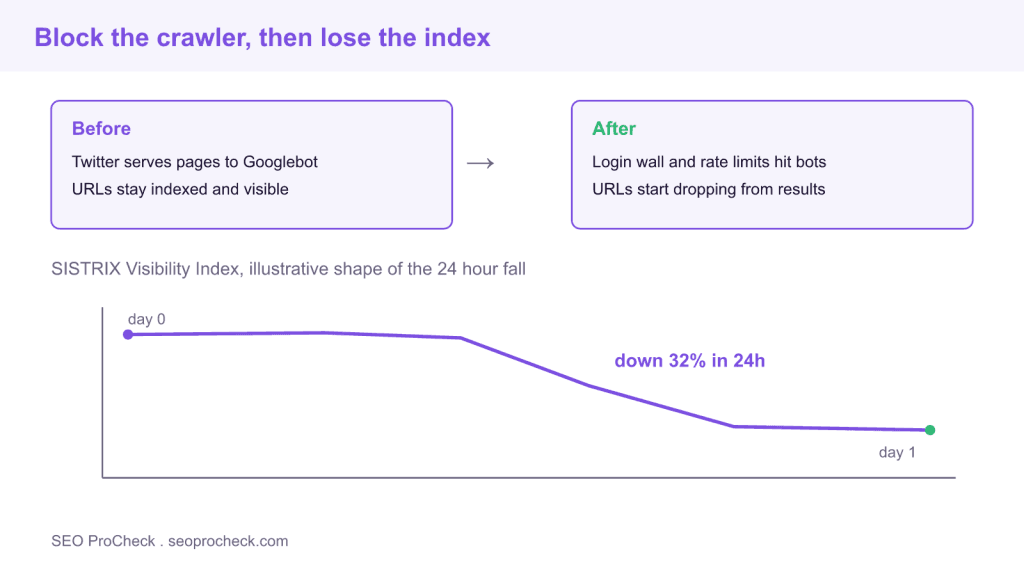
In July 2023 Twitter began blocking logged out visitors and rate limiting requests, so Googlebot met login walls and error responses instead of tweets. SISTRIX recorded the Twitter visibility index falling about 32 percent within 24 hours, a textbook example of how a change in crawl access turns into an indexing loss.
- A page has to stay crawlable to stay indexed, so when you block the crawler the index follows it down.
- Login walls and aggressive rate limits reach Googlebot as
401,403or429responses, not as readable content. - Visibility can recover once clean access returns, but only after Google recrawls the affected URLs at its own pace.
- Confirm what Googlebot actually receives with server logs and a live header check, never with a browser you are already signed into.
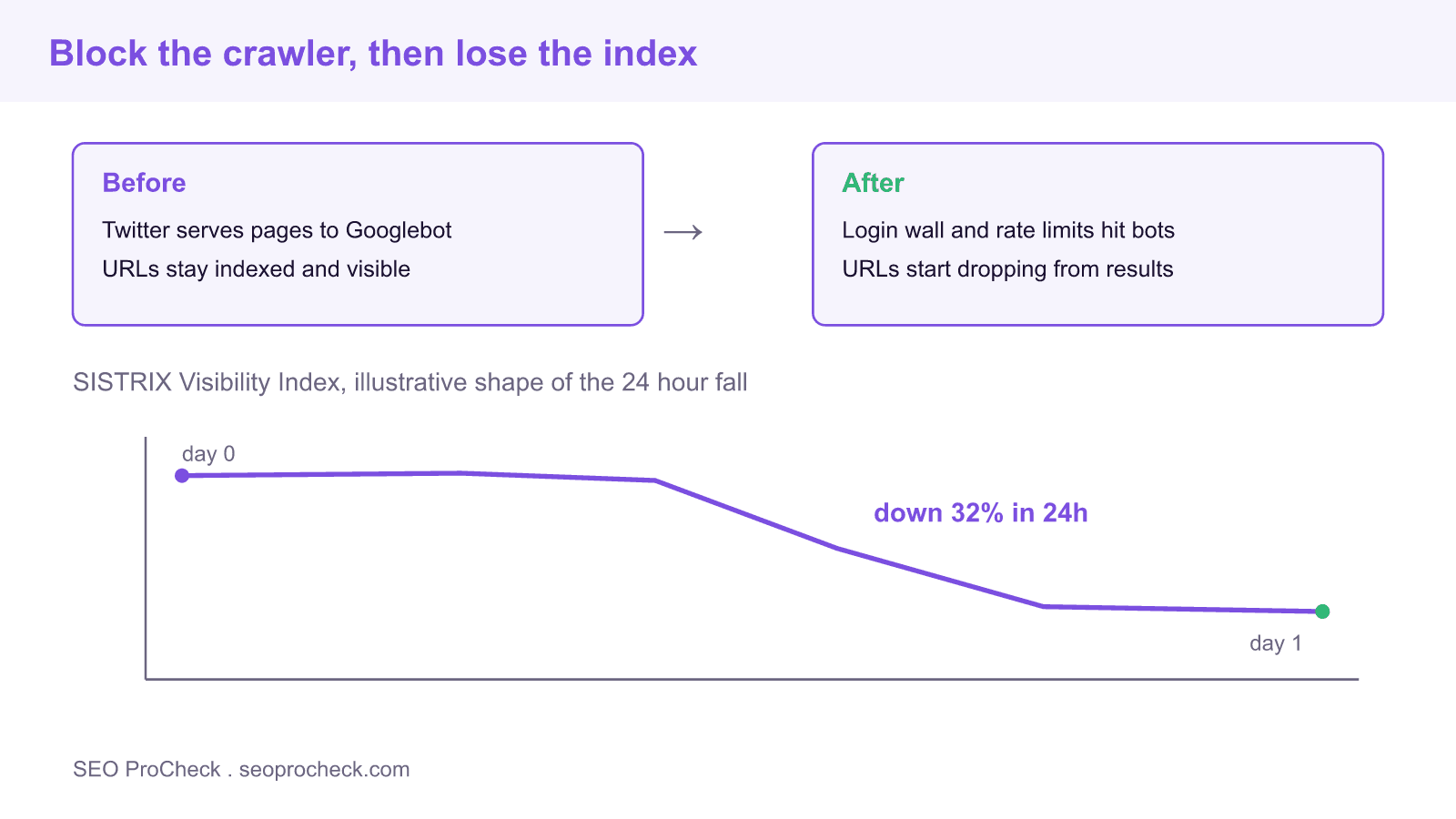
This case note documents a public event that every technical SEO should keep in their back pocket. When Twitter, now X, restricted access for logged out users and throttled requests in July 2023, its footprint in Google fell fast. SISTRIX, a visibility tracking platform, put the fall at roughly 32 percent of the Twitter visibility index inside a single day. The mechanism is simple and it applies to any site: the crawler has to be able to fetch a URL before Google can decide to keep it in the index.
Why a login wall reads as an indexing problem
Googlebot crawls as an anonymous, logged out client. It does not hold a session, it does not solve a login form, and it does not wait in a queue. When Twitter started serving a login interstitial or a rate limit response to unauthenticated traffic, Googlebot received exactly that: an interstitial or an error, not the tweet. A URL that consistently returns a wall or an error, or that redirects to a sign in screen, stops looking like useful content. Over repeated crawls Google trims those URLs from results, and an aggregate tracker like SISTRIX reports the sum of those losses as a visibility drop.
The speed here is the instructive part. Deindexing is usually slow because Google has to recrawl before it acts. Twitter is crawled constantly and at enormous scale, so the recrawl that exposed the change happened almost immediately across millions of URLs. On a normal site the same cause would show up over days or weeks rather than hours, which is why smaller sites often bleed visibility quietly and blame the wrong thing.
What Googlebot receives, and what each response means
The whole story lives in the HTTP response your server hands back to an anonymous request. This table maps the responses involved in an access clampdown to their crawl and indexing effect.
| Response to Googlebot | What it signals | Indexing effect over time |
|---|---|---|
200 with real content | Page is available and readable | Stays eligible to rank |
200 with a login screen | Soft wall, thin or duplicate content | Treated as low value, drops out |
401 or 403 | Access denied to the crawler | URL falls from the index on recrawl |
429 | Too many requests, rate limited | Crawl budget shrinks, freshness stalls |
302 to a sign in URL | Content redirected away | Original URL loses its indexed value |
503 for a short window | Temporary unavailability, correct for maintenance | Held safely if it clears quickly |
The practical lesson is that a 503 for genuine maintenance is a controlled, reversible signal, whereas a persistent 401, 403 or login redirect is read as a decision to remove the page from the open web. If you ever must gate content, prefer a short 503 with a Retry-After header over an indefinite wall.
How to protect your own crawlability
You do not need to be Twitter to trip this wire. Membership gates, geoblocks, bot mitigation rules, and overly tight WAF settings all commonly serve walls or errors to Googlebot by accident. Work through this list before you ship any access change.
- Fetch a sample of important URLs with a plain, logged out request and read the raw status line and body, not the version your browser renders while signed in.
- Check your bot mitigation and rate limit rules for Googlebot verification by reverse DNS, so real Googlebot is never lumped in with scrapers.
- Return
503withRetry-Afterfor planned downtime, and reserve401or403only for pages you truly want off the index. - Watch server logs for a spike in error responses to Googlebot, which is the earliest signal that access broke.
- Keep public, indexable pages out from behind any login, and expose a crawlable public version if the full content sits behind a wall.
What is changed since the 2023 event
Two things have shifted since this drop was first recorded. First, X has continued to tune access for logged out users, so its search footprint has stayed volatile rather than snapping back to the old baseline, which shows that repeated access changes keep resetting the recovery clock. Second, the rise of AI crawlers has widened the question: many sites now decide separately whether to allow Googlebot, Google Extended, and third party AI bots. Blocking an AI crawler in robots.txt does not remove you from Google search, but blocking Googlebot itself, or walling the content it needs, still does. Treat search crawlability and AI crawlability as two distinct policies with different consequences.
FAQ
Googlebot browses as an anonymous, logged out client. Once anonymous requests hit a login wall or a rate limit, Googlebot stopped receiving tweet content and started receiving interstitials and errors, so Google trimmed those URLs from results and SISTRIX registered the aggregate loss.
Yes, if the wall is what Googlebot consistently receives. A page that returns a sign in screen, a 401, or a 403 to the crawler is treated as unavailable, and it drops out on the next few recrawls. A public preview that Googlebot can read keeps the URL eligible.
Use 429 for genuine rate limiting and 503 with a Retry-After header for short planned pauses. Both are understood as temporary, so Google backs off and returns later instead of dropping the URL as it would for a persistent 403.
Recovery depends on recrawl speed, which favors large, frequently crawled sites and is slower for smaller ones. Once clean 200 responses return, Google reindexes the URLs over the following crawls, so expect days to weeks rather than an instant rebound.
No. Disallowing an AI crawler such as GPTBot or Google Extended in robots.txt affects AI training and answers, not classic Google search ranking. Blocking Googlebot itself, or walling the content it fetches, is what removes you from search results.
Read your server access logs filtered to verified Googlebot, and run a live header check on key URLs as an anonymous client. The URL Inspection tool in Search Console shows the fetched response and rendered HTML, which exposes a wall that your signed in browser hides.
Keep reading and check your own setup
- Confirm the exact response your pages hand back with the HTTP header checker.
- Audit indexing directives with the meta robots checker and the meta robots and X-Robots-Tag reference.
- Trace what Googlebot actually fetched using the log file analyzer.
- Browse more crawling and indexing case studies.
Reference: original case note
This SEO case study documents a successful optimization initiative, providing actionable insights for practitioners. The documented approach demonstrates how strategic SEO implementation drives measurable results.
Initial Situation
Understanding the starting point is essential context for evaluating any case study. This documentation covers the initial challenges, competitive position, and business objectives that shaped the SEO strategy.
Strategy and Approach
The strategic approach combined multiple SEO disciplines to address identified opportunities. Key decisions around prioritization and resource allocation provide a template for similar initiatives.
Implementation
Moving from strategy to execution required specific technical implementations, content development, and process changes. This case study documents the practical steps that translated strategy into action.
Results and Learnings
The outcomes demonstrate effectiveness through measurable improvements in rankings, traffic, and business metrics. Analysis of successes and challenges provides learning value for practitioners.
Case studies like this contribute to the SEO knowledge base, helping practitioners learn from documented real-world experiences.
Source: https://www.sistrix.com/blog/twitter-down-32-in-24-hours/
Take this with you
The assistant links open with a question about this page already written. Nothing is sent until you press enter.
Claude Vincent is a technical SEO consultant focused on crawlability, rendering, and AI-search visibility. He writes the field guides and case studies at SEO ProCheck, with a bias toward the durable, unglamorous work that decides whether search engines and AI answer engines can actually read and cite a site.
About SEO ProCheck
Technical SEO consulting and GEO strategy with 20 years of enterprise experience. Case studies, resources, and tools for search and AI visibility.
Work With Me
Technical SEO audits, GEO strategy, site migrations, and international SEO. Hourly consulting for teams who need hands-on support, not just reports.
Subscribe to our newsletter!








Recent Posts
- Most Top Sites Never Say Who They Are in Structured Data October 14, 2026
- Homepage Titles Are Mostly Too Short, Not Too Long October 8, 2026
- Who Actually Serves an llms.txt? 184 Top Sites Measured September 29, 2026