

AI Summary
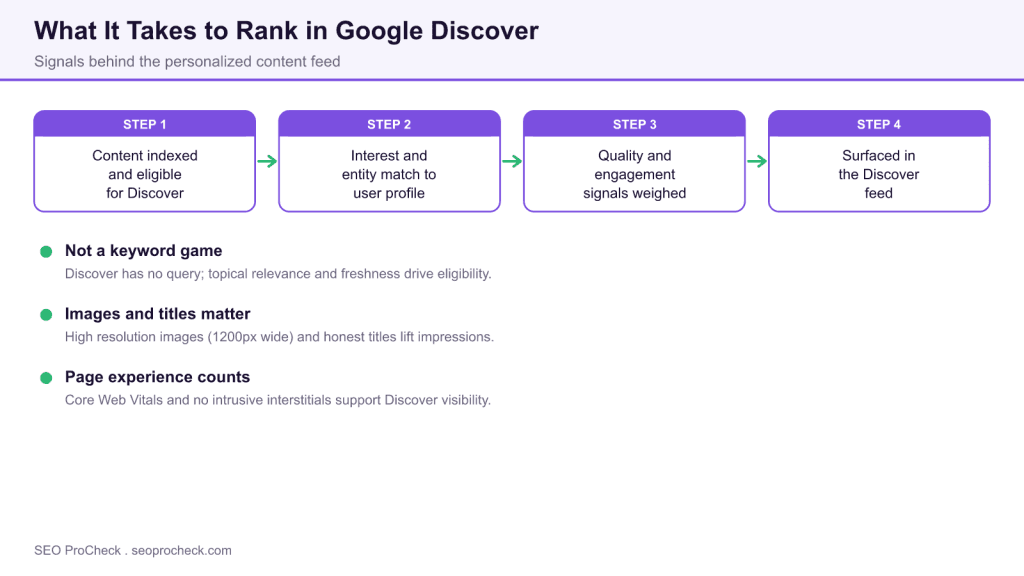
Ranking in Google Discover is not about keywords, because Discover has no search query; it is a personalized feed that surfaces indexed content matching a user interests, freshness and quality signals. To earn visibility, publish genuinely helpful content on topics you have authority in, use high resolution images, honest titles and strong page experience.
- Discover has no query: eligibility comes from topical relevance, freshness and interest matching.
- Large, high resolution images (at least 1200px wide with max-image-preview:large) drive impressions.
- E-E-A-T, honest non clickbait titles and page experience influence whether you are surfaced.
- Content must be indexed and eligible first; Discover draws from the same index as Search.
Discover is a feed, not a search results page
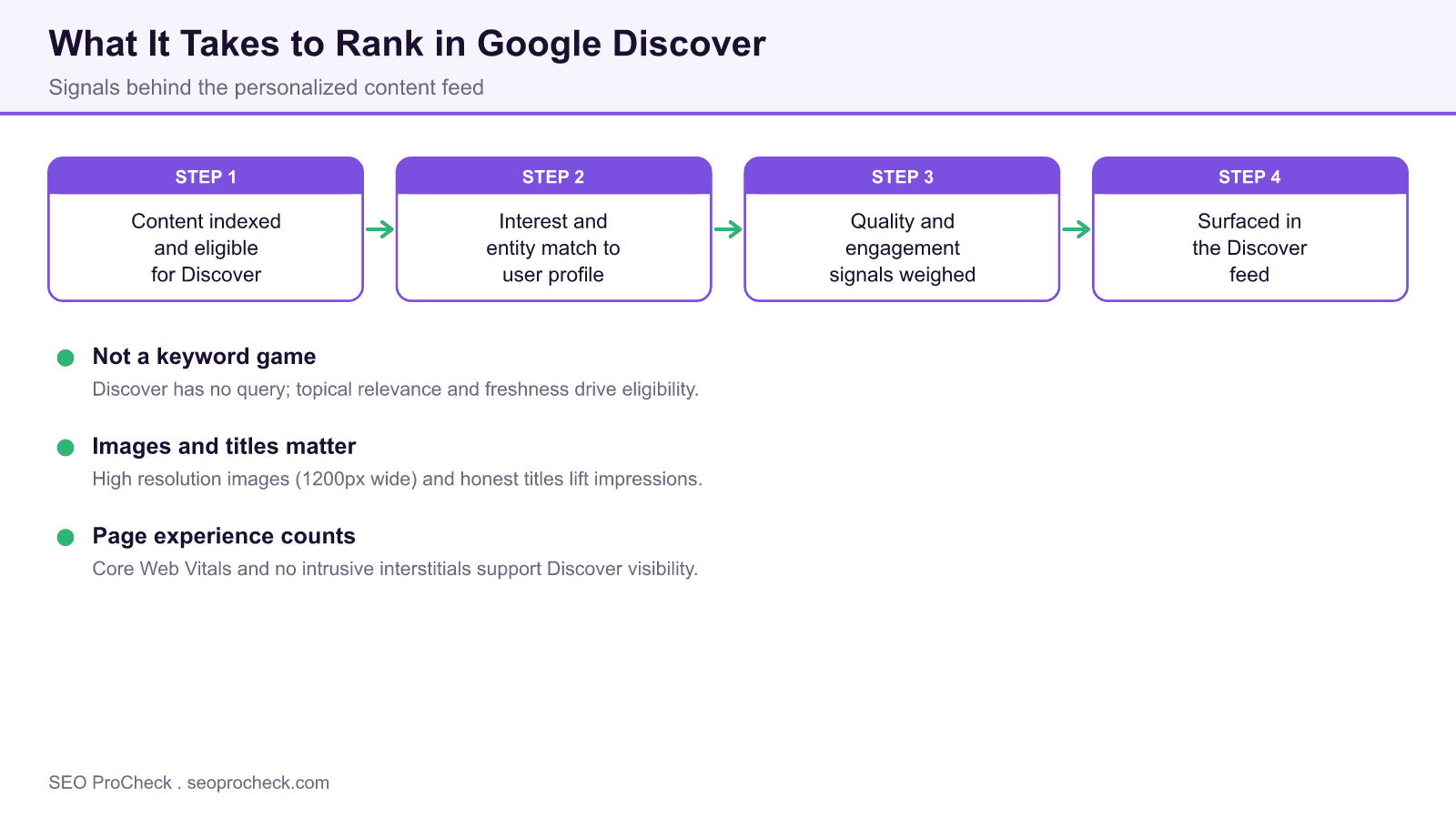
Google Discover shows content to signed in users based on what Google infers they care about, before they type anything. There is no query to optimize for, which flips the usual SEO model. Instead of matching a keyword, you are matching an interest graph. Google decides your content is relevant to a person because of the entities and topics it covers, its freshness, its quality and the person history of engaging with similar material.
Because there is no query, you cannot target Discover with keyword tactics. What you can do is build deep, current topical authority so that Google confidently associates your site with the subjects your audience follows. Content still has to be indexed and eligible, since Discover draws from the same index as Search.
The signals that actually move Discover
Google has been unusually direct that Discover rewards content quality and page experience. The recurring levers are worth stating plainly. First, helpfulness and expertise: content that demonstrates first hand experience and genuine authority is favored, which is the same E-E-A-T foundation that helps in Search. Second, imagery: Discover is visual, and large high resolution images at least 1200 pixels wide, enabled with the max-image-preview:large robots directive, materially affect whether your card is compelling. Third, titles: Discover penalizes clickbait and misleading or exaggerated headlines, so titles must be accurate. Fourth, page experience: fast pages that pass Core Web Vitals and avoid intrusive interstitials perform better.
Freshness, topical authority and following
Discover skews toward timely content, so news, trends and recently updated evergreen pieces have an advantage. It also rewards sites that publish consistently within a topic, because that builds the entity associations Google uses to match content to interests. Encouraging people to follow your site or topics in Chrome strengthens the signal that your content is worth surfacing to them again.
None of this means chasing virality. Sustainable Discover performance comes from being a reliable, high quality source in a defined space, then packaging each piece with a strong image and an honest title. For a tactical checklist, see our guide to Google Discover optimization tactics and the data in our study of what content gets surfaced.
Measuring Discover
Search Console has a dedicated Discover report that appears once your site receives Discover traffic. Watch impressions, click through rate and which URLs surface, and correlate spikes with the images, topics and formats that worked. Because Discover traffic is volatile by nature, judge performance over rolling periods rather than single days, and keep Core Web Vitals healthy so eligible content is not held back by slow pages.
| Factor | Why it matters for Discover | What to do |
|---|---|---|
| Images | Discover is a visual feed; large images drive clicks | Use images at least 1200px wide with max-image-preview:large |
| Titles | Clickbait and misleading titles suppress reach | Write accurate, specific titles that match the content |
| E-E-A-T | Quality and authority gate what is surfaced | Show first hand experience, credentials and citations |
| Page experience | Slow or interstitial heavy pages lose eligibility | Pass Core Web Vitals and avoid intrusive interstitials |
| Freshness | Discover favors timely, current content | Publish and update consistently within your topics |
Frequently asked questions
How do I rank in Google Discover?
There is no query to rank for. Publish helpful, authoritative content on topics you cover consistently, use large high resolution images and honest titles, keep page experience strong, and make sure the content is indexed and eligible.
Do keywords matter for Google Discover?
Not in the traditional sense. Discover has no search query, so it matches content to user interests using topics, entities, freshness and quality signals rather than a keyword you target.
What image size is best for Discover?
Use high resolution images at least 1200 pixels wide and enable them with the max-image-preview:large robots directive. Large, compelling images strongly influence Discover click through rate.
Why did my Discover traffic drop suddenly?
Discover traffic is inherently volatile because it depends on shifting user interests and timeliness. Sudden swings are normal; judge performance over rolling periods and check for quality, image or page experience regressions.
Where can I see Discover performance?
Google Search Console shows a dedicated Discover report once your site earns Discover traffic. It reports impressions, clicks, click through rate and the URLs that surfaced.
Source: https://www.amsive.com/insights/seo/what-does-it-take-to-rank-in-google-discover
Take this with you
The assistant links open with a question about this page already written. Nothing is sent until you press enter.
Claude Vincent is a technical SEO consultant focused on crawlability, rendering, and AI-search visibility. He writes the field guides and case studies at SEO ProCheck, with a bias toward the durable, unglamorous work that decides whether search engines and AI answer engines can actually read and cite a site.
About SEO ProCheck
Technical SEO consulting and GEO strategy with 20 years of enterprise experience. Case studies, resources, and tools for search and AI visibility.
Work With Me
Technical SEO audits, GEO strategy, site migrations, and international SEO. Hourly consulting for teams who need hands-on support, not just reports.
Subscribe to our newsletter!








Recent Posts
- Most Top Sites Never Say Who They Are in Structured Data October 14, 2026
- Homepage Titles Are Mostly Too Short, Not Too Long October 8, 2026
- Who Actually Serves an llms.txt? 184 Top Sites Measured September 29, 2026