

AI Summary
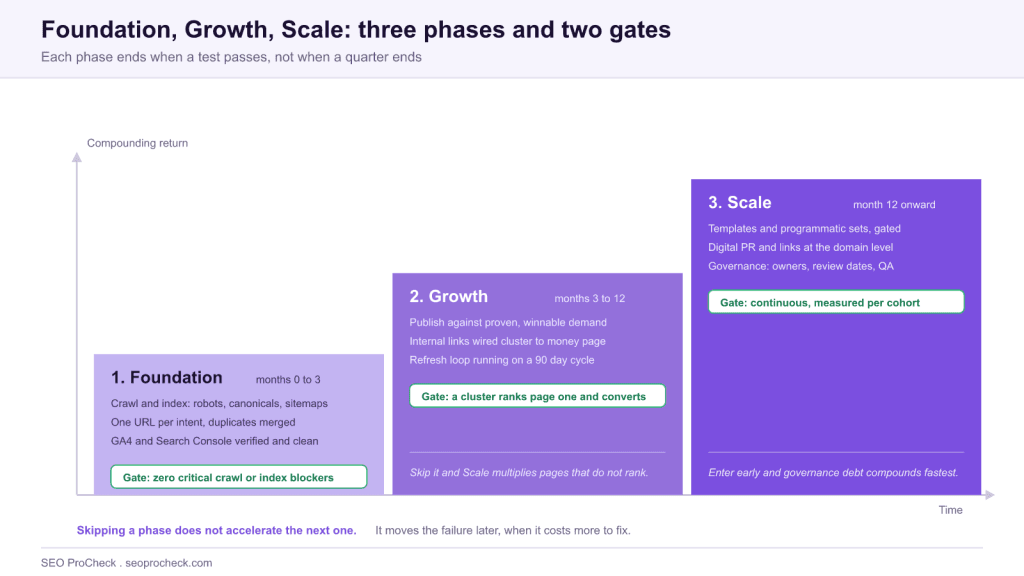
The framework splits an SEO program into three phases, Foundation, Growth and Scale, each with its own workstreams and an exit gate. Its value is not the labels, it is that a gate stops a team from scaling work that has not been proven to rank yet.
- Foundation makes measurement trustworthy. It produces almost no traffic and it is the phase most often skipped.
- Growth proves a repeatable pattern on a small number of URLs before any commitment to volume.
- Scale multiplies a proven pattern. Multiplying an unproven one is the most expensive failure in the model.
- Phases end on an exit gate, never on a calendar date. A quarter ending is not evidence that the work is done.

Case study overview
This case study documents a successful organic growth strategy, demonstrating how strategic SEO implementation drives measurable business results. The approach provides actionable insights for practitioners facing similar challenges.
Challenge and Context
Every successful SEO initiative begins with understanding the starting position and objectives. This case study reveals the initial challenges, competitive landscape, and business goals that shaped the strategy. Understanding context helps practitioners assess applicability to their own situations.
Strategic Approach
The methodology employed combined technical optimization, content strategy, and authority building in a coordinated approach. Key decisions around prioritization, resource allocation, and tactical execution provide a template for similar initiatives. The strategy balanced quick wins with sustainable long-term growth.
Implementation Details
Moving from strategy to execution required specific technical implementations, content creation processes, and measurement frameworks. This case study documents the practical steps taken, tools used, and workflows developed. These implementation details help practitioners translate strategy into action.
Results and Analysis
The outcomes demonstrate the effectiveness of the approach through measurable metrics: traffic growth, ranking improvements, and business impact. Analysis of what worked best and what could have been done differently provides learning value beyond the raw results.
This case study contributes to the evidence base for effective SEO strategy, helping practitioners learn from documented successes.
Why phased frameworks beat prioritised task lists
Most SEO plans are a ranked list of tasks. Lists degrade quickly, because everything on them looks equally available, and teams naturally pull the visible work forward. Publishing feels productive. Fixing canonical tags does not. So the list gets worked out of order and the dependencies get violated without anybody deciding to violate them.
A phased model with gates prevents that, not by being smarter about priority but by making the dependency explicit. You cannot honestly claim to be in the scale phase while your foundation gate is still open. The framework converts a judgement call into a checkable condition, which is what makes it survive contact with a deadline.
The three phases in this model map to three genuinely different questions, and it is worth being precise about them, because teams often run phase two work while believing they are in phase three.
The three phases, their gates and their duration
| Phase | Core question it answers | Primary workstreams | Exit gate | Typical duration |
|---|---|---|---|---|
| Foundation | Can search engines crawl, render and index the site, and can I trust my own data? | Crawl and index hygiene, canonicalisation, duplicate consolidation, sitemap accuracy, analytics verification | Zero critical crawl or index blockers, and 20 sample URLs verified indexed and self canonical | 1 to 3 months |
| Growth | Can this site rank for demand it does not already own, repeatably? | Winnable keyword selection, page templates, internal linking, refresh loop, on page work | One cluster ranks page one for its core terms and produces conversions | 6 to 12 months |
| Scale | Can the proven pattern be multiplied without diluting quality? | Programmatic and templated sets, digital PR and links, governance, content operations | Continuous, measured per cohort rather than as a single gate | Ongoing |
Note that the durations are the least important column. They are useful for setting expectations with stakeholders and useless as commitments. The gate is the decision rule. A site inheriting a decade of technical debt can legitimately spend two quarters in foundation, and a team that rushes that will spend four quarters undoing it.
Phase one: what foundation work actually is
Foundation is the phase most often declared complete without being done, because its output is the absence of problems rather than the presence of results. A concrete checklist keeps it honest:
- Indexability. No accidental noindex on templates, no robots.txt block over pages carrying a noindex directive, and no canonical tags pointing at the wrong URL.
- One URL per intent. Parameter variants, trailing slash duplicates, HTTP and HTTPS pairs and index.html twins all consolidated with self referencing canonicals and 301s.
- Sitemaps that reflect reality. Only canonical, indexable, live URLs. A sitemap listing redirects or noindexed pages tells the crawler your data is unreliable.
- Crawl reachability. Every important URL within three clicks of the home page and linked from somewhere other than a sitemap.
- Verified measurement. Search Console verified on the correct property type, GA4 receiving organic sessions, and the two reconciled well enough that you know why they differ.
The report that tells you whether this phase is genuinely finished is the Search Console page indexing view. How to read each exclusion bucket is covered in the Search Console page indexing report.
Phase two: proving a pattern before scaling it
The purpose of the growth phase is not traffic. It is evidence. You are trying to establish that a specific combination of topic selection, page template and internal linking produces rankings on this domain, in this market, at this authority level. Ten URLs is usually enough to know.
Run it deliberately. Pick one cluster with clear commercial relevance. Build a hub page and six to ten supporting pages. Wire them together properly, hub linking down and supporting pages linking back up and across. Then wait a full crawl and ranking cycle before judging, which in practice means 90 days minimum.
The outcome tells you what to do next:
- The cluster ranks and converts. The pattern works. Now scale it to adjacent clusters, and only now consider templating.
- The cluster ranks but does not convert. The pattern works, the topic selection does not. Fix the intent targeting before scaling, or you will scale traffic that never becomes revenue.
- The cluster does not rank at all. Do not scale anything. Diagnose whether it is authority, intent mismatch or quality, because scaling now multiplies the defect across every future URL.
The refresh loop that keeps phase two output alive is the other half of this phase, and it is covered in the content audit process. The linking structure that makes clusters behave like clusters is in the internal linking complete guide.
Phase three: scale is a governance problem
By the time a program reaches scale, the constraint is no longer knowing what to do. It is keeping thousands of URLs consistent while multiple people work on them. That is governance, and it is unglamorous enough that most teams postpone it until something breaks.
Three mechanisms carry most of the weight. First, an owner per content area, so no URL is unassigned. Second, a review date on every page, so decay is caught on a schedule instead of by accident. Third, a publish gate for any templated or programmatic set, so volume cannot be released without meeting a uniqueness and internal linking standard.
Where scale involves generated pages, the failure mode is well documented and entirely avoidable: see programmatic SEO done right. For how the roadmap is usually communicated to stakeholders at this stage, see the SEO roadmap definition.
What skipping a phase actually costs
Skipping is rarely a decision. It happens because the next phase is more interesting and nobody is enforcing the gate. The costs are predictable enough to name in advance.
| Phase skipped | What it looks like at the time | What it costs later | Where it shows up first |
|---|---|---|---|
| Foundation | Traffic goes up, so the technical debt feels theoretical | Every decision is made on unreliable data. Duplicates split signals across URLs and nobody can tell which page is the real one | Search Console page indexing report, with large excluded buckets and canonical mismatches |
| Growth | The team feels fast because volume is high | Hundreds of URLs built on a template that was never proven to rank, all needing rework at once | Clicks per indexed URL falling while the library grows |
| Scale governance | Everything is shipping and nobody is arguing about process | No owners, no review dates, so decay accumulates invisibly across thousands of URLs | Orphaned pages and a rising share of URLs with zero impressions |
The pattern in that table is worth sitting with: in every row, the skipped phase feels free at the time and expensive later. That asymmetry is exactly why the gate has to be a written condition rather than a shared understanding, because a shared understanding never survives a quarter where the traffic number is behind.
Using the framework without turning it into ceremony
A framework earns its place if it changes a decision. If it only produces a slide, it is overhead. Two lightweight practices keep it useful.
First, write the current phase and its open gate somewhere visible, in one sentence. For example: we are in growth, the gate is that the reporting cluster ranks page one and produces trials, and it is not yet met. That sentence prevents most of the drift.
Second, when someone proposes work, ask which phase it belongs to. Work from a later phase is not forbidden, but it should be a conscious exception with a stated reason, not the default. Most programs that stall did not choose to skip a phase. They just kept doing the more interesting work until the foundation quietly stopped supporting it.
FAQ
Anything that makes measurement and indexing trustworthy: a crawlable and indexable site, one canonical URL per intent, no duplicate or parameter sprawl, working XML sitemaps, and verified analytics. Foundation work is unglamorous and produces almost no traffic on its own. Its return is that every later decision is based on data you can believe.
When a full crawl produces no critical issues and the Search Console page indexing report shows your important templates indexed at a healthy rate. A useful practical test: pick 20 URLs you care about, inspect them, and confirm each is indexed, canonicalised to itself and reachable within three clicks. If that fails, foundation work is not done regardless of how long it has taken.
Partly, and most teams have to. The rule that keeps it safe is that you do not scale publishing while indexation is broken, because you will multiply the problem across hundreds of URLs. Publishing a handful of pages while fixing technical debt is fine. Committing to a cadence is not.
Growth is about proving a repeatable pattern on a manageable number of URLs. Scale is about multiplying that proven pattern with templates, programmatic sets and link acquisition. The distinction matters because scaling an unproven pattern produces volume without rankings, which is the most expensive mistake in the framework.
Foundation is typically one to three months, growth six to twelve, and scale is continuous. Treat those as expectations rather than schedule commitments, because the real trigger is the exit gate. A site with heavy technical debt can spend six months in foundation and be right to do so.
The failure does not appear immediately, which is what makes it dangerous. Skipping foundation means every later measurement is unreliable and you optimise against noise. Skipping growth means you scale a template that was never proven to rank. In both cases the cost surfaces a year later, when there is far more to unwind.
Not sure which phase your program is actually in?
An audit tests the foundation gate directly: indexability, duplication, measurement integrity, then tells you what has to close before scaling.
Source: https://seo.thefxck.com/foundation-growth-scale/
Take this with you
The assistant links open with a question about this page already written. Nothing is sent until you press enter.
Claude Vincent is a technical SEO consultant focused on crawlability, rendering, and AI-search visibility. He writes the field guides and case studies at SEO ProCheck, with a bias toward the durable, unglamorous work that decides whether search engines and AI answer engines can actually read and cite a site.
About SEO ProCheck
Technical SEO consulting and GEO strategy with 20 years of enterprise experience. Case studies, resources, and tools for search and AI visibility.
Work With Me
Technical SEO audits, GEO strategy, site migrations, and international SEO. Hourly consulting for teams who need hands-on support, not just reports.
Subscribe to our newsletter!








Recent Posts
- Most Top Sites Never Say Who They Are in Structured Data October 14, 2026
- Homepage Titles Are Mostly Too Short, Not Too Long October 8, 2026
- Who Actually Serves an llms.txt? 184 Top Sites Measured September 29, 2026