

AI Summary
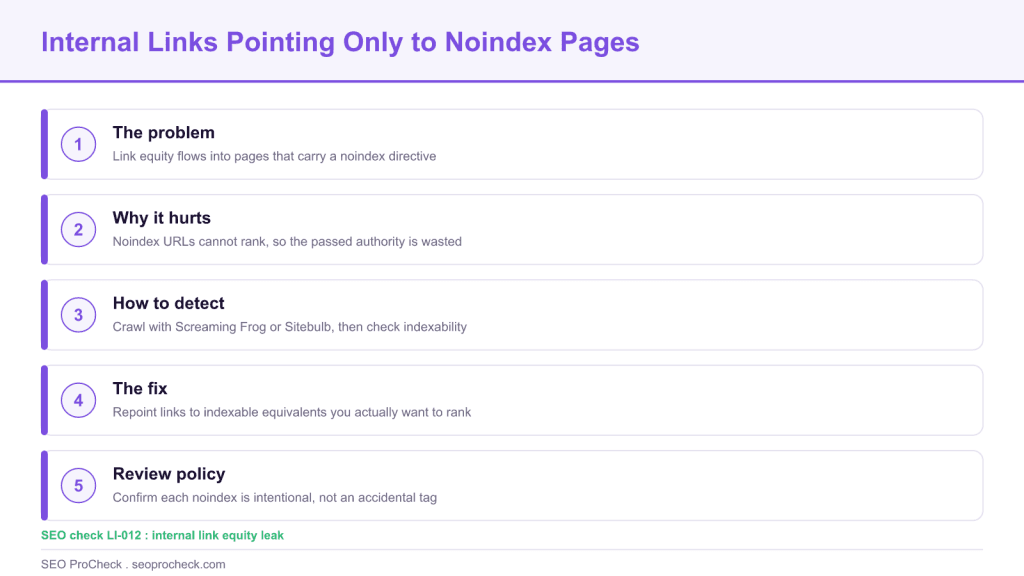
When your internal links point mainly at noindex pages, the authority those links carry flows into URLs that can never rank, so it is wasted. Fix it by crawling the site, finding links whose targets are noindex, and repointing them to the indexable pages you actually want to rank.
- Element code LI-012 flags internal links that mostly target noindex pages.
- Noindex URLs are removed from search, so any link equity you send them is lost.
- Detect it by cross referencing internal links with indexability in Screaming Frog or Sitebulb.
- Repoint the links to indexable equivalents, or confirm the noindex tag is truly intended.

Internal links do two jobs at once. They help users move through your site, and they distribute authority, often called link equity, between your pages. Search engines follow those links, pass a share of ranking value along each one, and use the pattern to understand which pages matter most. That second job is where this check earns its place: if the pages you link to cannot appear in search, the value you send them has nowhere to go.
A page carries a noindex directive when it returns a robots meta tag or an X-Robots-Tag header telling engines to keep it out of the index. Common examples are internal search results, filtered listing views, thank you pages, and staging templates. There is nothing wrong with those pages existing, the problem is aiming your strongest internal links at them.
Quick Reference
Element Code: LI-012
Issue: Internal links point only to non-indexable pages
Impact: Link equity flows to pages that cannot rank
Fix: Review linking strategy; link to indexable pages
Detection: Screaming Frog, Sitebulb
What Is This Issue?
When internal links predominantly go to noindex pages, you are directing link equity away from pages that can rank. This is inefficient use of your internal link value.
Why This Matters for Your Website
Internal link equity should flow to pages you want to rank. Linking to noindex pages does not help your SEO goals.
How to Fix This Issue
- Audit link targets: Check indexability of linked pages
- Redirect links: Point to indexable alternatives
- Review strategy: Should those pages be noindex?
Tools for Detection
- Screaming Frog: Cross-references links with indexability
TL;DR (The Simple Version)
Your internal links are going to pages that cannot be indexed. Link to indexable pages instead so your link equity helps pages that can actually rank.
Why this quietly drains rankings
Think of internal link equity as a budget. Every important page has a finite amount to pass along, split across its outgoing links. Send four of ten links to noindex URLs and you have handed roughly forty percent of that page budget to destinations that can never convert it into rankings. The indexable pages that actually need the support get a smaller share. Over a large site this adds up to real lost visibility, and it often hides behind navigation and template links that nobody reviews.
This is the mirror image of a missing internal links problem: there the important page gets too few links, here the links exist but point at the wrong targets. Both waste the same resource.
How to detect the leak step by step
- Crawl the full site with Screaming Frog or Sitebulb so every internal link and its target is captured.
- Segment by indexability. In Screaming Frog open the Directives tab and filter for pages marked Noindex, or use the Indexability column set to Non-Indexable.
- Pull inlinks for those URLs. Select the noindex pages, then read the Inlinks panel to see which pages link to them and with what anchor text.
- Judge intent per link. A single utility link to a noindex privacy page is fine. A body link or a repeated template link to a noindex category is the pattern to fix.
- Export and prioritize by the authority of the linking page, since links from your strongest pages leak the most.
For context on how these directives work, the noindex definition covers the tag and header syntax in detail.
Noindex link patterns and the right response
| Link pattern | Is it a problem | Recommended action |
|---|---|---|
| Body links to noindex category pages | Yes, high impact | Repoint to an indexable hub or landing page |
| Nav links to noindex filtered views | Yes, repeated site wide | Link the canonical listing instead of the filter |
| Footer link to privacy or thank you page | No, expected utility link | Leave as is |
| Links to a page you forgot was noindex | Maybe a tagging error | Decide if the page should be indexable, then fix the tag |
What has changed since this check was written
The mechanics of noindex have not changed, but two things around them have. First, sites now generate far more faceted and parameter URLs than they used to, so the volume of noindex targets is higher and this leak is easier to create by accident. Second, uncontrolled noindex sprawl often shows up alongside index bloat, so it pays to review indexability policy and internal linking together. For the broader discipline, the internal linking guide covers how to route equity to the pages that earn revenue.
Frequently Asked Questions
What does it mean when internal links point only to noindex pages
It means the pages you link to internally carry a noindex directive, so search engines will not include them in results. Any ranking value those links pass has no page that can use it. The check flags this so you can redirect the links to pages that are allowed to rank.
Do noindex pages pass link equity
A noindex page can still pass some equity through its own outgoing links for as long as it is crawled, but the page itself cannot rank, so equity that stops there is effectively lost. Google may also crawl noindex pages less over time, weakening any onward flow. The safe assumption is that links into noindex URLs are wasted.
How do I find internal links to noindex pages
Crawl the site with Screaming Frog or Sitebulb, filter for non indexable or noindex URLs, then open the inlinks report for those pages. That shows every internal link pointing at them and the anchor text used. Export the list and prioritize links coming from your strongest pages.
Should I remove every link to a noindex page
No. Utility links to pages like privacy, terms, or thank you pages are normal and expected. The goal is to stop sending your important body and navigation links to noindex pages that could instead point at indexable, revenue relevant destinations.
Could this be caused by an accidental noindex tag
Yes, and that is worth checking first. Sometimes a page you want indexed was tagged noindex by a template or plugin. If the target should rank, fix the directive rather than the links, and the leak resolves itself.
How much does this really affect rankings
On a small site the effect is minor, but on a large site with many templated links it can divert a meaningful share of internal authority away from pages that need it. The impact scales with how many strong pages link into noindex targets. Auditing periodically keeps the leak from growing.
Take this with you
The assistant links open with a question about this page already written. Nothing is sent until you press enter.
Claude Vincent is a technical SEO consultant focused on crawlability, rendering, and AI-search visibility. He writes the field guides and case studies at SEO ProCheck, with a bias toward the durable, unglamorous work that decides whether search engines and AI answer engines can actually read and cite a site.
About SEO ProCheck
Technical SEO consulting and GEO strategy with 20 years of enterprise experience. Case studies, resources, and tools for search and AI visibility.
Work With Me
Technical SEO audits, GEO strategy, site migrations, and international SEO. Hourly consulting for teams who need hands-on support, not just reports.
Subscribe to our newsletter!
Recent Posts
- Most Top Sites Never Say Who They Are in Structured Data October 14, 2026
- Homepage Titles Are Mostly Too Short, Not Too Long October 8, 2026
- Who Actually Serves an llms.txt? 184 Top Sites Measured September 29, 2026