

How To Scale From 0 to 200,000 Visits w/ Gaetano DiNardi - Siege Media
- November 1, 2022
- Growth
AI Summary
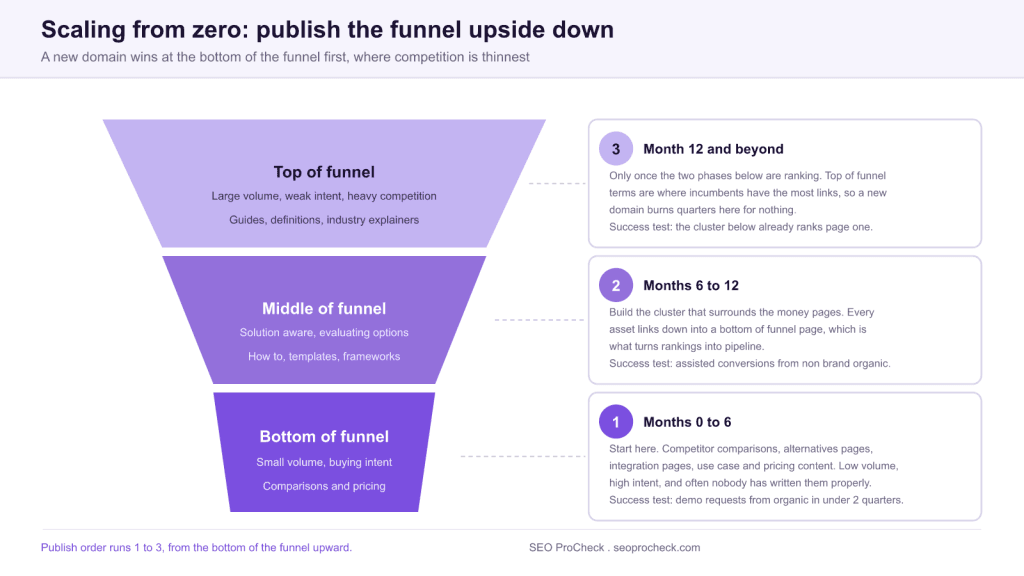
A domain with no authority should publish the funnel upside down: bottom of funnel comparison and pricing pages first, broad guides last. The order matters more than the volume, because early wins have to come from queries where incumbents are not defending.
- Months 0 to 6 belong to bottom of funnel pages: comparisons, alternatives, integrations, pricing, use cases.
- Move phases on an exit test, not a date. Phase one ends when organic produces demo or trial requests.
- Impressions are the first signal of life. No impressions by month four means an indexation or internal linking problem, not slow progress.
- Prove the template on 10 URLs before committing to a publishing cadence. Volume before validation is the standard failure.
Case study overview
This case study documents a successful organic growth strategy, demonstrating how strategic SEO implementation drives measurable business results. The approach provides actionable insights for practitioners facing similar challenges.
Challenge and Context
Every successful SEO initiative begins with understanding the starting position and objectives. This case study reveals the initial challenges, competitive landscape, and business goals that shaped the strategy. Understanding context helps practitioners assess applicability to their own situations.
Strategic Approach
The methodology employed combined technical optimization, content strategy, and authority building in a coordinated approach. Key decisions around prioritization, resource allocation, and tactical execution provide a template for similar initiatives. The strategy balanced quick wins with sustainable long-term growth.
Implementation Details
Moving from strategy to execution required specific technical implementations, content creation processes, and measurement frameworks. This case study documents the practical steps taken, tools used, and workflows developed. These implementation details help practitioners translate strategy into action.
Results and Analysis
The outcomes demonstrate the effectiveness of the approach through measurable metrics: traffic growth, ranking improvements, and business impact. Analysis of what worked best and what could have been done differently provides learning value beyond the raw results.
This case study contributes to the evidence base for effective SEO strategy, helping practitioners learn from documented successes.
Why the conventional order fails a new domain
The standard advice is to build authority with broad, high volume content and then convert that authority into commercial rankings. That works for a site that already has links. For a domain with no history it is close to the worst possible sequence, because broad terms are exactly where established competitors have accumulated the most links and the most behavioural data. You publish a good guide, it lands on page four, and it stays there.
Publishing the funnel upside down inverts the risk. Bottom of funnel queries have small volumes, which is precisely why nobody defends them properly. A comparison page or an integration page can rank inside a quarter, because the competing results are often a forum thread, a stale listicle, or nothing at all. Those pages also convert, which means the SEO program produces evidence of value long before it produces traffic charts.
The wider strategic frame for this in software is in B2B SaaS content SEO, and typical traffic patterns for the category are in the SaaS SEO benchmark.
The three phases and their exit tests
Phases should end when a test passes, not when a quarter ends. A date based roadmap moves you into top of funnel work whether or not the foundation exists, which is how programs end up with 200 URLs and no rankings.
| Phase | Window | What you publish | Exit test before moving on | What you are buying |
|---|---|---|---|---|
| 1. Bottom of funnel | Months 0 to 6 | Competitor comparisons, alternatives pages, integration pages, pricing and use case pages | Organic is producing demo or trial requests | Credibility with the business, and the budget for phase 2 |
| 2. Middle of funnel | Months 6 to 12 | How to guides, templates, frameworks and calculators that surround the money pages | The cluster ranks page one for its core terms | Topical depth and internal links pointing down into phase 1 pages |
| 3. Top of funnel | Month 12 and beyond | Broad guides, definitions, industry explainers, original research | Continuous, this phase does not end | Volume, brand reach and links that lift the whole domain |
The exit test for phase one is deliberately commercial rather than a ranking. It is possible to rank a comparison page and still get no demand, usually because the page targets a competitor nobody is leaving. The test forces you to check that the queries you won are queries that matter.
Phase one in detail: the pages to build first
Six page types cover almost every early opportunity for a software company. Each has a query pattern you can search for directly, and each has a characteristic way of being done badly.
| Page type | Query pattern | Why it works early | The mistake to avoid |
|---|---|---|---|
| Competitor comparison | your brand vs competitor | Searcher has already decided to buy. Very few competitors will write this page honestly | Writing a sales page. If you never concede a point, nobody trusts it or links to it |
| Alternatives page | competitor alternatives | Captures dissatisfaction with an incumbent at the moment it peaks | Listing only yourself. A real list of options ranks, a disguised ad does not |
| Integration page | product plus integration name | One page per supported integration, each with genuinely different setup detail | Generating them all from a stub. Empty integration pages are the classic thin page set |
| Use case page | software for role or industry | Matches how buyers self identify, and converts far better than generic feature pages | Rewriting the same page with the job title swapped |
| Pricing and cost | product pricing, how much does X cost | High intent, and most vendors hide pricing so the query stays unanswered | Publishing a page that refuses to give any numbers or ranges |
| Template or tool | topic template, topic calculator | Earns links and email signups, and gives phase 2 something to link from | Building a tool nobody asked for instead of the one your sales calls keep requesting |
Finding the phase one list
You do not need a keyword tool to build the first list, and using one too early tends to hide these queries because the volumes are small enough to be rounded away. Three faster sources:
- Sales call recordings. Which competitors come up, what objections repeat, and which integrations get asked about. Every recurring question is a page.
- Support tickets. The setup problems people hit are the integration and use case pages that will rank, because they are written from the specifics.
- Autocomplete and related searches on competitor names. Type a competitor name plus vs, plus alternatives, plus pricing and read what the engine offers. That list is your first quarter.
Then check the actual SERP for each before committing. If the top results are all vendor comparison pages from well linked domains, deprioritise it. If the top results are a Reddit thread and two listicles from 2021, that is where to start.
Internal linking is what turns phase two into pipeline
Phase two content exists to do two jobs: rank for the surrounding topic, and pass relevance and link equity down into the phase one pages that convert. If a how to guide does not link to a product or comparison page, it is a traffic asset with no commercial function.
The rule that keeps this honest is simple. Every middle of funnel asset links to at least one bottom of funnel page, contextually, in the body, with descriptive anchor text. Every bottom of funnel page links back up to the two or three most relevant guides. That reciprocal wiring is what makes a cluster behave like a cluster rather than a folder.
The mechanics, including anchor text and link depth, are covered in the internal linking complete guide. For choosing which terms to build the cluster around, see keyword research fundamentals.
What to measure in each phase
| Phase | Leading indicator | Lagging indicator | The number that would make you stop |
|---|---|---|---|
| Phase 1 | Impressions on competitor and comparison queries | Demo or trial requests attributed to organic | Pages indexed but zero impressions after 90 days |
| Phase 2 | Positions moving into the top 20 for cluster terms | Assisted conversions from non brand organic | Cluster ranks but sends no traffic to phase 1 pages |
| Phase 3 | Growth in distinct ranking queries | Non brand organic sessions and links earned | Clicks per indexed URL falling as the library grows |
The last column matters more than the first two. Each phase has a specific way of failing, and naming it in advance is what prevents a team from spending a year defending a plan that stopped working in month five.
The realistic timeline
Case studies compress time. A story that describes reaching a large traffic number reads as though the curve was smooth, when in practice the first two quarters usually look like nothing is happening. That flat period is not failure, but it is also not automatically success, and the difference is measurable.
During the flat period, check three things monthly. Are new URLs getting indexed within a few weeks. Are impressions appearing at all, even for tiny query sets. Are the pages being crawled, which you can read in Search Console under Settings then Crawl stats. If all three are healthy, the curve is coming. If URLs are not indexing and crawl requests are flat, waiting longer will not help, and the problem is quality or architecture.
FAQ
Start at the bottom of the funnel with comparison pages, alternatives pages, integration pages and pricing content. These queries have low volume but explicit buying intent, and they are frequently under served because incumbents assume nobody searches them. They also produce pipeline within the first two quarters, which is what buys you the budget to keep going.
Expect very little for the first three to six months regardless of quality, because a new domain has no track record and gets crawled sparingly. The first real signal is impressions appearing for long tail and branded comparison queries. If you have no impressions at all by month four, the problem is indexation or internal linking rather than patience.
For B2B software they are among the highest value pages you can own, because someone searching your competitor's name plus alternatives has already decided to buy something. Write them honestly, including where the competitor is genuinely better, since a page that only flatters you converts worse and earns no links. Keep them factual and update them when either product changes.
Usually not. Broad guides are where established competitors have the most links, so a new domain spends quarters ranking on page four for terms that would not convert anyway. Build them once your bottom and middle of funnel clusters rank, at which point the topical foundation makes them reachable.
Use an exit test rather than a date. Move from phase one when your bottom of funnel pages are producing demo or trial requests from organic. Move from phase two when the surrounding cluster ranks on page one for its core terms. If the test has not passed, the calendar does not matter.
Publishing volume before establishing that anything ranks. Teams commit to a publishing cadence in month one, produce 60 URLs by month six, and only then discover the template does not rank and none of the pages have internal links. Prove the pattern on 10 URLs, then scale it.
Building organic from zero and not sure the sequence is right?
An audit checks whether your early pages can actually rank, whether they are indexed, and which bottom of funnel queries are sitting unclaimed.
Source: https://www.siegemedia.com/conversation/gaetano-dinardi
Take this with you
The assistant links open with a question about this page already written. Nothing is sent until you press enter.
Claude Vincent is a technical SEO consultant focused on crawlability, rendering, and AI-search visibility. He writes the field guides and case studies at SEO ProCheck, with a bias toward the durable, unglamorous work that decides whether search engines and AI answer engines can actually read and cite a site.
About SEO ProCheck
Technical SEO consulting and GEO strategy with 20 years of enterprise experience. Case studies, resources, and tools for search and AI visibility.
Work With Me
Technical SEO audits, GEO strategy, site migrations, and international SEO. Hourly consulting for teams who need hands-on support, not just reports.
Subscribe to our newsletter!








Recent Posts
- Most Top Sites Never Say Who They Are in Structured Data October 14, 2026
- Homepage Titles Are Mostly Too Short, Not Too Long October 8, 2026
- Who Actually Serves an llms.txt? 184 Top Sites Measured September 29, 2026