

AI Summary
This case study covers a startup that scaled organic traffic with programmatic SEO: pages generated at volume from a structured dataset using a shared template. The approach only works when every generated URL carries data a searcher actually wants, when demand is validated at the query pattern level before the build, and when there is a gate that keeps genuinely thin templates out of the index instead of shipping them and hoping.
- Validate the query pattern on a sample of twenty values before generating anything.
- Pilot 50 to 200 URLs, read the Search Console Pages report, then scale.
- Every generated page needs unique data, a distinct title and description, and content that renders without JavaScript.
- Link generated pages from browsable hubs, not from the XML sitemap alone.
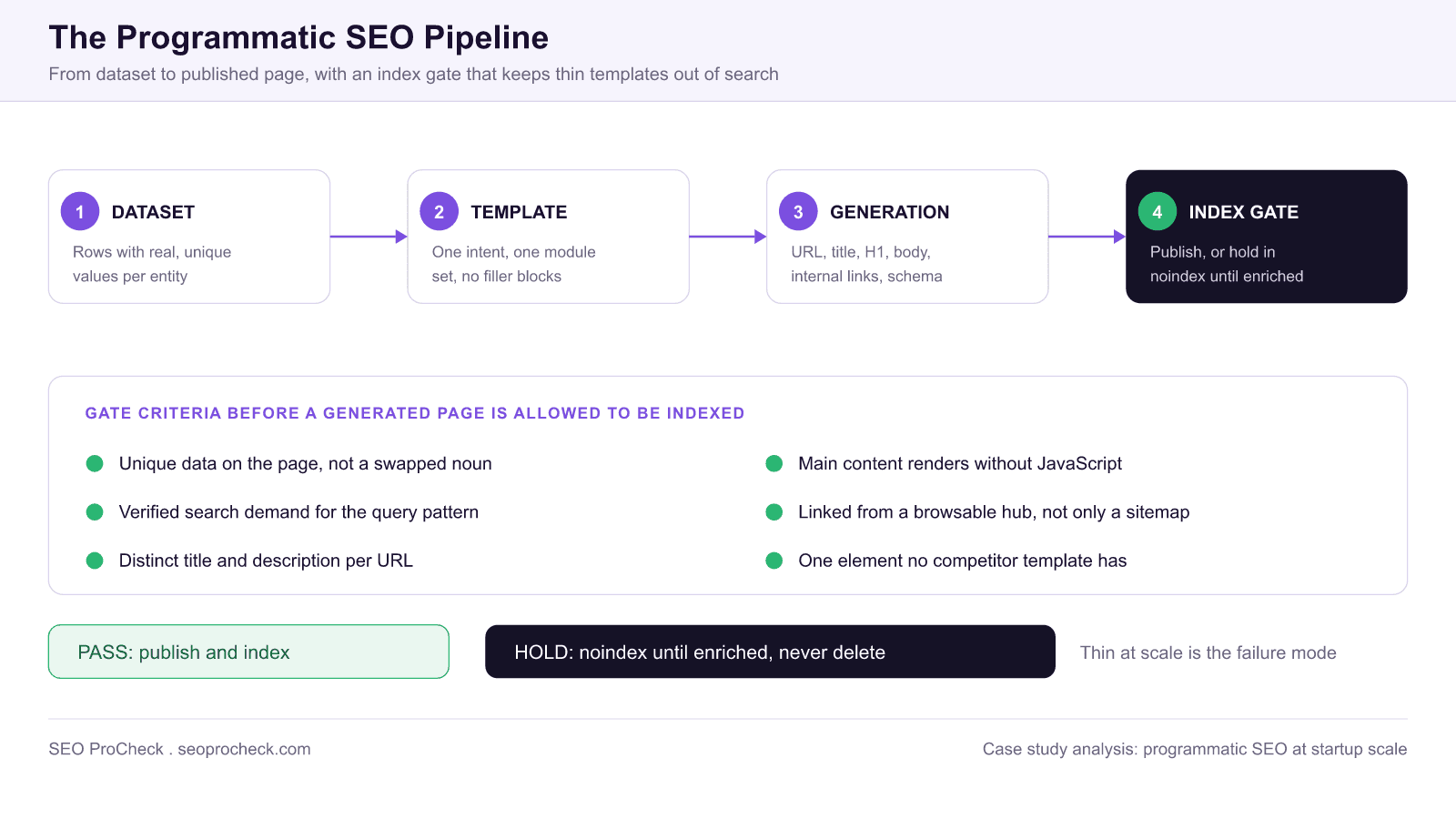
Programmatic SEO is a supply side answer to a demand side question. You are betting that a repeatable query pattern has enough real demand across thousands of values to justify a templated build. The bet pays when the dataset itself is the value, and loses when the template is the value, because a template with one variable swapped is exactly what Google's scaled content abuse policy describes. Validate the pattern first, pilot small, gate on uniqueness before indexing, and give the generated set browsable hub pages so crawl demand reaches it. If pages come back as crawled currently not indexed, the template is too thin, and the fix is enrichment, never deletion.
The case study below is summarised from the original source, credited in full at the end of the summary. After it you will find the operating detail that a summary cannot carry: how to validate a query pattern before you build it, what the template has to contain to survive an index gate, the exact Search Console reports that tell you whether the launch worked, and the failure modes that show up two quarters after a large programmatic launch.
This case study documents a successful organic growth strategy, demonstrating how strategic SEO implementation drives measurable business results. The approach provides actionable insights for practitioners facing similar challenges.
Challenge and Context
Every successful SEO initiative begins with understanding the starting position and objectives. This case study reveals the initial challenges, competitive landscape, and business goals that shaped the strategy. Understanding context helps practitioners assess applicability to their own situations.
Strategic Approach
The methodology employed combined technical optimization, content strategy, and authority building in a coordinated approach. Key decisions around prioritization, resource allocation, and tactical execution provide a template for similar initiatives. The strategy balanced quick wins with sustainable long-term growth.
Implementation Details
Moving from strategy to execution required specific technical implementations, content creation processes, and measurement frameworks. This case study documents the practical steps taken, tools used, and workflows developed. These implementation details help practitioners translate strategy into action.
Results and Analysis
The outcomes demonstrate the effectiveness of the approach through measurable metrics: traffic growth, ranking improvements, and business impact. Analysis of what worked best and what could have been done differently provides learning value beyond the raw results.
This case study contributes to the evidence base for effective SEO strategy, helping practitioners learn from documented successes.
Source: https://buildd.co/marketing/remote-tools-seo-strategy
Practitioner notes: what has to be true before you generate a single page
The interesting decision in programmatic SEO happens before any page is generated. It is a question about the dataset, not about the template: does each row contain something a searcher wants and cannot assemble in ten seconds themselves? Salary data by role and city, hardware compatibility by model, shipping times by route, tool comparisons with tested outputs: all of these carry information per row. A row that only contains a name and a category does not, and no amount of template polish will change that.
Validate demand at the pattern level, not the individual keyword level. Take twenty representative values from your dataset, expand them into the full query pattern, and check them as a set in your keyword tool. Then look at what currently ranks for five of them. If the SERP is already full of pages that answer the query better than your template will, the volume is irrelevant. This step takes an afternoon and it is the single highest leverage hour in the whole project. Background on running that research properly is in semantic SEO and content strategy.
The template: what each generated page must contain
A template that passes an index gate is not more words, it is more distinct information. The table below separates the parts of a generated page that must vary per URL from the parts that can safely be shared across the whole set.
| Page element | Must be unique per URL? | Why | How to check at scale |
|---|---|---|---|
| URL slug | Yes | Two entities cannot share a URL without one being lost | Screaming Frog, Internal then HTML, sort by Address for duplicates |
| Title tag | Yes | Duplicate titles are the first signal a set is templated too tightly | Screaming Frog, Page Titles then Duplicate |
| Meta description | Yes | Rewrites happen anyway, but duplicates flag thinness | Screaming Frog, Meta Description then Duplicate |
| H1 | Yes | Confirms the page is about this entity, not the category | Screaming Frog, H1 then Duplicate |
| Primary data block | Yes | This is the reason the page deserves to exist | Custom Extraction on the data container, then check for empty cells |
| Supporting explainer copy | No | Shared context is legitimate and expected | Keep it short so it does not dominate the unique content |
| Internal links module | Partly | Related entities should differ per page, boilerplate nav can repeat | Bulk Export then Links then All Inlinks, check inlink counts are not zero |
| Schema markup | Yes | Values must match the visible data on that URL | Rich Results Test on a random sample of ten URLs |
Pilot before you scale
Generate 50 to 200 URLs first. Submit them, wait for the Search Console Pages report to settle, and read three numbers: how many were indexed, how many landed in Crawled currently not indexed, and how many are pulling impressions. That report is at Search Console then Indexing then Pages, and the excluded reasons are the diagnostic, not the total count.
- Indexed and pulling impressions. The pattern is validated. Scale, and keep the same gate.
- Indexed but no impressions after six weeks. Demand was mis read. The pages are fine, the query pattern is not worth it. Stop here rather than scaling into the same mistake.
- Crawled currently not indexed. The template is too thin, or too close to something you already publish. Enrich the template with more unique data per row and resubmit, rather than publishing more of the same.
- Discovered currently not indexed. A crawl demand problem, not a quality problem yet. The set is not linked well enough. Build the hub pages before touching the template.
Crawl and index management for a large generated set
A programmatic launch changes the shape of your site overnight, and the crawler notices. Three controls matter. First, internal linking: hub pages that group the generated set into browsable collections, linked from somewhere with existing authority. An XML sitemap alone declares existence, not importance. Second, indexing directives on the pages you are not ready to expose: hold them in noindex until the data is complete, then flip them, which is a controlled version of the process described in the meta robots and X-Robots-Tag reference. Third, faceted parameters: if your template exposes filters, decide before launch which parameter combinations are canonical and which are blocked, because retrofitting that decision across 20,000 URLs is a migration.
Watch crawl stats after launch at Search Console then Settings then Crawl stats. A large jump in total crawl requests with a flat average response time is healthy. A jump with rising response time means the generated pages are expensive to serve, and the crawler will throttle itself, which slows discovery of the very pages you just launched.
Measurement that separates the template from the pattern
- Search Console, Performance then Pages, filtered to the generated path. This is your set level view. Track indexed URL count and impressions together: impressions per indexed URL is the number that tells you whether the template earns attention.
- Search Console, Performance then Queries, filtered to the same path. If queries returned are mostly your brand or the category term rather than the entity pattern, the pages are ranking as a category, not as entities, and the template needs more entity specific content.
- Indexing then Pages, excluded reasons. Review monthly. A rising Crawled currently not indexed count on a growing set is the early warning that quality per page is falling as volume rises.
- GA4, Reports then Engagement then Landing page. Add engagement rate. Generated pages with high impressions and near zero engagement are being clicked and abandoned, which is the worst outcome of all.
Failure modes to design out up front
- The noun swap template. The same 400 words with one variable changed. This is the definition of scaled content abuse, and it is also the most common programmatic build.
- Publishing before the data is complete. Empty states like No data available on 30 percent of URLs poison the whole set, because the engine samples.
- Orphaned generated pages. Twenty thousand URLs in a sitemap, zero internal links. They get discovered and then ignored.
- Client side rendering of the unique data. If the one distinctive element on the page needs JavaScript to appear, you have shipped a set of identical pages as far as first pass indexing is concerned.
- Deleting the underperformers. When a subset underperforms, enrich it or hold it in noindex. Bulk deletion throws away link equity and creates a 404 pattern across a large URL set.
- No refresh cycle. Data driven pages decay faster than editorial ones. If the dataset is stale, the page is wrong, and wrong is worse than thin.
Other worked examples of this approach are collected in the growth case study library.
FAQ
Programmatic SEO is the practice of generating a large set of pages from a structured dataset and a shared template, so that one build covers thousands of long tail queries that follow the same pattern. It works when each row of the dataset carries information a searcher genuinely wants, and it fails when the template only swaps a noun into otherwise identical copy.
Generating pages at scale is not the problem. Google's spam policies target scaled content created primarily to manipulate rankings without adding value. A generated page that surfaces real data a user cannot easily assemble themselves is fine. A generated page that is the same paragraph with a different city name in it is the exact thing the policy describes.
Launch a pilot of roughly 50 to 200 URLs, wait until Search Console shows how many were actually indexed and what they rank for, then scale. Publishing 20,000 pages before you know the template earns impressions means you find out about a template flaw at 20,000 times the cost of fixing it.
Crawled currently not indexed on a templated set almost always means the pages are too similar to each other or to pages that already exist. Check the Pages report in Search Console, sample twenty of the excluded URLs, and compare their unique text. If the only difference between two pages is one variable, the engine has decided one of them is enough.
Validate demand at the pattern level before you build. Take twenty representative values from your dataset, check volume for the full query pattern in a keyword tool, then look at what currently ranks. If the results are dominated by pages that already do the job better, the pattern is not worth the build regardless of the volume.
Yes, always. An XML sitemap tells the crawler a URL exists, it does not tell the crawler the URL matters. Build browsable hub pages that link to the generated set in logical groupings, and link those hubs from your main navigation or from an existing strong page, so crawl demand and internal link equity actually reach the new URLs.
Want this analysed against your own site?
Case studies are only useful once you know which constraint is actually holding your site back. An audit tells you that.
Take this with you
The assistant links open with a question about this page already written. Nothing is sent until you press enter.
Claude Vincent is a technical SEO consultant focused on crawlability, rendering, and AI-search visibility. He writes the field guides and case studies at SEO ProCheck, with a bias toward the durable, unglamorous work that decides whether search engines and AI answer engines can actually read and cite a site.
About SEO ProCheck
Technical SEO consulting and GEO strategy with 20 years of enterprise experience. Case studies, resources, and tools for search and AI visibility.
Work With Me
Technical SEO audits, GEO strategy, site migrations, and international SEO. Hourly consulting for teams who need hands-on support, not just reports.
Subscribe to our newsletter!








Recent Posts
- Most Top Sites Never Say Who They Are in Structured Data October 14, 2026
- Homepage Titles Are Mostly Too Short, Not Too Long October 8, 2026
- Who Actually Serves an llms.txt? 184 Top Sites Measured September 29, 2026