AI Summary
International SEO is the practice of serving the right language and country version of a page to the right audience, and getting it right rests on three decisions: your URL structure, your hreflang annotations, and genuine localisation rather than raw translation. For most sites, subdirectories such as example.com/de/ are the pragmatic structure, hreflang tags must be reciprocal and use valid region codes, and content should be adapted to local intent, not just machine translated.
- Pick one structure: ccTLD, subdomain or subdirectory, and subdirectories suit most sites.
- hreflang maps versions to each other and must be reciprocal, self referential, with an x-default.
- Target language and country separately: de-DE and de-AT can need different pages.
- Localise to local search intent and currency, do not just translate the words.
Best Practices for International SEO provides valuable insights for SEO practitioners. This resource examines approaches and considerations that can improve organic search performance.
International SEO fails in predictable ways. A team translates the site into six languages, launches, and then watches the wrong version rank in the wrong country, duplicate content warnings appear, and conversions stay flat because the copy reads like a dictionary rather than a local voice. Almost all of it traces back to three decisions made early: how you structure the URLs, how you annotate the alternates with hreflang, and whether you truly localise or merely translate. Get those right and the rest is maintenance. This guide walks each one and finishes with what has shifted as AI enters multilingual search.
Decision one: URL structure
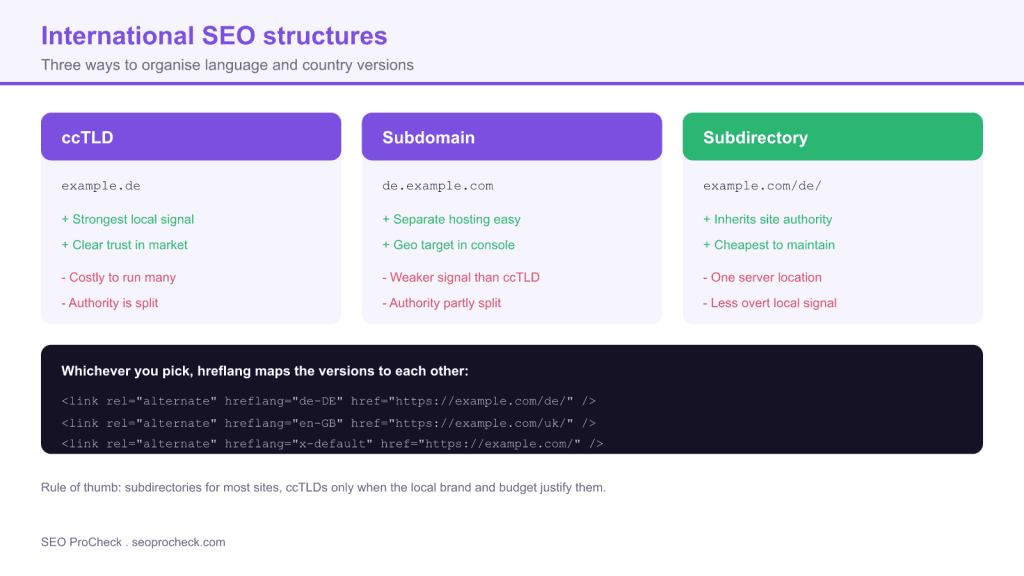
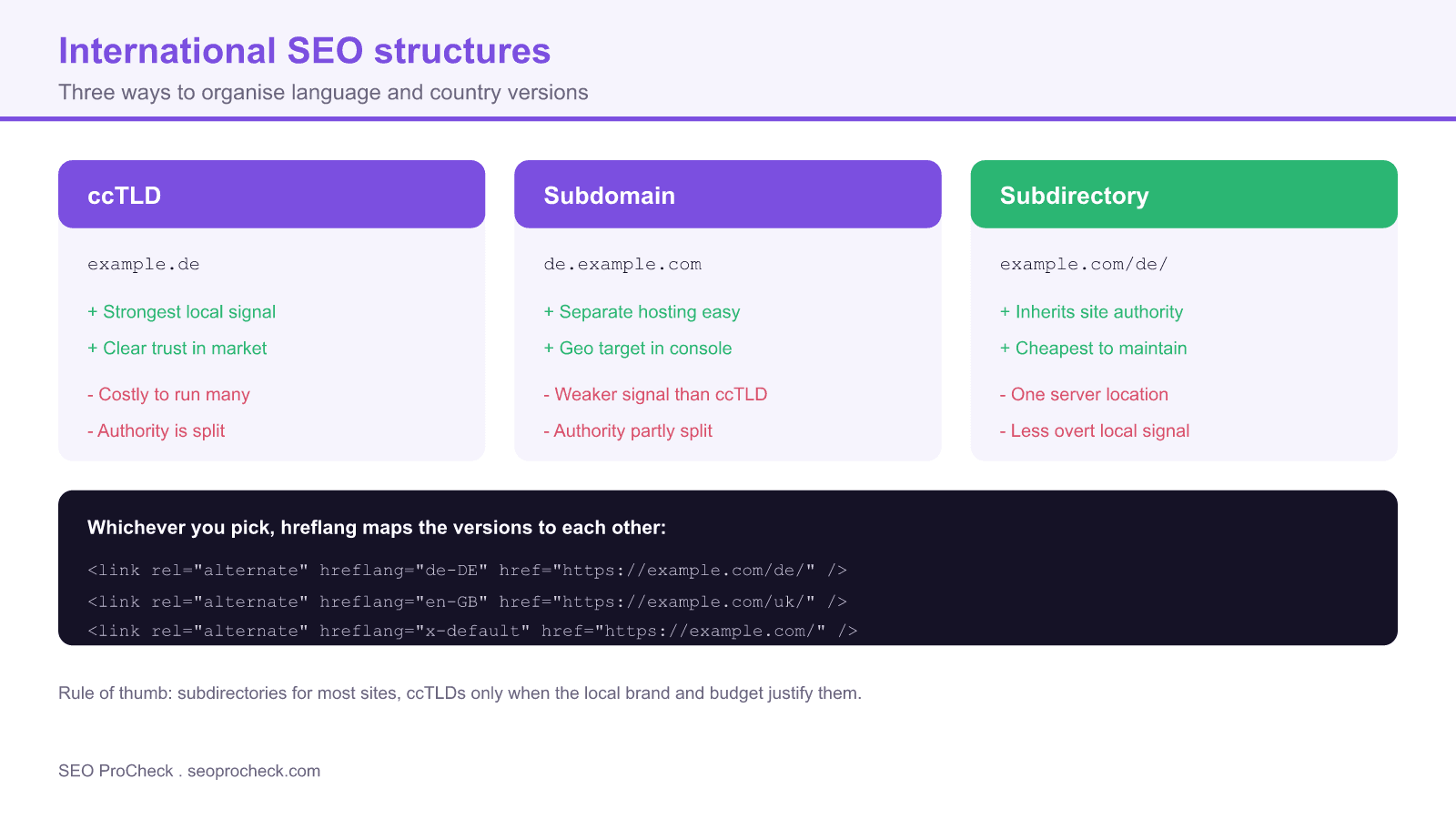
There are three ways to house your international versions, shown in the diagram above, and the choice is a trade off between local signal strength and cost. A country code top level domain like example.de sends the strongest signal that a site belongs to a market, but every ccTLD is a separate property whose authority you build from scratch, which is expensive across many markets. A subdomain such as de.example.com is easy to host separately and can be geo targeted, but sends a weaker signal and still splits authority. A subdirectory like example.com/de/ inherits the authority of the main domain and is the cheapest to run, at the cost of a less overt local signal and, usually, one server location.
| Structure | Example | Local signal | Best when |
|---|---|---|---|
| ccTLD | example.de | Strongest | A few priority markets with local brand and budget |
| Subdomain | de.example.com | Medium | Separate infrastructure or teams per region |
| Subdirectory | example.com/de/ | Inherited | Most sites, especially those expanding into many markets |
The pragmatic default for the majority of sites is the subdirectory, because consolidating authority on one domain is worth more than a marginal local signal, and it keeps operations simple. Reserve ccTLDs for markets where a local domain genuinely changes trust and you can commit the resources to grow each one.
Decision two: hreflang done correctly
hreflang is the annotation that tells Google which language and region each version serves, so it can show the German page to German searchers and the British page to British ones instead of treating them as duplicates. It is also the single most error prone part of international SEO, because the rules are strict and the mistakes are silent.
Four rules prevent almost every hreflang failure:
- Be reciprocal. If page A points to page B as an alternate, page B must point back to A. Missing return links are the most common reason hreflang is ignored.
- Be self referential. Each page must include an hreflang tag pointing to itself as well as to its alternates.
- Use valid codes. The language is an ISO 639-1 code and the optional region is an ISO 3166-1 alpha-2 code. The United Kingdom is
GB, notUK, and getting this wrong voids the tag. - Add an x-default. Provide an
x-defaultversion for searchers who match no specific target, typically a language selector or your primary market.
You can place hreflang in the HTML head, in the HTTP header, or in the XML sitemap. The sitemap approach scales best for large sites because it centralises the mapping in one file rather than bloating every page head.
Decision three: localise, do not just translate
Translation converts words; localisation converts meaning, intent and commercial detail. The same product can be searched with entirely different terms across two markets that nominally share a language, so keyword research has to be redone per market against local search intent, not translated from the source language. Localisation also covers currency, units, date formats, payment methods, local examples and legal wording. A page that ranks and converts locally reads as if it were written in that market, because effectively it was. Machine translation is a reasonable first draft for scale, but shipping it unedited is how you get grammatically correct pages that convert poorly and, increasingly, read as low effort to both users and search engines.
What has changed for international SEO
The structure and hreflang fundamentals have been stable for years, but two shifts are worth folding into a current strategy. First, AI answer engines and Google AI Overviews increasingly answer multilingual queries by synthesising sources, which rewards content that is genuinely authoritative and well localised in each language rather than thinly translated. Depth and local relevance travel; machine translated filler does not. Second, translation quality from large language models has jumped, which makes a good first draft cheaper but raises the bar on editing, because everyone now has access to the same passable baseline. The differentiator is local expertise layered on top. Measure success per market rather than in aggregate, watching organic traffic and conversions country by country, since a healthy global total can hide a market that is quietly serving the wrong version.
Frequently asked questions
For most sites, subdirectories such as example.com/de/ are the pragmatic choice because they inherit the main domain's authority and are cheapest to maintain. Country code domains send the strongest local signal but split authority and cost the most, so reserve them for a few priority markets with a genuine local brand. Subdomains sit in between and suit setups with separate regional infrastructure.
hreflang is an annotation that tells Google which language and country each version of a page targets, so it serves the right one and does not treat your versions as duplicates. If you publish the same content in multiple languages or for multiple countries, you need it. Without it, Google may show the wrong version to a searcher or collapse your alternates together.
The frequent failures are missing return links, where page A references B but B does not reference A, leaving out the self referential tag, and using invalid region codes such as UK instead of GB. Forgetting an x-default fallback is also common. Any of these can cause Google to ignore the annotations entirely, so validate them after every launch.
It is a good first draft but rarely a finished page. Modern translation from large language models is fluent, yet it misses local search intent, terminology, currency, and cultural nuance that drive both rankings and conversions. Use it to accelerate, then have someone with local knowledge adapt the keywords, examples and commercial detail before publishing.
Often yes. German for Germany and German for Austria, or English for the US and the UK, can differ in terminology, currency, pricing and local intent enough to justify separate pages targeted with region specific hreflang such as de-DE and de-AT. If the versions are genuinely identical, a single language targeted page can suffice, but validate that against real local search behaviour.
AI answer engines and Google AI Overviews synthesise answers across languages and reward content that is genuinely authoritative and well localised in each market, not thinly translated. Because good machine translation is now widely available, the differentiator is local expertise and depth layered on top. Strong, market specific content is what gets cited, so measure and optimise per country rather than in aggregate.
Source: https://www.brightedge.com/blog/international-seo-best-practices
Claude Vincent is a technical SEO consultant focused on crawlability, rendering, and AI-search visibility. He writes the field guides and case studies at SEO ProCheck, with a bias toward the durable, unglamorous work that decides whether search engines and AI answer engines can actually read and cite a site.
About SEO ProCheck
Technical SEO consulting and GEO strategy with 20 years of enterprise experience. Case studies, resources, and tools for search and AI visibility.
Work With Me
Technical SEO audits, GEO strategy, site migrations, and international SEO. Hourly consulting for teams who need hands-on support, not just reports.
Subscribe to our newsletter!