

AI Summary
When hreflang tags are not respected, Google has almost always found a reason to drop the pairing rather than a bug on its side. The fix is to make every annotation confirmable: reciprocal return tags, alternates that resolve to a 200 status, valid codes, and no conflict with the canonical tag.
- hreflang is a signal Google confirms or quietly ignores, it never returns a hard error to force your attention.
- The top cause is a missing return tag, which makes the pairing non reciprocal and unconfirmable.
- Alternates that point at redirects, non canonical URLs, or robots blocked URLs are dropped.
- Diagnose with a crawler that checks reciprocity and status codes, then confirm in the URL Inspection tool.
International SEO presents unique challenges for reaching users across languages and regions. This case study documents successful international expansion strategies that established search visibility in target markets. A large share of international projects fail not because hreflang was skipped, but because the tags were present and still ignored. Understanding why Google drops an annotation is the difference between guessing and fixing.
International Context
International SEO requirements vary based on target markets, content localization needs, and technical infrastructure. This case study establishes the international scope and specific challenges addressed. The first thing to internalize is that hreflang is a signal, not a directive. Google reads your alternates, tries to confirm each pairing, and uses the confirmed ones to decide which version to swap in for a given searcher. Anything it cannot confirm is silently discarded. There is no fatal error, no warning banner, and since Google retired the dedicated hreflang report in Search Console, no built in dashboard either. That silence is exactly why so many correct looking setups quietly do nothing.
Technical Implementation
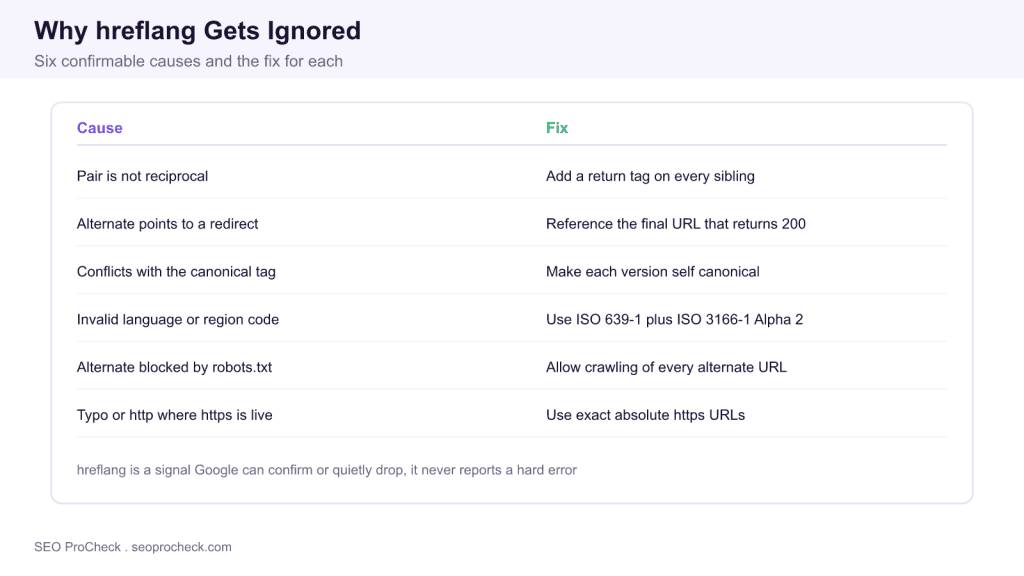
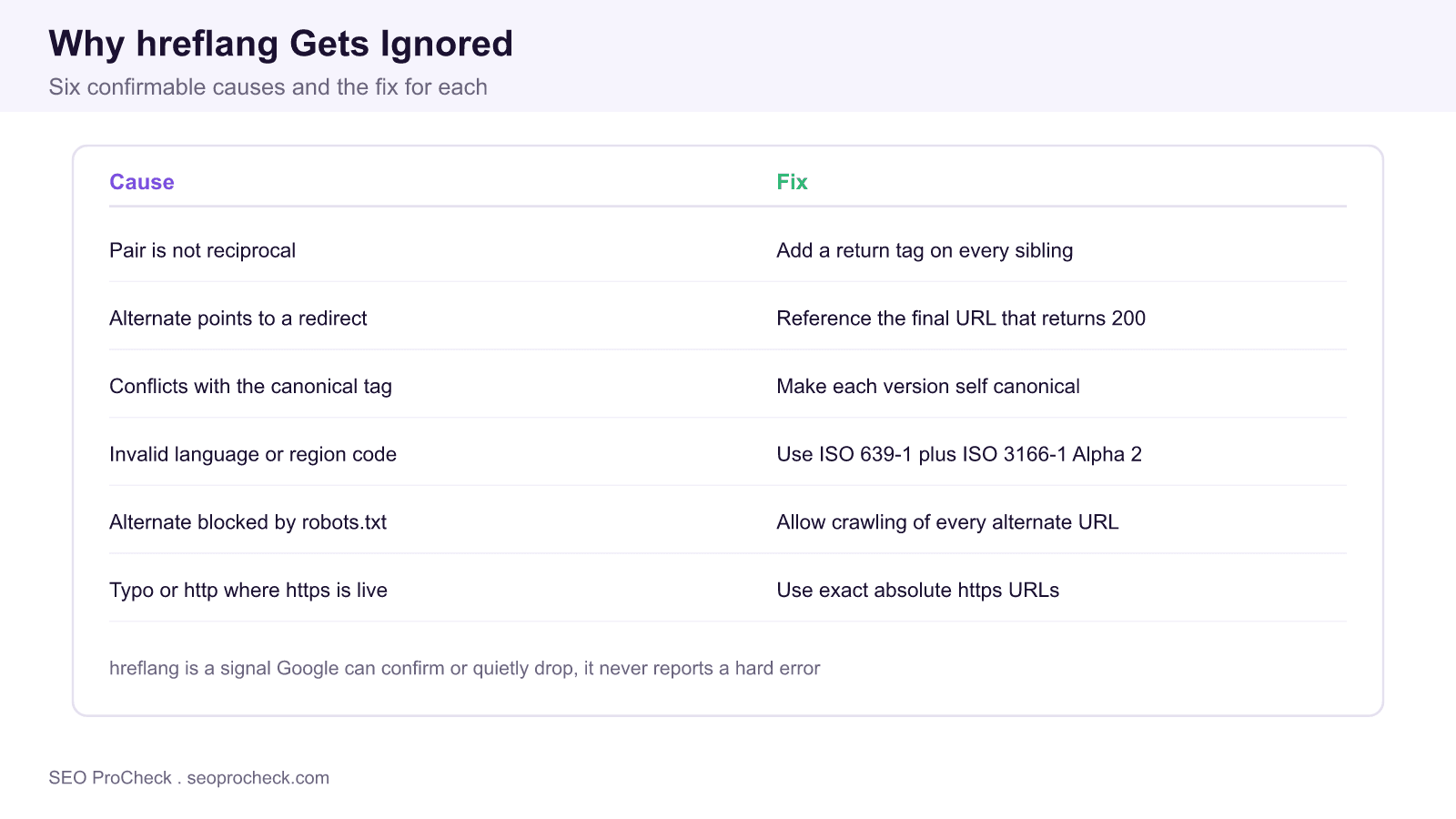
International targeting requires proper technical setup: URL structure decisions, hreflang implementation, and Search Console configuration. This case study documents the technical approach that enabled successful international targeting. The diagram above lists the six causes that account for most ignored hreflang, each with its fix. The single most common is a missing return tag. hreflang only counts a pairing when it is mutual: if the United States page points to the United Kingdom page, the United Kingdom page must point back. Miss one direction and the pair is unconfirmable, so both sides are dropped.
The next tier is about resolution. An alternate that points at a URL which 301 redirects elsewhere, or at a URL excluded by a canonical tag that names a different address, gives Google contradictory instructions, so it trusts the stronger canonical and drops the hreflang. Invalid codes fail too: en-uk is not valid because the country code for the United Kingdom is gb, giving en-gb. Alternates blocked by robots.txt cannot be fetched and confirmed. And a plain typo, or an http URL where the live page is https, quietly breaks the pairing.
How to Diagnose Ignored hreflang
Work the causes in order of likelihood. The table gives a repeatable diagnostic sequence you can run on any site, using tools you already have.
| Diagnostic check | How to test it | Passing condition |
|---|---|---|
| Reciprocity | Crawl the cluster in Screaming Frog or Sitebulb | Every version lists itself and all siblings |
| Status code | Request each alternate URL | Each returns 200 with no redirect hop |
| Canonical agreement | Compare canonical and hreflang targets | Each version is self canonical, no cross pointing |
| Code validity | Validate against ISO 639-1 and ISO 3166-1 | Values like en-gb pass, en-uk fails |
| Robots access | Check robots.txt against each alternate | No alternate sits behind a disallow rule |
| Protocol and host | Inspect the exact href | Absolute https URLs, no http or trailing typo |
Localization Strategy
Beyond technical implementation, international success requires appropriate content localization. This case study covers translation quality, local relevance adaptation, and market-specific content development. Even a perfectly confirmed cluster underdelivers if the versions it points to are thin machine translations. hreflang decides which version is eligible to be shown, the quality of that version decides whether the click converts. Localize currency, spelling, availability, and local proof so the correct version actually earns the visit it now receives.
Market Performance
International SEO success is measured by visibility and traffic in target markets. This case study quantifies performance across markets, demonstrating the effectiveness of the international approach. After fixing the annotations, verify rather than assume. Crawl the site and confirm every alternate is reciprocal and returns a 200 status. Inspect a handful of key URLs in the URL Inspection tool to confirm the alternates were discovered. Then filter the performance report by country and watch for the wrong locale version dropping out of a market, which is the earliest sign the fix took effect.
International SEO case studies help practitioners navigate the complexity of multi-market optimization.
What Has Changed Since This Case Study Was Published
The failure modes above are stable, but the tooling to catch them has moved off Google. With the legacy hreflang report and the international targeting setting removed from Search Console, diagnosis now lives in crawlers such as Screaming Frog and Sitebulb, server log analysis, and direct inspection of the rendered head or sitemap. Google has reaffirmed that hreflang is a hint used to select the version shown, not a ranking factor and not a promise of indexing. The practical implication is unchanged: if hreflang is being ignored, look for the confirmable defect in your own markup before assuming a Google problem.
Related SEO ProCheck resources
- Missing hreflang check: catch pages that ship without any alternates.
- Missing x-default check: confirm your fallback is declared.
- International SEO glossary and case studies: more hreflang troubleshooting context.
Frequently Asked Questions
Why is Google ignoring my hreflang tags?
Because it could not confirm the pairing. hreflang is a signal, so Google drops any annotation that is not reciprocal, points at a redirect or non canonical URL, uses an invalid code, is blocked by robots.txt, or contains a typo. It does not report a hard error, so the fix starts with a crawl that checks reciprocity and status codes.
What does reciprocal hreflang mean?
It means the pairing is mutual. If page A declares page B as an alternate, page B must declare page A in return. Google only trusts confirmed pairs, so a one directional reference is treated as unconfirmed and both sides are ignored. Every URL in a cluster should list itself and all siblings.
Does hreflang override the canonical tag?
No. When hreflang and canonical disagree, Google trusts the canonical and drops the hreflang. Each language or region version must be self canonical, and the hreflang alternates must reference those same self canonical URLs. A canonical that points all versions at one URL will collapse the cluster.
Is en-uk a valid hreflang value?
No. The language code for English is en and the country code for the United Kingdom is gb, so the correct value is en-gb. hreflang uses ISO 639-1 for language and ISO 3166-1 Alpha 2 for region. An invalid code like en-uk is silently ignored.
Can robots.txt cause hreflang to be ignored?
Yes. If an alternate URL is blocked in robots.txt, Google cannot fetch it to confirm the pairing, so the annotation is dropped. Make sure every URL referenced by hreflang is crawlable, and that none of the alternates sit behind a disallow rule.
How do I confirm hreflang is now working?
Crawl the site to confirm every alternate is reciprocal and returns a 200 status, inspect a few key URLs in the URL Inspection tool to confirm the alternates were discovered, then filter the Search Console performance report by country and watch for the wrong locale version dropping out of a market.
Source: https://ohgm.co.uk/hreflang-tags-not-respected-how-to-solve/
Take this with you
The assistant links open with a question about this page already written. Nothing is sent until you press enter.
Claude Vincent is a technical SEO consultant focused on crawlability, rendering, and AI-search visibility. He writes the field guides and case studies at SEO ProCheck, with a bias toward the durable, unglamorous work that decides whether search engines and AI answer engines can actually read and cite a site.
About SEO ProCheck
Technical SEO consulting and GEO strategy with 20 years of enterprise experience. Case studies, resources, and tools for search and AI visibility.
Work With Me
Technical SEO audits, GEO strategy, site migrations, and international SEO. Hourly consulting for teams who need hands-on support, not just reports.
Subscribe to our newsletter!








Recent Posts
- Most Top Sites Never Say Who They Are in Structured Data October 14, 2026
- Homepage Titles Are Mostly Too Short, Not Too Long October 8, 2026
- Who Actually Serves an llms.txt? 184 Top Sites Measured September 29, 2026