

AI Summary
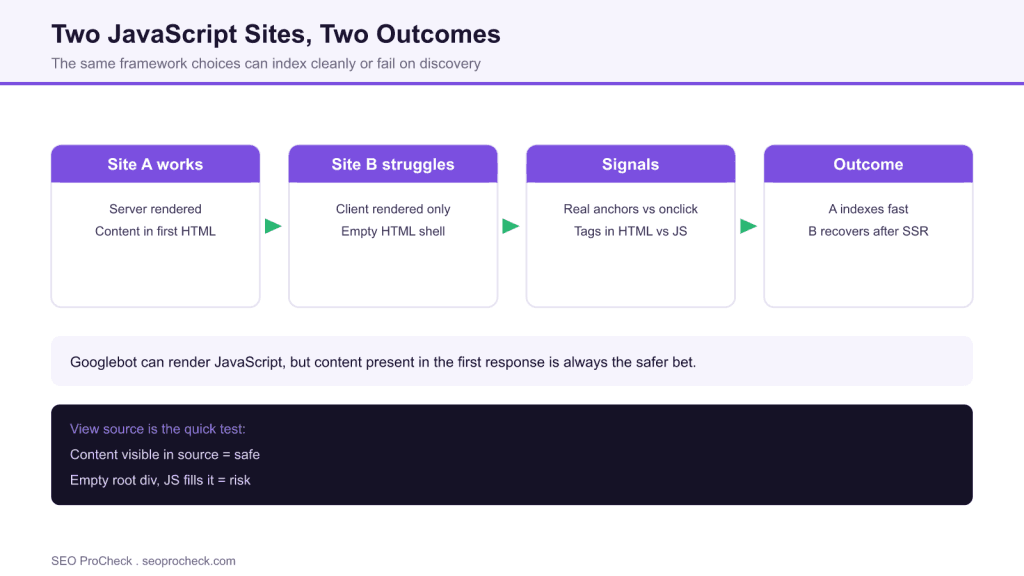
Two JavaScript dependent websites can get opposite SEO results depending on whether critical content and links exist in the first HTML response. The site that server rendered its content indexed cleanly, while the pure client rendered site with an empty HTML shell struggled until it changed its rendering strategy.
- Identical frameworks can produce opposite SEO outcomes based on rendering strategy.
- Server rendered or statically generated content in the first response indexes reliably.
- A pure client rendered shell with an empty root element and JS only links tends to struggle.
- The fix is server side rendering for content routes, real anchor links, and tags in the HTML.
This SEO case study documents a successful optimization initiative, providing actionable insights for practitioners. The documented approach demonstrates how strategic SEO implementation drives measurable results.
Initial Situation
Understanding the starting point is essential context for evaluating any case study. This documentation covers the initial challenges, competitive position, and business objectives that shaped the SEO strategy.
Strategy and Approach
The strategic approach combined multiple SEO disciplines to address identified opportunities. Key decisions around prioritization and resource allocation provide a template for similar initiatives.
Implementation
Moving from strategy to execution required specific technical implementations, content development, and process changes. This case study documents the practical steps that translated strategy into action.
Results and Learnings
The outcomes demonstrate effectiveness through measurable improvements in rankings, traffic, and business metrics. Analysis of successes and challenges provides learning value for practitioners.
Case studies like this contribute to the SEO knowledge base, helping practitioners learn from documented real-world experiences.
Source: https://rozhon.com/blog/seo-stories-of-two-javascript-dependent-websites/
Practitioner Notes: A Tale of Two Rendering Strategies
The value of comparing two JavaScript dependent sites is that it controls for the framework and isolates the thing that actually matters: whether the critical content and links are present in the initial HTML response. Two teams can pick the same modern stack and end up with opposite search outcomes purely because of how they render. That is the whole story in one sentence, and it is worth internalizing.
The site that works tends to use server side rendering or static generation. The content is in the first response, the canonical and robots tags are in the HTML, and internal links are real anchor elements. Googlebot gets everything it needs on the first pass and does not have to wait for a render. The site that struggles is usually a pure client rendered application: the initial HTML is an almost empty shell, and the content is injected after a data fetch that Googlebot defers, or that fails silently under crawl conditions.
There are reliable warning signs you can check in minutes. View source shows an empty container such as <div id="root"></div> with no meaningful content. Internal navigation is built from click handlers rather than real anchors, so there is nothing for a crawler to follow. Pagination exists only in JavaScript state. Key content sits behind an interaction like a tab or an accordion that the crawler never triggers. Each of these is survivable for a human user and invisible to a crawler on its first pass. The study on how well Google crawls JavaScript explains why the first pass is where so much is won or lost.
Remediation follows directly from the diagnosis. Adopt server side rendering or static generation for content routes so the important markup is in the first response. Use real <a href> links for anything you want crawled. Keep the canonical and robots directives in the HTML rather than setting them with JavaScript. Avoid blocking the initial render on a slow third party API. For a real recovery walkthrough of exactly this class of problem, see how Walker Sands reversed a drop in indexed pages, and browse the wider JavaScript SEO library for more patterns.
What's Changed Since
Googlebot now renders with an evergreen Chromium build, so it handles modern JavaScript well. The structural constraint remains: rendering happens in a second wave and is resource bound, so client rendered content is indexed more slowly and can be missed at scale. The framework ecosystem has responded by shipping server rendering as a first class default, with Next.js and Nuxt making server rendering and static generation the normal path rather than an advanced option.
Two more forces push in the same direction. Core Web Vitals penalize heavy client side hydration through slow interaction and layout metrics, so the client only approach carries a user experience cost as well as a crawl cost. And the newer generation of AI answer crawlers frequently do not execute JavaScript at all, which means client only content can be invisible to the systems now feeding AI Overviews and chat assistants. Putting content in the first response is more important in 2026, not less.
Two JavaScript Sites Compared
| Factor | Site that indexed well | Site that struggled |
|---|---|---|
| Rendering | Server side or static | Client side only |
| Initial HTML | Content present | Empty shell |
| Internal links | Real anchor elements | JavaScript click handlers |
| Canonical and robots | In the HTML | Set by JavaScript |
| Outcome | Fast, stable indexing | Recovered after adopting SSR |
Frequently Asked Questions
Why do two similar JavaScript sites get different SEO results?
Because the framework is not the deciding factor, the rendering strategy is. A site that puts content and links in the first HTML response indexes cleanly, while a site that relies on client side rendering to build the page can be crawled slowly or incompletely.
Is client side rendering bad for SEO?
It is riskier, not automatically fatal. Google can render JavaScript, but it does so in a deferred second wave that uses crawl budget, so content that depends entirely on client rendering is indexed more slowly and can be missed on large sites.
What is server side rendering and does it help SEO?
Server side rendering produces the full HTML on the server so content is present in the first response. It helps SEO because crawlers and AI systems get the content immediately without waiting for or executing JavaScript, which improves reliability of indexing.
How do I check what Google sees on a JavaScript page?
Use view source to see the raw HTML and the URL Inspection live test in Search Console to see the rendered DOM. If your main content and links are missing from the raw HTML, that is a signal to move rendering to the server.
Do JavaScript links pass PageRank?
Only links that resolve to real anchor elements with href attributes are reliably crawled and pass signals. Navigation built purely from click handlers gives the crawler nothing to follow, so use standard anchors for anything you want indexed.
Should I use dynamic rendering?
Dynamic rendering, which serves a prerendered version to bots, was a workaround Google now describes as a stopgap rather than a long term recommendation. Server side rendering or static generation is the more durable solution for content routes.
Take this with you
The assistant links open with a question about this page already written. Nothing is sent until you press enter.
Claude Vincent is a technical SEO consultant focused on crawlability, rendering, and AI-search visibility. He writes the field guides and case studies at SEO ProCheck, with a bias toward the durable, unglamorous work that decides whether search engines and AI answer engines can actually read and cite a site.
About SEO ProCheck
Technical SEO consulting and GEO strategy with 20 years of enterprise experience. Case studies, resources, and tools for search and AI visibility.
Work With Me
Technical SEO audits, GEO strategy, site migrations, and international SEO. Hourly consulting for teams who need hands-on support, not just reports.
Subscribe to our newsletter!








Recent Posts
- Most Top Sites Never Say Who They Are in Structured Data October 14, 2026
- Homepage Titles Are Mostly Too Short, Not Too Long October 8, 2026
- Who Actually Serves an llms.txt? 184 Top Sites Measured September 29, 2026