

AI Summary
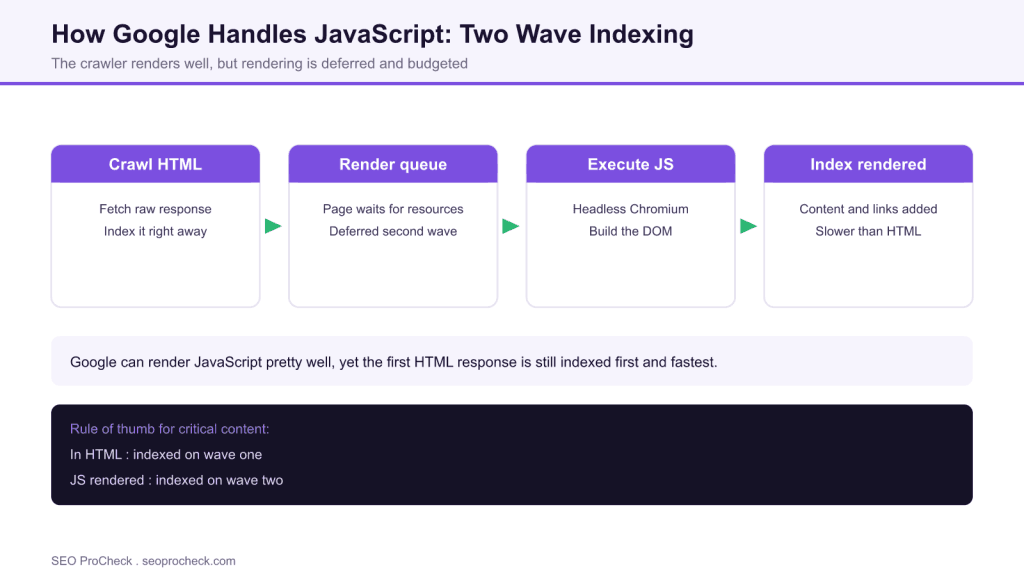
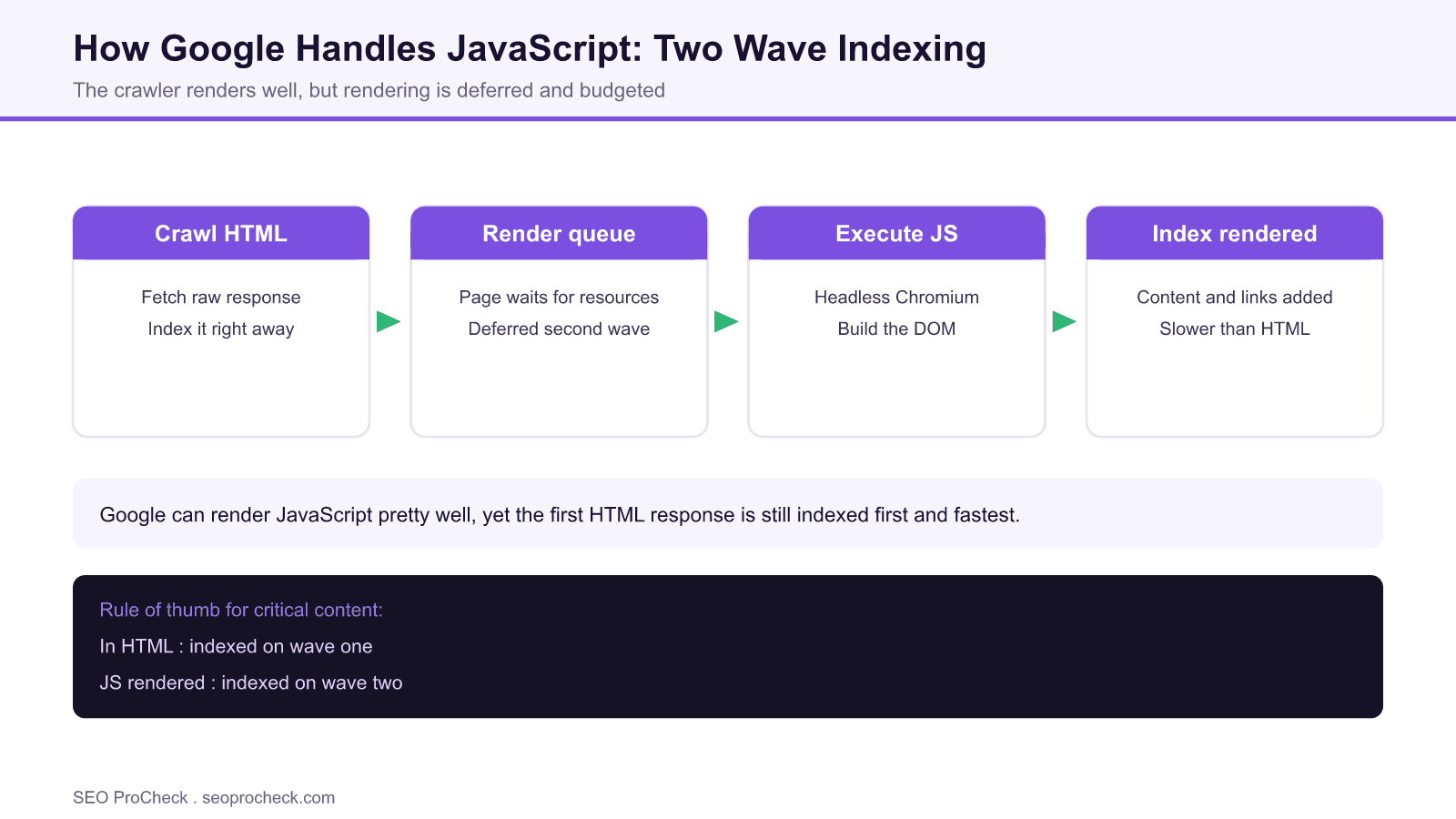
An influential study concluded that Google can render and index a lot of JavaScript, including content and links injected by scripts. The nuance practitioners took from it is that Google can render JavaScript, but doing so at scale is deferred and resource bound, so critical content is still safer in the initial HTML.
- The study tested JS injected content, JS links and dynamic tags, and found Google handled many of them.
- Can render is not the same as will render at scale within a tight time budget.
- Since 2018 Google documented two wave indexing and moved to an evergreen Chromium renderer.
- Many AI search crawlers still do not execute JavaScript, so client only content can be invisible to them.
This SEO case study documents a successful optimization initiative, providing actionable insights for practitioners. The documented approach demonstrates how strategic SEO implementation drives measurable results.
Initial Situation
Understanding the starting point is essential context for evaluating any case study. This documentation covers the initial challenges, competitive position, and business objectives that shaped the SEO strategy.
Strategy and Approach
The strategic approach combined multiple SEO disciplines to address identified opportunities. Key decisions around prioritization and resource allocation provide a template for similar initiatives.
Implementation
Moving from strategy to execution required specific technical implementations, content development, and process changes. This case study documents the practical steps that translated strategy into action.
Results and Learnings
The outcomes demonstrate effectiveness through measurable improvements in rankings, traffic, and business metrics. Analysis of successes and challenges provides learning value for practitioners.
Case studies like this contribute to the SEO knowledge base, helping practitioners learn from documented real-world experiences.
Source: https://www.merkleinc.com/blog/how-well-does-google-crawl-javascript-pretty-darn-well
Practitioner Notes: What the Study Really Showed
This study earned its reputation because it tested specific behaviors rather than making broad claims. It checked content injected through JavaScript, links created by JavaScript, and meta information inserted dynamically, and it found that Google handled a surprising amount of it. At the time that was reassuring, because many practitioners assumed the crawler ignored JavaScript almost entirely. The honest caveat is that any such test is a snapshot, and Google's rendering pipeline has changed substantially since.
The nuance that survived is the distinction between can and will. Google can render JavaScript, but can is not the same as will render every page immediately at web scale within a tight resource budget. Rendering is deferred and bounded, so a page that depends on JavaScript to show its main content is at the mercy of the render queue. That is why the practical guidance did not change even as the crawler improved: put the content and the links that matter into the HTML, test individual URLs with the URL Inspection tool, and keep an eye on crawl stats for signs of strain.
It also matters how you interpret a positive result from a test like this. Seeing Google index a JavaScript injected paragraph on a small test page does not prove it will do the same reliably across a million page catalog under real crawl pressure. Treat rendering as a capability with a cost, not a guarantee you can lean on. For a concrete example of that cost turning into lost coverage and a recovery, see how Walker Sands recovered indexed pages, and for a controlled contrast of two rendering strategies read the two JavaScript sites comparison.
What's Changed Since
Between 2018 and 2019 Google publicly documented two wave indexing and moved its Web Rendering Service to an evergreen headless Chromium, meaning the renderer now tracks a current browser version instead of an old fixed one. Those changes closed many of the gaps the original study probed, so a lot of modern JavaScript that once failed now renders correctly. The two wave model is the mental picture to keep: the HTML is crawled and can be indexed almost immediately, while the rendered version follows in a deferred second pass.
Two caveats keep the old guidance alive. Rendering budget, timeouts, and blocked resources still cause misses, especially on large sites and slow templates. And a newer factor has arrived: the crawlers behind AI Overviews and assistants such as ChatGPT frequently do not execute JavaScript at all, so content that only exists after a client render can be completely invisible to them even when Googlebot handles it. If your audience is shifting toward AI answer surfaces, server rendering the content is now a visibility issue, not just a speed one. Browse the full JavaScript SEO case study library for more worked examples.
What Google Could and Could Not Rely On
| Capability | Around the original study | In 2026 |
|---|---|---|
| Render modern JavaScript | Partial, fixed old browser | Strong, evergreen Chromium |
| Index JS injected content | Often yes, with delay | Usually yes, on wave two |
| Follow JS only links | Unreliable | Prefer real anchors |
| Speed of indexing | HTML first, render later | Still HTML first, render later |
| AI answer crawlers | Not a factor yet | Often skip JavaScript entirely |
Frequently Asked Questions
Can Google crawl JavaScript?
Yes. Google renders JavaScript with an evergreen headless Chromium and can index content and links that scripts create. The practical limit is that rendering is deferred to a second wave and uses crawl budget, so it is not instant or guaranteed at large scale.
Does Google render every page?
Not immediately and not without limits. Google crawls the HTML first and queues pages for rendering, so rendering can lag behind crawling. Blocked resources, timeouts and crawl budget mean some JavaScript dependent content is rendered late or missed.
What is two wave indexing?
It is Google's model where the HTML is crawled and can be indexed in a first wave, then the page is queued and rendered with JavaScript in a second wave. Content that only appears after the render is added later, which is why it can be indexed more slowly.
Do AI search crawlers run JavaScript?
Frequently they do not. Many of the crawlers feeding AI Overviews and assistants read the raw HTML without executing scripts, so content that depends on client side rendering can be invisible to them even when Googlebot renders it correctly.
Should I use server side rendering in 2026?
For content you want indexed and cited, yes, it is the safer default. Server side rendering or static generation puts the content in the first response, which serves Google's first wave and the AI crawlers that skip JavaScript at the same time.
How do I test if Google renders my page?
Use the URL Inspection tool in Search Console and run a live test to see the rendered HTML and the resources Google loaded. If your main content or links are missing there, the page depends too heavily on client side rendering.
Claude Vincent is a technical SEO consultant focused on crawlability, rendering, and AI-search visibility. He writes the field guides and case studies at SEO ProCheck, with a bias toward the durable, unglamorous work that decides whether search engines and AI answer engines can actually read and cite a site.
About SEO ProCheck
Technical SEO consulting and GEO strategy with 20 years of enterprise experience. Case studies, resources, and tools for search and AI visibility.
Work With Me
Technical SEO audits, GEO strategy, site migrations, and international SEO. Hourly consulting for teams who need hands-on support, not just reports.
Subscribe to our newsletter!







Recent Posts
- Can AI Crawlers Actually Read Your Site? I Measured 400 of the Biggest September 5, 2026
- The Pre-Publish Quality Gate for AI-Assisted Content August 6, 2026
- AGENTS.md vs llms.txt vs llms-full.txt: Which Agent File Does What July 18, 2026