• Articles
    &Evergreen
    • Articles
      • Algorithm Updates
      • Analytics & Measurement
      • CMS and Platforms
      • Content Strategy
      • E-commerce SEO
      • General
      • Industry Guides
      • Keyword Research
      • Link Building
      • Local SEO
      • Mobile SEO
      • On-Page SEO
      • SEO Tools
    • Evergreen
      • AI and Search
        • AEO (Answer Engine Optimization)
        • AI Overviews and SGE
        • GEO (Generative Engine Optimization)
        • LLM Citation Optimization
      • Content SEO
        • Content Architecture
        • E-E-A-T Optimization
        • Internal Linking Strategy
      • Python and Automation
      • Technical SEO
        • Core Web Vitals and Performance
        • Crawlability and Indexation
        • International SEO and Hreflang
        • Log File Analysis
        • Schema and Structured Data
        • Site Architecture
        • Site Migrations
  • Case Studies
    & Researches
    • Case Studies
      • Content
      • Crawling and Indexing
      • Growth
      • International SEO
      • JavaScript SEO
      • Metadata
      • Migrations
      • Website Architecture
      • Web Performance
    • Research
      • AI Search
      • Cross-Industry
      • E-commerce
      • Enterprise
      • Local and Listings
      • Publisher
  • Free Tools
    & Resources
    • Free SEO Tools
      • Content Analysis
      • Developer Utilities
      • GEO & AI Visibility
      • Local SEO
      • Schema & Structured Data
      • Social & Meta
      • Technical SEO
    • Executive Briefings
      • What SEO Actually Is
      • Why SEO Takes Time
      • Technical vs Content SEO
      • What AI Search Changes
      • Is Your SEO Working?
      • Case Studies
      • Is It Worth It?
      • Hiring an Agency
      • SEO vs Paid
      • Resourcing SEO
    • Best Practices
      • Accessibility
      • AMP
      • Content & GEO
      • Duplicates
      • HTML Structure
      • hrefLang
      • Images
      • Indexation
      • Links
      • Mobile
      • On-Page SEO
      • Organic & Analytics
      • Performance
      • Redirections
      • Robots.txt
      • Security
      • Structured Data
      • Technical GEO
      • URLs
      • XML Sitemaps
    • FAQ
      • AI & Search FAQ
      • Technical SEO FAQ
      • Content SEO FAQ
      • Off-Page SEO FAQ
      • Local SEO FAQ
      • E-commerce SEO FAQ
      • Tools and Analytics FAQ
    • Glossary
      • Glossary | Algorithms
      • Glossary | Analytics
      • Glossary | Business
      • Glossary | Content SEO
      • Glossary | E-commerce
      • Glossary | Emerging
      • Glossary | GEO & AI SEO
      • Glossary | International SEO
      • Glossary | Link Building
      • Glossary | Local SEO
      • Glossary | Search Behavior
      • Glossary | Technical SEO
      • Glossary | Tools
  • Free Tools Hub
  • About
    Me
    • Consulting
      • Advanced SEO Audit
      • GEO & AI SEO
      • Performance & Indexation
      • Site Migrations
      • International SEO
    • Portfolio
    • Contact
    • Tools & Resources
    • Browser Extensions
  • Articles
    &Evergreen
    • Articles
      • Algorithm Updates
      • Analytics & Measurement
      • CMS and Platforms
      • Content Strategy
      • E-commerce SEO
      • General
      • Industry Guides
      • Keyword Research
      • Link Building
      • Local SEO
      • Mobile SEO
      • On-Page SEO
      • SEO Tools
    • Evergreen
      • AI and Search
        • AEO (Answer Engine Optimization)
        • AI Overviews and SGE
        • GEO (Generative Engine Optimization)
        • LLM Citation Optimization
      • Content SEO
        • Content Architecture
        • E-E-A-T Optimization
        • Internal Linking Strategy
      • Python and Automation
      • Technical SEO
        • Core Web Vitals and Performance
        • Crawlability and Indexation
        • International SEO and Hreflang
        • Log File Analysis
        • Schema and Structured Data
        • Site Architecture
        • Site Migrations
  • Case Studies
    & Researches
    • Case Studies
      • Content
      • Crawling and Indexing
      • Growth
      • International SEO
      • JavaScript SEO
      • Metadata
      • Migrations
      • Website Architecture
      • Web Performance
    • Research
      • AI Search
      • Cross-Industry
      • E-commerce
      • Enterprise
      • Local and Listings
      • Publisher
  • Free Tools
    & Resources
    • Free SEO Tools
      • Content Analysis
      • Developer Utilities
      • GEO & AI Visibility
      • Local SEO
      • Schema & Structured Data
      • Social & Meta
      • Technical SEO
    • Executive Briefings
      • What SEO Actually Is
      • Why SEO Takes Time
      • Technical vs Content SEO
      • What AI Search Changes
      • Is Your SEO Working?
      • Case Studies
      • Is It Worth It?
      • Hiring an Agency
      • SEO vs Paid
      • Resourcing SEO
    • Best Practices
      • Accessibility
      • AMP
      • Content & GEO
      • Duplicates
      • HTML Structure
      • hrefLang
      • Images
      • Indexation
      • Links
      • Mobile
      • On-Page SEO
      • Organic & Analytics
      • Performance
      • Redirections
      • Robots.txt
      • Security
      • Structured Data
      • Technical GEO
      • URLs
      • XML Sitemaps
    • FAQ
      • AI & Search FAQ
      • Technical SEO FAQ
      • Content SEO FAQ
      • Off-Page SEO FAQ
      • Local SEO FAQ
      • E-commerce SEO FAQ
      • Tools and Analytics FAQ
    • Glossary
      • Glossary | Algorithms
      • Glossary | Analytics
      • Glossary | Business
      • Glossary | Content SEO
      • Glossary | E-commerce
      • Glossary | Emerging
      • Glossary | GEO & AI SEO
      • Glossary | International SEO
      • Glossary | Link Building
      • Glossary | Local SEO
      • Glossary | Search Behavior
      • Glossary | Technical SEO
      • Glossary | Tools
  • Free Tools Hub
  • About
    Me
    • Consulting
      • Advanced SEO Audit
      • GEO & AI SEO
      • Performance & Indexation
      • Site Migrations
      • International SEO
    • Portfolio
    • Contact
    • Tools & Resources
    • Browser Extensions
consulting services
Home / Metadata / "Adding a ""Book Now"" CTA to start of titles: SEO Split Testing Lessons from SearchPilot"

"Adding a ""Book Now"" CTA to start of titles: SEO Split Testing Lessons from SearchPilot"

  • October 13, 2021
  • Metadata
No Comments
"adding a ""book now"" cta to start of titles: seo split testing lessons from searchpilot"

AI Summary

This split test adds a Book Now call to action to the start of title tags to see whether an action cue lifts organic click through rate. The lesson is that a CTA can help on transactional pages but costs valuable keyword space, so it should be tested per template rather than rolled out blindly.

  • The test moves a Book Now cue to the front of the title tag.
  • A CTA competes with keywords for the limited space in a title.
  • Action cues tend to suit transactional intent more than research intent.
  • Google may rewrite titles, so measure the live result, not just the tag.
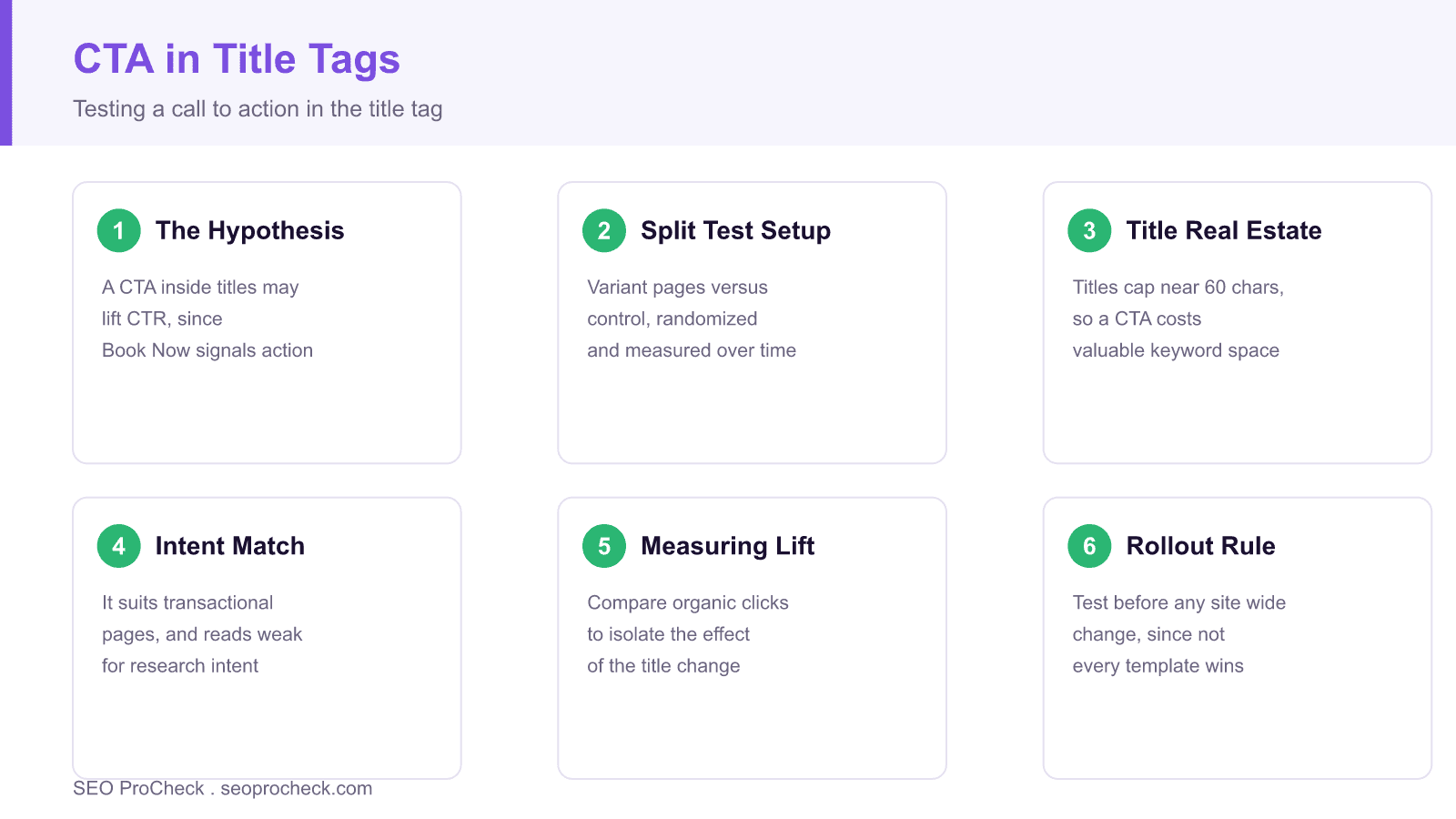
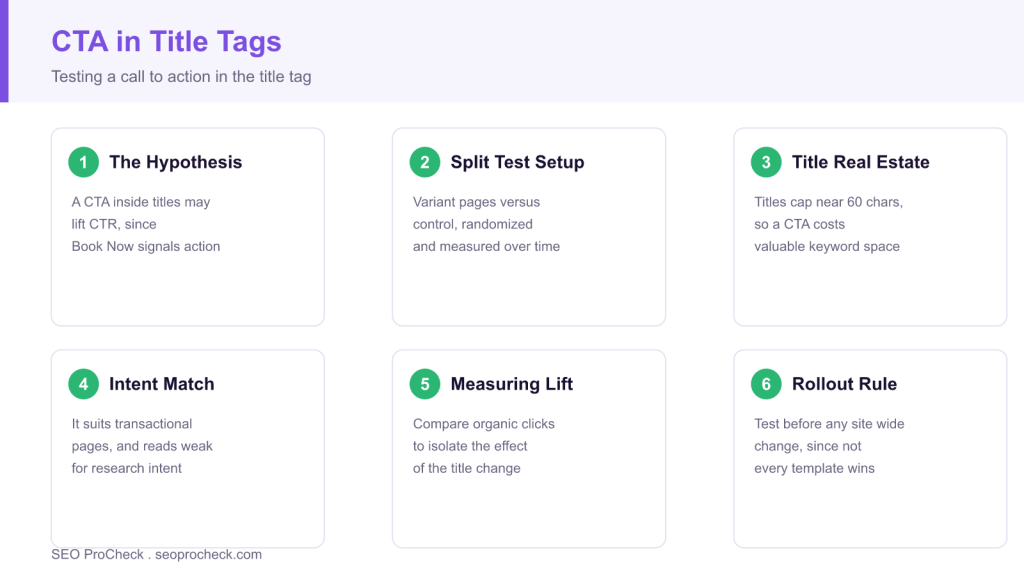
Diagram outlining a split test that adds a book now call to action to the start of title tags.
Split testing a Book Now CTA inside title tags.

This SEO case study documents a successful optimization initiative, providing actionable insights for practitioners. The documented approach demonstrates how strategic SEO implementation drives measurable results.

Initial Situation

Understanding the starting point is essential context for evaluating any case study. This documentation covers the initial challenges, competitive position, and business objectives that shaped the SEO strategy.

Strategy and Approach

The strategic approach combined multiple SEO disciplines to address identified opportunities. Key decisions around prioritization and resource allocation provide a template for similar initiatives.

Implementation

Moving from strategy to execution required specific technical implementations, content development, and process changes. This case study documents the practical steps that translated strategy into action.

Results and Learnings

The outcomes demonstrate effectiveness through measurable improvements in rankings, traffic, and business metrics. Analysis of successes and challenges provides learning value for practitioners.

Case studies like this contribute to the SEO knowledge base, helping practitioners learn from documented real-world experiences.

Source: https://www.searchpilot.com/resources/case-studies/seo-split-test-lessons-add-book-now-cta-to-titles/

Practitioner Commentary

Title tags are the most tested element in SEO because they are cheap to change and they influence both relevance and clicks. Adding a call to action such as Book Now at the start of the title is a classic experiment: the hope is that an explicit action cue nudges searchers to choose your result over neighbors that read as plain descriptions. On a booking or ecommerce template with clear transactional intent, that nudge can be real.

The trade off is space. A title has only so many characters before it truncates in the results, so every word spent on a CTA is a word not spent on a keyword or a differentiator. On pages that rank for informational queries, a Book Now prefix can feel mismatched and may even suppress clicks. This is why the result of any single test travels poorly to other templates, and why split testing exists in the first place. For a related metadata experiment, see the breadcrumb markup case study, and for structured data that changes the look of the snippet, see the ratings and reviews test.

Method matters more than the headline outcome. A credible title test splits comparable pages into a variant group and a control group, applies the change to only one group, and compares organic clicks over enough time to clear noise and seasonality. Without that control you cannot separate the title effect from a general traffic shift. Tools that run this at the template level make the analysis defensible.

The durable lesson is to treat titles as hypotheses. Write the CTA variant, ship it to a defined group, watch clicks against the control, and keep the winner. What lifts a hotel booking page can easily sink a guide, so the right answer is a tested answer, not a rule copied from someone else's win.

What Has Changed Since This Was Published

Google began rewriting title links more aggressively, often pulling from on page headings or other text when it judges your tag a poor fit. That means a Book Now prefix you set may not be the title a searcher sees, so verifying the rendered title in the live results is now an essential step. It also raises the value of the control group, since a rewrite can affect variant and control differently. The core practice is unchanged: test the CTA per template, confirm what actually renders, and keep only the versions that lift real clicks.

When a Title CTA Tends to Help

Page intentLikely effect of a CTARecommendation
Booking or productCan lift clicksWorth testing first
Local serviceMixed, depends on queryTest with a control group
Informational guideOften neutral or negativePrioritize keywords instead
Homepage or brandUsually unnecessaryKeep brand and clarity

Frequently Asked Questions

Does adding a CTA to the title improve rankings?

A title CTA targets click through rate rather than ranking position. It can indirectly help by earning more clicks on transactional pages, but it does not change relevance the way keywords do.

Why put the CTA at the start of the title?

Front loading puts the action cue where the eye lands first and before any truncation. The risk is that it pushes keywords later, so the placement should be tested rather than assumed.

Will Google keep my Book Now title?

Not always, since Google may rewrite titles it considers a poor match. Always check the rendered title in live results before judging the test.

How long should a title split test run?

Run it long enough to clear weekly patterns and seasonality, which usually means several weeks of data. Ending too early risks reading noise as a result.

Should I roll a winning title to the whole site?

Only after the test on that template wins clearly. A CTA that helps booking pages can hurt guides, so validate per template before a site wide change.

What metric proves the test worked?

Compare organic clicks or click through rate between the variant and the control over the same period. A consistent gap in the variant, with rankings steady, points to a real effect.

  • Claude Vincent

Claude Vincent is a technical SEO consultant focused on crawlability, rendering, and AI-search visibility. He writes the field guides and case studies at SEO ProCheck, with a bias toward the durable, unglamorous work that decides whether search engines and AI answer engines can actually read and cite a site.

  • CRO, Title Tags, Travel

About SEO ProCheck

Technical SEO consulting and GEO strategy with 20 years of enterprise experience. Case studies, resources, and tools for search and AI visibility.

Learn more about me

Work With Me

Technical SEO audits, GEO strategy, site migrations, and international SEO. Hourly consulting for teams who need hands-on support, not just reports.

Contact now

Subscribe to our newsletter!

More from our blog


Diagram of the agent-readable file stack showing AGENTS.md in the code repository read by coding agents, llms.txt and llms-full.txt at the website root read by answer engines, and robots.txt plus RSL as the access and licensing layer beneath both.

AGENTS.md vs llms.txt vs llms-full.txt: Which Agent File Does What

AGENTS.md, llms.txt and llms-full.txt look alike but serve different readers. What each…
Continue reading

Profound vs Semrush and Ahrefs: What an AI-Search Tool Actually Replaces (and What It Doesn't)

Profound vs Semrush and Ahrefs don't measure the same thing. A practitioner's…
Continue reading
SEO is the foundation everything is built on; AEO (be the answer) and GEO (get cited) are what it makes possible

SEO vs AEO vs GEO: What Each One Means and How They Actually Differ

SEO, AEO, and GEO are three different jobs: rank in search results,…
Continue reading
Google May 2026 Core Update: What We Learned After the Dust Settled

Google May 2026 Core Update: What We Learned After the Dust Settled

The May 2026 Core Update rolled out from May 21 to June…
Continue reading
Pogosticking: The Click Pattern That Quietly Decides Who Ranks

Pogosticking: The Click Pattern That Quietly Decides Who Ranks

Pogosticking is when a searcher clicks your result, bounces back to Google,…
Continue reading
Interaction to Next Paint (INP): The Complete Guide

Interaction to Next Paint (INP): The Complete Guide

Interaction to Next Paint (INP) is the Core Web Vital that replaced…
Continue reading
SSR vs CSR: Why Rendering Decides Whether AI Can Read Your Site

SSR vs CSR: Why Rendering Decides Whether AI Can Read Your Site

AI crawlers mostly don't run JavaScript, so client-side rendering hides your content…
Continue reading
Which AI Bots Are You Actually Blocking? (GPTBot, ClaudeBot, Perplexity & More)

Which AI Bots Are You Actually Blocking? (GPTBot, ClaudeBot, Perplexity & More)

Blocking 'AI bots' isn't one switch. A field guide to GPTBot, OAI-SearchBot,…
Continue reading
Prev. Post
Next Post

Recent Posts

  • AGENTS.md vs llms.txt vs llms-full.txt: Which Agent File Does What July 18, 2026
  • Profound vs Semrush and Ahrefs: What an AI-Search Tool Actually Replaces (and What It Doesn't) June 19, 2026
  • SEO vs AEO vs GEO: What Each One Means and How They Actually Differ June 15, 2026

All Website Tags

AI SEO Analytics B2B Batch Check Content Analysis Content Quality Content Strategy Core Web Vitals Crawl Budget Crawling DOM Parsing E-commerce E-E-A-T Enterprise FAQ GEO Googlebot Google Search Console High Priority Hreflang HTTP Requests Indexing Internal Linking International SEO JavaScript SEO Keyword Research Link Building Live Check Local SEO Low Priority Medium Priority Multiple APIs On-Page SEO Page Speed PageSpeed API Rich Results SaaS Schema Validation SEO Tools SERP Features Site Architecture Site Migrations Structured Data Technical SEO Title Tags

Technical SEO consulting and GEO strategy for teams who need real implementation support. 20 years of enterprise experience across major media, technology, recruitment, and ecommerce brands, and a major enterprise brand. Case studies, research, and resources for search and AI visibility.

SEO Geek since 2004. © All Rights Reserved.

Sitemap for Humans  |  Privacy Policy   |  Terms of Service