

AI Summary
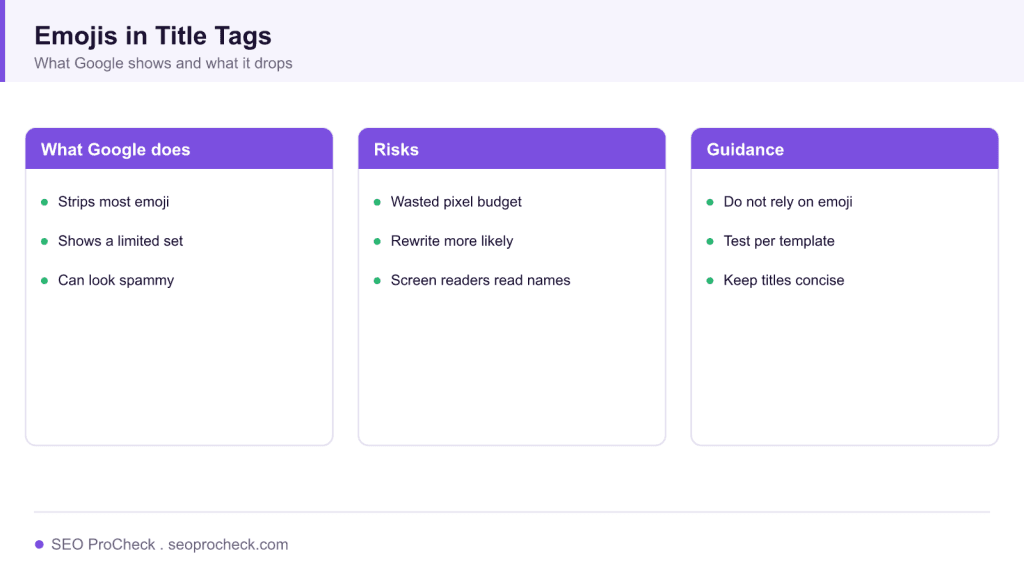
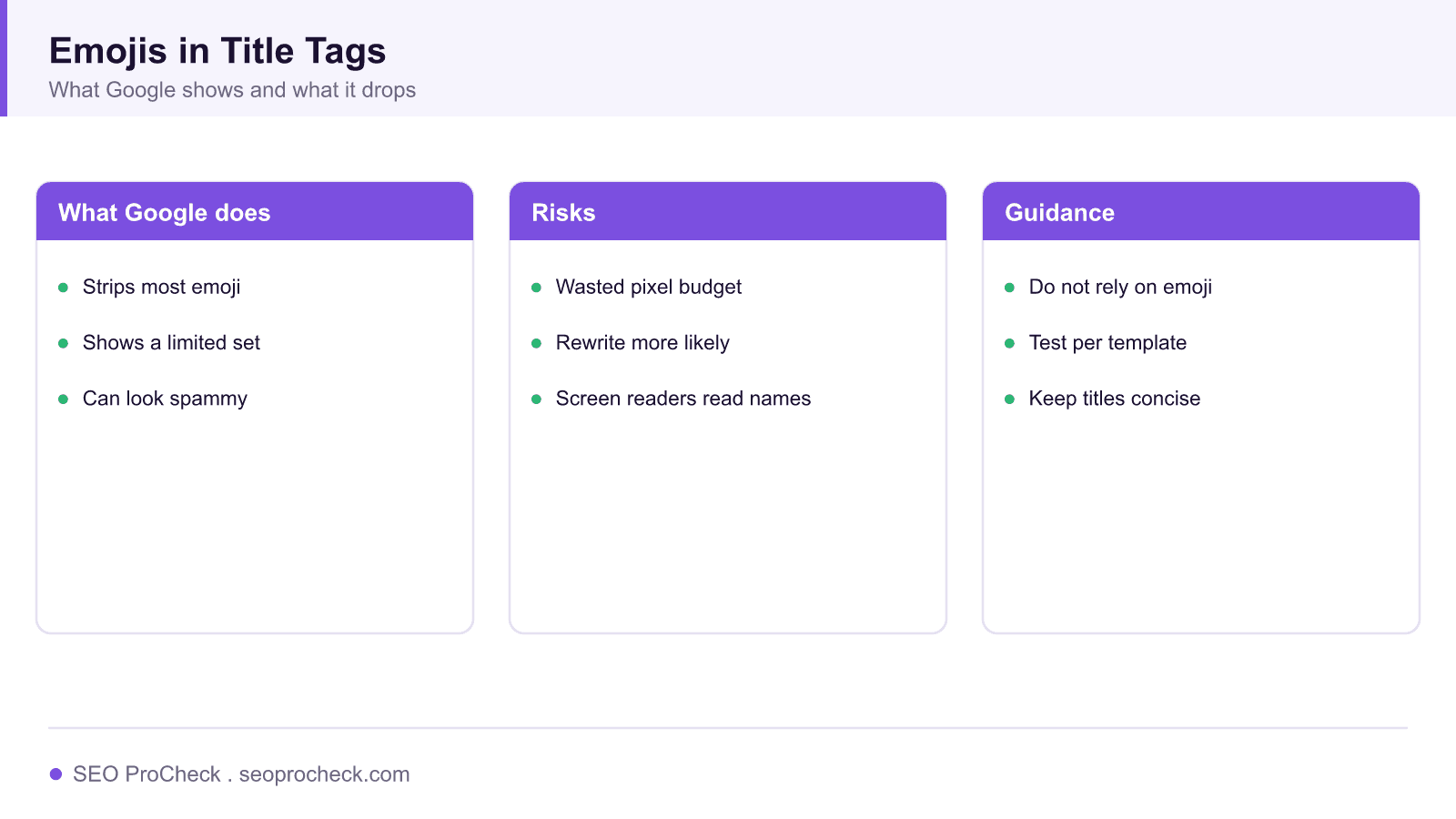
Emojis in title tags rarely reach the search result, because Google strips most of them from the title link and shows only a limited set inconsistently. They can occasionally lift attention where they do render, but they waste pixel budget, raise rewrite risk, and add accessibility noise, so treat them as a small experiment rather than a tactic.
- Google removes most emoji from the displayed title link.
- A small set may render, but behavior is inconsistent across queries and devices.
- Emoji consume pixel budget and can make a listing look spammy.
- Screen readers announce the emoji name, which can clutter the title for assistive tech.
This SEO case study documents a successful optimization initiative, providing actionable insights for practitioners. The documented approach demonstrates how strategic SEO implementation drives measurable results.
Initial Situation
Understanding the starting point is essential context for evaluating any case study. This documentation covers the initial challenges, competitive position, and business objectives that shaped the SEO strategy.
Strategy and Approach
The strategic approach combined multiple SEO disciplines to address identified opportunities. Key decisions around prioritization and resource allocation provide a template for similar initiatives.
Implementation
Moving from strategy to execution required specific technical implementations, content development, and process changes. This case study documents the practical steps that translated strategy into action.
Results and Learnings
The outcomes demonstrate effectiveness through measurable improvements in rankings, traffic, and business metrics. Analysis of successes and challenges provides learning value for practitioners.
Case studies like this contribute to the SEO knowledge base, helping practitioners learn from documented real-world experiences.
How Google handles emoji in titles
You can place an emoji in a title tag, but reaching the search result is a different matter. Google strips most emoji and pictographic characters from the displayed title link, and shows only a limited subset, inconsistently, depending on the query, the device, and the character. So the tag in your HTML and the title a searcher sees are often not the same, which is the core reason emoji are an unreliable tactic.
Reading the test as a practitioner
The linked SearchPilot case study runs a controlled split test to measure whether emoji in title tags change click behavior across a set of template pages. That is the honest way to answer the question, because opinions about eye catching characters are easy to form and hard to trust. When you read the outcome, check whether the emoji actually rendered in the result for those pages, since a test where Google stripped the emoji is really testing something else.
Practical guidance
Do not rely on an emoji for ranking or for a guaranteed visual edge. If you want to try one, keep it away from the front of the title so a stripped or replaced character does not damage your key words, and stay within the pixel budget, since an emoji still consumes space even when it is removed later. Watch for a listing that looks spammy, which can cost trust even if clicks tick up briefly. Because rendering varies, test per template and per market rather than rolling emoji out sitewide. For the fundamentals, see our guide to title tags and meta descriptions, and if your titles already run long, fix the length problem before adding characters.
Keep accessibility in mind. A screen reader announces the emoji by its name, so a star or a fire symbol becomes spoken words inside your title. That noise can make an otherwise clear title harder to parse for assistive technology users, a cost that rarely shows up in a clicks only test.
What has changed since this test
In the current title rewrite era, Google generates the displayed title more often and is even more likely to drop or ignore decorative characters. That makes emoji a weaker lever than it may once have looked. A concise, front loaded title that matches the H1 remains the dependable way to control your wording, as our lexicon entry on the title tag explains.
How emoji behave in the title link
| Aspect | What happens | Practical takeaway |
|---|---|---|
| Rendering | Most emoji are stripped | Do not depend on it showing |
| Pixel budget | Emoji still consume space | Keep key words within the budget |
| Perception | Can look promotional or spammy | Use sparingly, if at all |
| Accessibility | Screen readers read the emoji name | Avoid cluttering the spoken title |
Frequently asked questions
Do emojis in title tags help SEO?
There is no ranking benefit. At best an emoji that renders may draw the eye and lift clicks on some queries, but Google strips most emoji from the title link, so the effect is unreliable.
Will Google show my emoji in the title?
Sometimes, for a limited set of characters, and inconsistently. Many emoji are removed from the displayed title link, so you cannot count on yours appearing across queries and devices.
Can emojis in titles hurt my listing?
They can. Emoji consume pixel budget, can make a result look spammy, and add accessibility noise since screen readers announce the emoji name. Weigh those costs against an uncertain click gain.
Where should I place an emoji if I test one?
Keep it away from the front of the title so a stripped or replaced character does not push out your key words. Stay within the pixel budget and test on a small set of pages first.
Do emojis affect accessibility?
Yes. Assistive technology reads the emoji by its name, so a symbol becomes spoken words inside your title. That can clutter the title for users who rely on screen readers.
Should I add emoji to meta descriptions instead?
The same caution applies. Google often rewrites descriptions and may strip emoji, so any gain is uncertain. Focus first on clear, benefit led wording that earns the click.
Source: https://www.searchpilot.com/resources/case-studies/seo-testing-lessons-emoji-title-tags/
Take this with you
The assistant links open with a question about this page already written. Nothing is sent until you press enter.
Claude Vincent is a technical SEO consultant focused on crawlability, rendering, and AI-search visibility. He writes the field guides and case studies at SEO ProCheck, with a bias toward the durable, unglamorous work that decides whether search engines and AI answer engines can actually read and cite a site.
About SEO ProCheck
Technical SEO consulting and GEO strategy with 20 years of enterprise experience. Case studies, resources, and tools for search and AI visibility.
Work With Me
Technical SEO audits, GEO strategy, site migrations, and international SEO. Hourly consulting for teams who need hands-on support, not just reports.
Subscribe to our newsletter!








Recent Posts
- Most Top Sites Never Say Who They Are in Structured Data October 14, 2026
- Homepage Titles Are Mostly Too Short, Not Too Long October 8, 2026
- Who Actually Serves an llms.txt? 184 Top Sites Measured September 29, 2026