

AI Summary
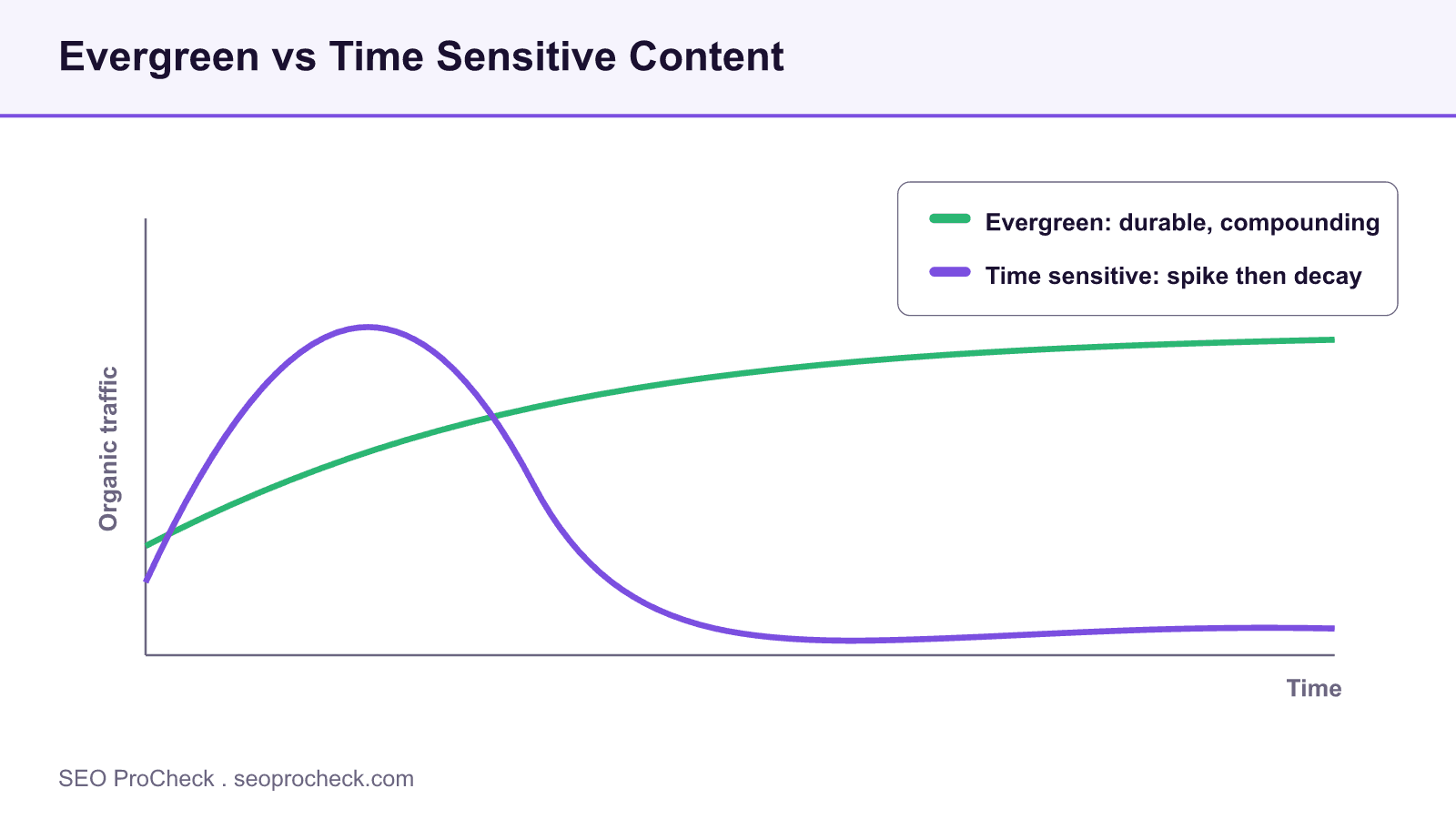
Evergreen content is content that stays useful and keeps attracting search traffic long after it is published, because it answers durable questions rather than reacting to a moment. It compounds over time, unlike news style content that spikes and decays, which makes it the backbone of sustainable organic growth when you choose lasting topics and maintain them.
- Evergreen means durable relevance: how to guides, definitions, glossaries, calculators and reference pages.
- It compounds traffic and links over years, while time sensitive content spikes then fades.
- It still needs maintenance: facts, examples and screenshots drift and must be refreshed.
- Pick topics with stable, ongoing demand rather than seasonal or trend driven spikes.
Evergreen content is the material that keeps working. A well built how to guide, a clear definition, a reference table or a calculator can earn steady organic traffic for years because the underlying question does not expire. That is the opposite of a news post or a launch announcement, which may spike hard in its first week and then flatten to almost nothing. Understanding the difference is the foundation of a content strategy that grows instead of treading water.
What makes content evergreen
The defining trait is durable demand. People search for how to tie a tie, what is compound interest or how to write a resignation letter every day, year after year. Content that targets those questions can rank once and keep paying off. Time sensitive content, by contrast, is tied to a date, a release, a season or a trend, and its search demand collapses once the moment passes. Both have a place, but only evergreen content compounds.
| Attribute | Evergreen content | Time sensitive content |
|---|---|---|
| Search demand | Stable and ongoing | Spikes then decays |
| Typical formats | How to, definitions, glossaries, reference, calculators | News, launches, trend takes, seasonal roundups |
| Traffic pattern | Compounds over months and years | Front loaded, short lived |
| Link acquisition | Accumulates steadily as a citation | Concentrated at publication |
| Maintenance need | Periodic refresh of facts and examples | Usually archived once the moment passes |
High performing evergreen formats
Some structures lend themselves to durability. Step by step tutorials answer a stable how to need. Definitions and glossary entries capture what is queries and feed featured snippets and AI answers. Reference pages and comparison tables become the resource people bookmark and cite. Tools and calculators are especially sticky because they solve the task on the page. Original frameworks and checklists earn links because other writers reference them. The common thread is that each one answers a question that will still be asked next year.
Choosing the topic is where most evergreen strategies succeed or fail. Validate that demand is stable rather than seasonal, that the question is broad enough to matter but specific enough to answer well, and that you can add something beyond what already ranks. Depth is part of durability: a shallow definition gets replaced, while a thorough, genuinely useful page resists being displaced. This is the same depth advantage that shows up in enterprise B2B content research.
Evergreen does not mean set and forget
The most common mistake is treating evergreen as permanent. The core question stays stable, but the details around it drift. Statistics age, interfaces change, screenshots go stale, best practices evolve and new competitors publish fresher takes. A page that was the best answer three years ago can quietly slide down the results simply because everything around it moved on. The fix is a maintenance cadence: review your top evergreen pages on a schedule, update the facts and visuals, add a clearly labelled note on what has changed, and re examine whether the page still matches how people search today.
Maintenance is also where internal links matter. As you publish more, point new articles at your evergreen cornerstones and refresh the cornerstones to reference the newer pieces. Outbound citations to authoritative sources help too, a pattern explored in the outgoing links study. Keeping your content library interlinked turns a set of individual pages into a compounding library.
Measuring evergreen performance
Judge evergreen content on a longer horizon than a launch. Look at the trend of organic clicks over quarters, the number of distinct queries a page ranks for, the links it accumulates and the assisted conversions it contributes. A healthy evergreen page shows a rising or stable line long after publication, and a widening set of keywords as the engine learns it answers a topic rather than a single phrase. When a page that used to climb starts to slide, that is your signal to refresh it rather than write something new.
Source: https://www.siegemedia.com/strategy/evergreen-content
Frequently asked questions
It is content that stays relevant and keeps drawing search traffic long after publication because it answers a question that does not expire, such as a how to guide or a definition. It compounds over time instead of spiking and fading like news.
How to tutorials, definitions and glossary entries, reference tables, comparison guides, checklists, and calculators or tools. Each targets a durable question that people keep searching, which is what gives the content its lasting value.
They serve different goals. Evergreen content builds a compounding base of steady traffic, while timely content captures spikes of interest and demonstrates freshness. A strong strategy uses evergreen pieces as the foundation and timely pieces for reach and relevance.
Yes. The core question stays stable, but facts, screenshots and best practices drift, and competitors publish fresher pages. Reviewing and refreshing your top evergreen pages on a schedule protects their rankings and keeps them accurate.
Look for stable, ongoing search demand rather than seasonal or trend driven spikes, pick questions you can answer more thoroughly than the current top results, and confirm the topic is broad enough to matter. Depth and durable demand are the two tests.
It usually builds gradually, gaining rankings and links over months rather than days. That slower ramp is the trade off for a traffic curve that compounds and lasts, which is why evergreen content is measured over quarters, not launch weeks.
Want a page that actually earns the click?
Thin, templated pages get suppressed. A focused review finds the gaps and turns them into content that ranks and converts.
Claude Vincent is a technical SEO consultant focused on crawlability, rendering, and AI-search visibility. He writes the field guides and case studies at SEO ProCheck, with a bias toward the durable, unglamorous work that decides whether search engines and AI answer engines can actually read and cite a site.
About SEO ProCheck
Technical SEO consulting and GEO strategy with 20 years of enterprise experience. Case studies, resources, and tools for search and AI visibility.
Work With Me
Technical SEO audits, GEO strategy, site migrations, and international SEO. Hourly consulting for teams who need hands-on support, not just reports.
Subscribe to our newsletter!







Recent Posts
- Can AI Crawlers Actually Read Your Site? I Measured 400 of the Biggest September 5, 2026
- The Pre-Publish Quality Gate for AI-Assisted Content August 6, 2026
- AGENTS.md vs llms.txt vs llms-full.txt: Which Agent File Does What July 18, 2026