• Articles
    &Evergreen
    • Articles
      • Algorithm Updates
      • Analytics & Measurement
      • CMS and Platforms
      • Content Strategy
      • E-commerce SEO
      • General
      • Industry Guides
      • Keyword Research
      • Link Building
      • Local SEO
      • Mobile SEO
      • On-Page SEO
      • SEO Tools
    • Evergreen
      • AI and Search
        • AEO (Answer Engine Optimization)
        • AI Overviews and SGE
        • GEO (Generative Engine Optimization)
        • LLM Citation Optimization
      • Content SEO
        • Content Architecture
        • E-E-A-T Optimization
        • Internal Linking Strategy
      • Python and Automation
      • Technical SEO
        • Core Web Vitals and Performance
        • Crawlability and Indexation
        • International SEO and Hreflang
        • Log File Analysis
        • Schema and Structured Data
        • Site Architecture
        • Site Migrations
  • Case Studies
    & Researches
    • Case Studies
      • Content
      • Crawling and Indexing
      • Growth
      • International SEO
      • JavaScript SEO
      • Metadata
      • Migrations
      • Website Architecture
      • Web Performance
    • Research
      • AI Search
      • Cross-Industry
      • E-commerce
      • Enterprise
      • Local and Listings
      • Publisher
  • Free Tools
    & Resources
    • Free SEO Tools
      • Content Analysis
      • Developer Utilities
      • GEO & AI Visibility
      • Local SEO
      • Schema & Structured Data
      • Social & Meta
      • Technical SEO
    • Executive Briefings
      • What SEO Actually Is
      • Why SEO Takes Time
      • Technical vs Content SEO
      • What AI Search Changes
      • Is Your SEO Working?
      • Case Studies
      • Is It Worth It?
      • Hiring an Agency
      • SEO vs Paid
      • Resourcing SEO
    • Best Practices
      • Accessibility
      • AMP
      • Content & GEO
      • Duplicates
      • HTML Structure
      • hrefLang
      • Images
      • Indexation
      • Links
      • Mobile
      • On-Page SEO
      • Organic & Analytics
      • Performance
      • Redirections
      • Robots.txt
      • Security
      • Structured Data
      • Technical GEO
      • URLs
      • XML Sitemaps
    • FAQ
      • AI & Search FAQ
      • Technical SEO FAQ
      • Content SEO FAQ
      • Off-Page SEO FAQ
      • Local SEO FAQ
      • E-commerce SEO FAQ
      • Tools and Analytics FAQ
    • Glossary
      • Glossary | Algorithms
      • Glossary | Analytics
      • Glossary | Business
      • Glossary | Content SEO
      • Glossary | E-commerce
      • Glossary | Emerging
      • Glossary | GEO & AI SEO
      • Glossary | International SEO
      • Glossary | Link Building
      • Glossary | Local SEO
      • Glossary | Search Behavior
      • Glossary | Technical SEO
      • Glossary | Tools
  • Free Tools Hub
  • About
    Me
    • Consulting
      • Advanced SEO Audit
      • GEO & AI SEO
      • Performance & Indexation
      • Site Migrations
      • International SEO
    • Portfolio
    • Contact
    • Tools & Resources
    • Browser Extensions
  • Articles
    &Evergreen
    • Articles
      • Algorithm Updates
      • Analytics & Measurement
      • CMS and Platforms
      • Content Strategy
      • E-commerce SEO
      • General
      • Industry Guides
      • Keyword Research
      • Link Building
      • Local SEO
      • Mobile SEO
      • On-Page SEO
      • SEO Tools
    • Evergreen
      • AI and Search
        • AEO (Answer Engine Optimization)
        • AI Overviews and SGE
        • GEO (Generative Engine Optimization)
        • LLM Citation Optimization
      • Content SEO
        • Content Architecture
        • E-E-A-T Optimization
        • Internal Linking Strategy
      • Python and Automation
      • Technical SEO
        • Core Web Vitals and Performance
        • Crawlability and Indexation
        • International SEO and Hreflang
        • Log File Analysis
        • Schema and Structured Data
        • Site Architecture
        • Site Migrations
  • Case Studies
    & Researches
    • Case Studies
      • Content
      • Crawling and Indexing
      • Growth
      • International SEO
      • JavaScript SEO
      • Metadata
      • Migrations
      • Website Architecture
      • Web Performance
    • Research
      • AI Search
      • Cross-Industry
      • E-commerce
      • Enterprise
      • Local and Listings
      • Publisher
  • Free Tools
    & Resources
    • Free SEO Tools
      • Content Analysis
      • Developer Utilities
      • GEO & AI Visibility
      • Local SEO
      • Schema & Structured Data
      • Social & Meta
      • Technical SEO
    • Executive Briefings
      • What SEO Actually Is
      • Why SEO Takes Time
      • Technical vs Content SEO
      • What AI Search Changes
      • Is Your SEO Working?
      • Case Studies
      • Is It Worth It?
      • Hiring an Agency
      • SEO vs Paid
      • Resourcing SEO
    • Best Practices
      • Accessibility
      • AMP
      • Content & GEO
      • Duplicates
      • HTML Structure
      • hrefLang
      • Images
      • Indexation
      • Links
      • Mobile
      • On-Page SEO
      • Organic & Analytics
      • Performance
      • Redirections
      • Robots.txt
      • Security
      • Structured Data
      • Technical GEO
      • URLs
      • XML Sitemaps
    • FAQ
      • AI & Search FAQ
      • Technical SEO FAQ
      • Content SEO FAQ
      • Off-Page SEO FAQ
      • Local SEO FAQ
      • E-commerce SEO FAQ
      • Tools and Analytics FAQ
    • Glossary
      • Glossary | Algorithms
      • Glossary | Analytics
      • Glossary | Business
      • Glossary | Content SEO
      • Glossary | E-commerce
      • Glossary | Emerging
      • Glossary | GEO & AI SEO
      • Glossary | International SEO
      • Glossary | Link Building
      • Glossary | Local SEO
      • Glossary | Search Behavior
      • Glossary | Technical SEO
      • Glossary | Tools
  • Free Tools Hub
  • About
    Me
    • Consulting
      • Advanced SEO Audit
      • GEO & AI SEO
      • Performance & Indexation
      • Site Migrations
      • International SEO
    • Portfolio
    • Contact
    • Tools & Resources
    • Browser Extensions
consulting services
Home / Metadata / Which is better for SEO: dynamic prices or static prices in title tags?

Which is better for SEO: dynamic prices or static prices in title tags?

  • February 23, 2022
  • Metadata
No Comments
Which is better for seo: dynamic prices or static prices in title tags?

AI Summary

For price-driven pages, a dynamic price in the title tag beats a static one by a wide margin. On a travel and rental site, SearchPilot reported that adding a live, automatically updated price to titles lifted organic traffic by about 10 percent, while adding a hardcoded static price lost about 7 percent.

  • A live price stays accurate and specific, which improves both click-through and trust.
  • A hardcoded price drifts away from the real price and can contradict the landing page.
  • Only add a price token you can keep genuinely current at crawl time.
  • Always build a graceful fallback for when the price is missing or zero.
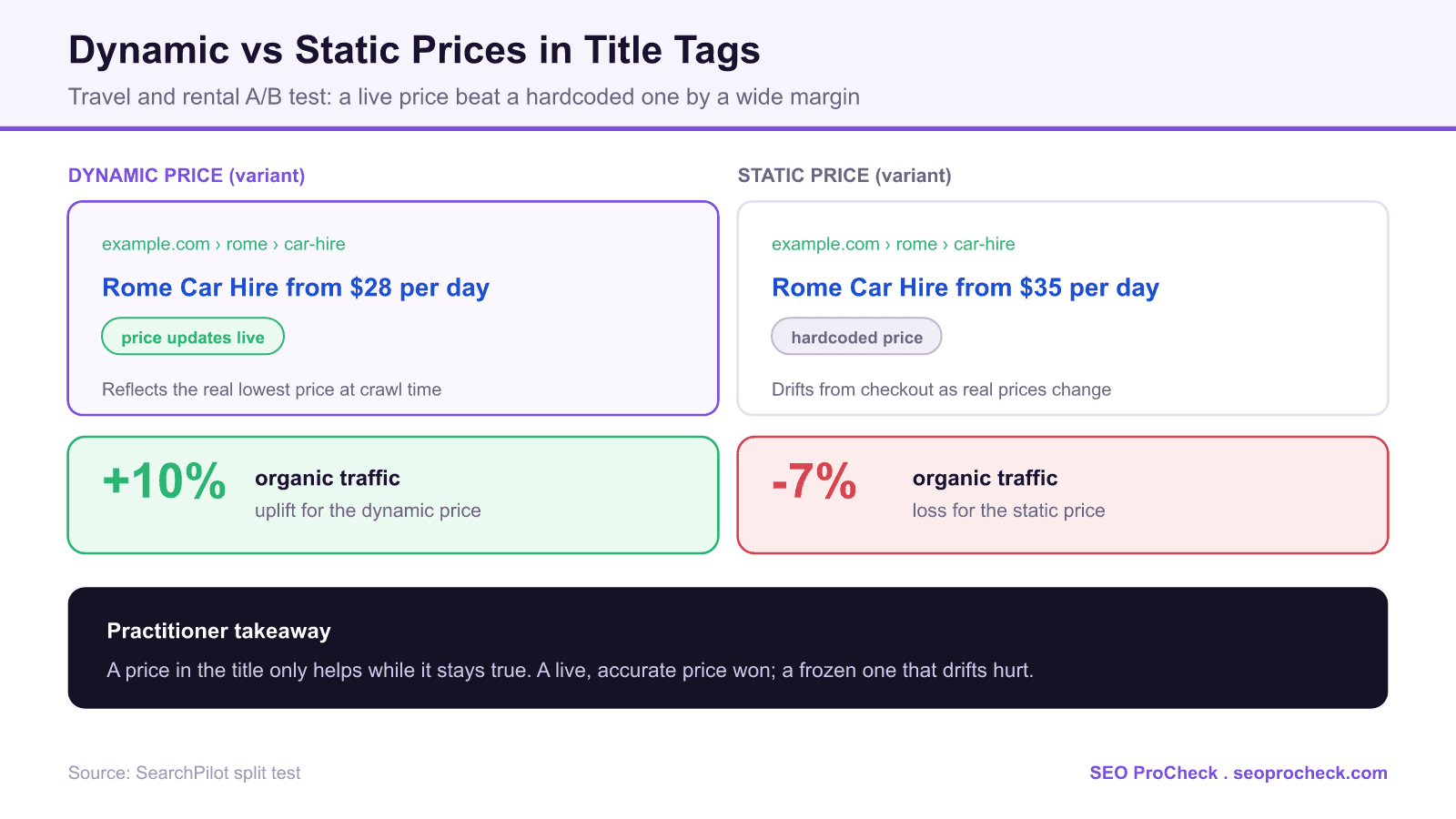
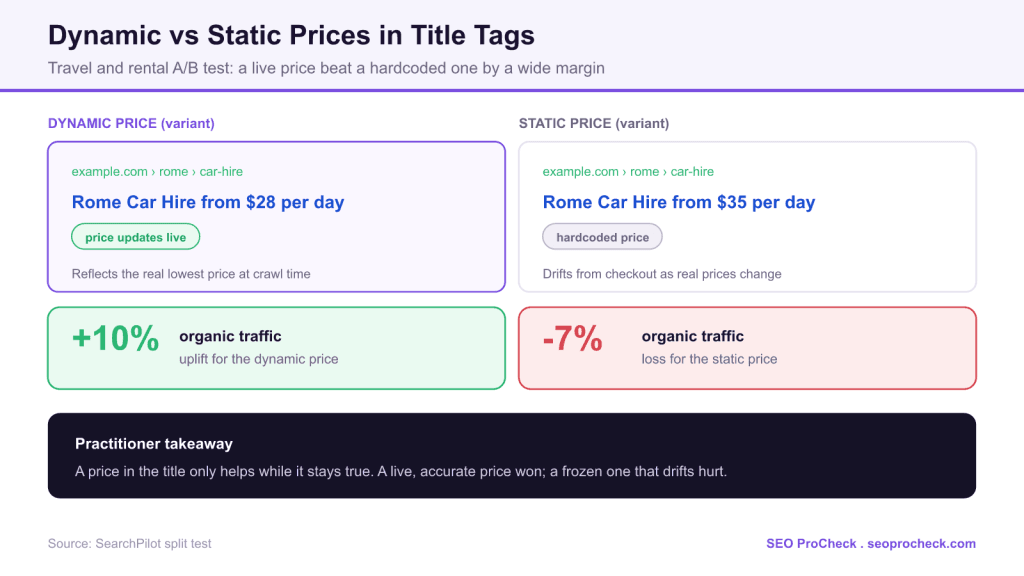
Seo split test comparison of prices in title tags: a dynamic, live updating price of 28 dollars per day gave a 10 percent organic traffic uplift, while a hardcoded static price of 35 dollars per day caused a 7 percent organic traffic loss.
A live, dynamic price in the title tag lifted organic traffic by 10 percent, while a hardcoded static price lost 7 percent, in a SearchPilot split test.

Putting a price in the title tag is a classic click-through lever for ecommerce, travel, and rental pages: a searcher scanning results sees a concrete number and a reason to click. The open question is how to source that number. Do you inject a live price that updates as inventory changes, or hardcode a representative price into the template? This case study answers it directly, and the two options do not just differ in degree, they point in opposite directions.

Initial Situation

The test ran on a customer's travel and rental website, the kind of inventory where prices move constantly with demand, season, and availability. Titles are prime real estate for a price because they are the first thing a searcher reads and they influence the click before the page even loads. The risk is equally obvious: a price shown in search that does not match what the user finds on the page is a fast way to lose trust and the click.

Strategy and Approach

SearchPilot examined two related variants. One added a dynamic price to the title, pulled from live data so the number reflected the real lowest price at crawl time. The other added a static price, a fixed number written into the title template. Each was validated with a full-funnel SEO A/B test that splits comparable pages into control and variant groups, so the traffic effect of the title change is isolated from seasonality and ranking movement rather than guessed at from a noisy before and after.

Implementation

A dynamic price token is populated server-side from your pricing or inventory source, then written into the title format for a template. The pattern looks like this, with a fallback for missing data:

if lowest_price > 0:
    title = f"{route} from {currency}{lowest_price} per day | Brand"
else:
    title = f"{route} | Brand"   # graceful fallback, never show a broken price

Three implementation rules decide whether this helps or hurts. First, render the price in the initial HTML so Googlebot sees it without executing JavaScript. Second, keep the value fresh: if your crawl-time price lags real inventory by days, you have effectively built a slow static price. Third, match the title price to the price on the page, because a mismatch between the SERP promise and the landing page is worse than showing no price at all.

Dynamic vs static price in the title

FactorDynamic priceStatic price
AccuracyTracks the real lowest price at crawl timeDrifts from reality as prices change
Searcher trustTitle matches the landing pageRisks a mismatch that loses the click
MaintenanceAutomated once wired to a live sourceNeeds manual updates that rarely happen
Main riskBroken output if the data source failsShowing a price that is simply wrong
Reported resultAbout a 10 percent organic upliftAbout a 7 percent organic loss

Results and Learnings

SearchPilot reported that implementing dynamic prices in the title tag produced roughly a 10 percent uplift in organic traffic, compared with a roughly 7 percent loss when a static price was added instead. The swing between the two is the real lesson: the same idea, a price in the title, wins decisively when the number is true and backfires when it is not. Accuracy and specificity drive the click; a stale or generic number does the opposite. This mirrors the pattern in freshness signals, where an honest "Updated Daily" claim outperformed a stale date: in titles, truth is the multiplier.

Should you add a price to your titles

  1. Only if you can keep it live. If you cannot wire the title to a current price source, do not add a price at all rather than hardcode one.
  2. Build the fallback first. Decide what the title shows when the price is missing, zero, or the feed is down, so you never render a broken or misleading number.
  3. Keep SERP and page in sync. The price in the title must match what the user sees on arrival; test this on real URLs, not just in a template preview.
  4. Split test, do not switch. Prices interact with seasonality, so an A/B split is the only reliable read. If you lack a platform, hold back a control group and compare in Search Console.

What has changed since this test

Two developments matter in 2026. Google now rewrites titles more aggressively and may drop or reformat a price you add, so confirm on the live SERP that your price is actually showing. And structured data has become the more durable home for pricing: a correct Offer with price and priceCurrency feeds rich results and increasingly feeds the price data that AI Overviews and shopping surfaces read. Treat the title price as a click-through lever and back it with accurate Offer markup so the same number is available to every surface that consumes it.

Common mistakes

  • Hardcoding a price to save engineering time. The test suggests a static price actively cost traffic, so the shortcut is worse than doing nothing.
  • Letting the title price drift from the page. A mismatch between search and landing page erodes trust and click-through.
  • Injecting the price with client-side JavaScript only. If it is not in the initial HTML, the crawler may never see it.
  • No fallback. A null or zero price that leaks into the title as "from $0" is a credibility hit on every affected URL.

FAQ

Is it better to use a dynamic or static price in a title tag?

Dynamic. On a travel and rental site, SearchPilot reported that a live, automatically updated price lifted organic traffic about 10 percent, while a hardcoded static price lost about 7 percent. A price in the title only helps when it stays accurate.

Why did the static price hurt organic traffic?

A hardcoded price drifts away from the real price over time and can contradict what the user sees on the page. That mismatch undermines trust and click-through, which is why the static variant tested negative while the live price tested positive.

How do I add a dynamic price to my title tags?

Populate a price token server-side from your live pricing or inventory source and write it into the title format for that template, with a fallback title for when the price is missing or zero. Render it in the initial HTML so the crawler sees the number without running JavaScript.

Will Google keep my price in the displayed title?

Not always. Google rewrites titles more often than it used to and may drop or reformat a price. Check the live search results and the Search Console Performance report to confirm your price is the version being shown.

Does a price in the title help with AI Overviews or shopping results?

The title itself is mainly a click-through lever. The more durable place for pricing is structured data: a correct Offer with price and priceCurrency feeds rich results and the price data that AI and shopping surfaces read. Use both, and keep the numbers consistent.

What if my prices change several times a day?

That is exactly where a dynamic price wins, as long as your crawl-time value reflects current inventory. If your pipeline only refreshes the title price occasionally, you have built a slow static price and should expect the weaker result.

Source: https://www.searchpilot.com/resources/case-studies/seo-split-test-lessons-adding-dynamic-prices-to-titles-versus-static-prices/

Wondering whether your titles are helping or hurting?

Prices, dates, and keyword order in title tags all move organic traffic, and the wrong choice can cost clicks. An audit shows which of your templates to test first.

Request an Advanced SEO Audit

  • Claude Vincent

Claude Vincent is a technical SEO consultant focused on crawlability, rendering, and AI-search visibility. He writes the field guides and case studies at SEO ProCheck, with a bias toward the durable, unglamorous work that decides whether search engines and AI answer engines can actually read and cite a site.

  • E-commerce, Title Tags

About SEO ProCheck

Technical SEO consulting and GEO strategy with 20 years of enterprise experience. Case studies, resources, and tools for search and AI visibility.

Learn more about me

Work With Me

Technical SEO audits, GEO strategy, site migrations, and international SEO. Hourly consulting for teams who need hands-on support, not just reports.

Contact now

Subscribe to our newsletter!

More from our blog


Diagram of the agent-readable file stack showing AGENTS.md in the code repository read by coding agents, llms.txt and llms-full.txt at the website root read by answer engines, and robots.txt plus RSL as the access and licensing layer beneath both.

AGENTS.md vs llms.txt vs llms-full.txt: Which Agent File Does What

AGENTS.md, llms.txt and llms-full.txt look alike but serve different readers. What each…
Continue reading

Profound vs Semrush and Ahrefs: What an AI-Search Tool Actually Replaces (and What It Doesn't)

Profound vs Semrush and Ahrefs don't measure the same thing. A practitioner's…
Continue reading
SEO is the foundation everything is built on; AEO (be the answer) and GEO (get cited) are what it makes possible

SEO vs AEO vs GEO: What Each One Means and How They Actually Differ

SEO, AEO, and GEO are three different jobs: rank in search results,…
Continue reading
Google May 2026 Core Update: What We Learned After the Dust Settled

Google May 2026 Core Update: What We Learned After the Dust Settled

The May 2026 Core Update rolled out from May 21 to June…
Continue reading
Pogosticking: The Click Pattern That Quietly Decides Who Ranks

Pogosticking: The Click Pattern That Quietly Decides Who Ranks

Pogosticking is when a searcher clicks your result, bounces back to Google,…
Continue reading
Interaction to Next Paint (INP): The Complete Guide

Interaction to Next Paint (INP): The Complete Guide

Interaction to Next Paint (INP) is the Core Web Vital that replaced…
Continue reading
SSR vs CSR: Why Rendering Decides Whether AI Can Read Your Site

SSR vs CSR: Why Rendering Decides Whether AI Can Read Your Site

AI crawlers mostly don't run JavaScript, so client-side rendering hides your content…
Continue reading
Which AI Bots Are You Actually Blocking? (GPTBot, ClaudeBot, Perplexity & More)

Which AI Bots Are You Actually Blocking? (GPTBot, ClaudeBot, Perplexity & More)

Blocking 'AI bots' isn't one switch. A field guide to GPTBot, OAI-SearchBot,…
Continue reading
Prev. Post
Next Post

Recent Posts

  • AGENTS.md vs llms.txt vs llms-full.txt: Which Agent File Does What July 18, 2026
  • Profound vs Semrush and Ahrefs: What an AI-Search Tool Actually Replaces (and What It Doesn't) June 19, 2026
  • SEO vs AEO vs GEO: What Each One Means and How They Actually Differ June 15, 2026

All Website Tags

AI SEO Analytics B2B Batch Check Content Analysis Content Quality Content Strategy Core Web Vitals Crawl Budget Crawling DOM Parsing E-commerce E-E-A-T Enterprise FAQ GEO Googlebot Google Search Console High Priority Hreflang HTTP Requests Indexing Internal Linking International SEO JavaScript SEO Keyword Research Link Building Live Check Local SEO Low Priority Medium Priority Multiple APIs On-Page SEO Page Speed PageSpeed API Rich Results SaaS Schema Validation SEO Tools SERP Features Site Architecture Site Migrations Structured Data Technical SEO Title Tags

Technical SEO consulting and GEO strategy for teams who need real implementation support. 20 years of enterprise experience across major media, technology, recruitment, and ecommerce brands, and a major enterprise brand. Case studies, research, and resources for search and AI visibility.

SEO Geek since 2004. © All Rights Reserved.

Sitemap for Humans  |  Privacy Policy   |  Terms of Service