

Clarks International SEO Migration - Struggling to Land on its Feet
- April 30, 2020
- Migrations
AI Summary
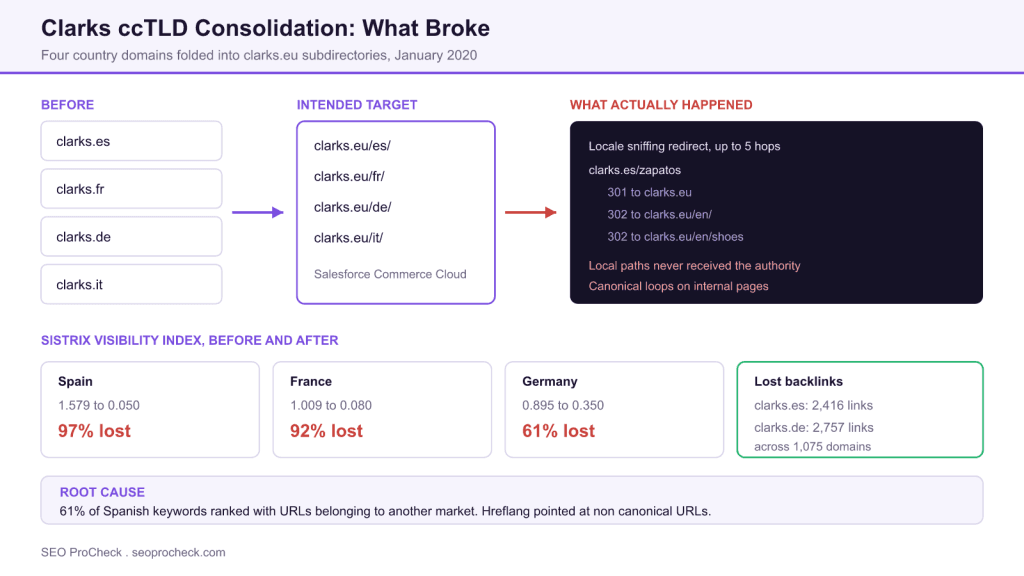
Clarks consolidated clarks.es, clarks.fr, clarks.de and clarks.it into subdirectories on clarks.eu around 20 January 2020. Sistrix measured visibility falling by almost 97% in Spain, 92% in France and 61% in Germany, and traced the damage to browser locale redirects, canonical loops and broken hreflang rather than to the consolidation strategy itself.
- Spain fell from 1.579 to 0.050 visibility points, France from 1.009 to 0.080, Germany from 0.895 to 0.350.
- Legacy country URLs were pushed through redirect chains of up to four or five hops, often landing on the
/en/version. - 61% of Spanish keywords, 68% in France and 64% in Germany ranked with URLs belonging to a different market.
- clarks.es lost 2,416 backlinks across 362 domains; clarks.de lost 2,757 links from 1,075 domains.
- Sistrix reported no significant recovery by the 30 April 2020 follow up.
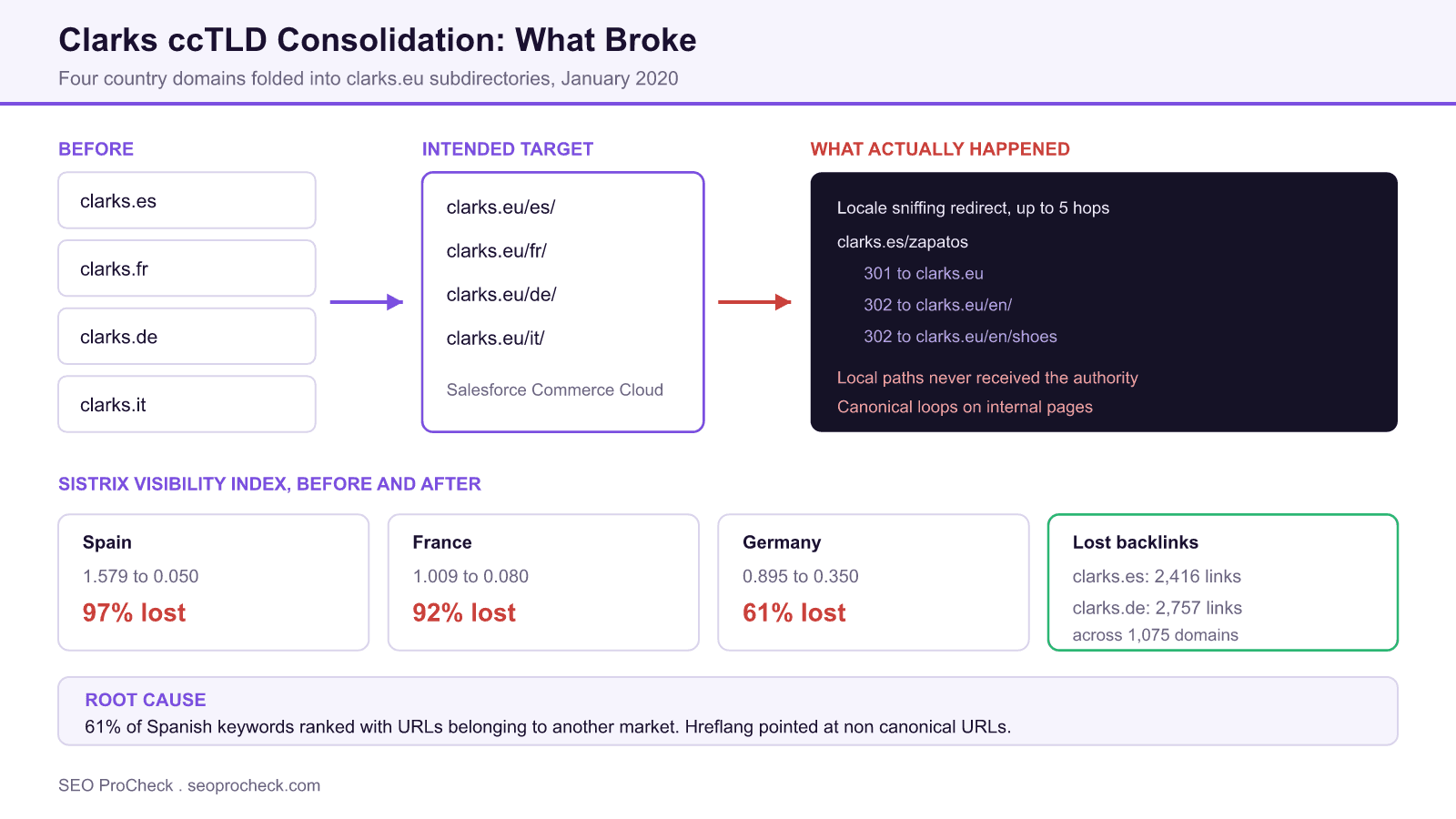
This is one of the most instructive international migrations on public record, because the strategy was reasonable and the execution was not. Consolidating a set of country code top level domains into language subdirectories on one domain is a mainstream approach: it pools authority, simplifies platform maintenance and removes the need to build every market from a cold start. Clarks did exactly that in January 2020, moving four European country domains onto clarks.eu while simultaneously replatforming onto Salesforce Commerce Cloud. Within weeks the European organic footprint had largely evaporated.
The value of the case is that Sistrix documented the failure modes precisely enough to work backwards from symptom to cause. Every one of them is a check you can run on a staging environment before launch, in under an hour, with tools you already own.
What was measured
Sistrix tracks a Visibility Index per country database, so the four markets can be read independently. The recorded movement across the migration window:
| Market | Visibility before | Visibility after | Change | Cross market ranking URLs |
|---|---|---|---|---|
| Spain (clarks.es) | 1.579 | 0.050 | almost 97% lost | 61% of keywords |
| France (clarks.fr) | 1.009 | 0.080 | almost 92% lost | 68% of keywords |
| Germany (clarks.de) | 0.895 | 0.350 | almost 61% lost | 64% of keywords |
| Italy (clarks.it) | 0.279 on 10 February | site still coexisting | not yet migrated | not applicable |
Figures as reported by Sistrix. The final column is the share of ranking keywords whose ranking URL belonged to a market other than the one being queried, which is the fingerprint of a broken hreflang and canonical setup.
Failure one: locale sniffing instead of a redirect map
The dominant fault was that legacy country URLs were not mapped one to one onto their new equivalents. Instead the new platform applied browser locale detection at the edge, and Sistrix observed chains running to four or five hops that repeatedly terminated on the /en/ version rather than the market path.
This is fatal for a crawler. Googlebot crawls predominantly from United States infrastructure and does not send a meaningful Accept-Language preference, so a locale sniffing rule routes it to English every time. The Spanish and French subdirectories that were supposed to inherit twenty years of authority were, from Googlebot's perspective, barely reachable.
# What a locale sniffing chain looks like to a crawler
curl -sIL -A 'Mozilla/5.0 (compatible; Googlebot/2.1)' https://www.clarks.es/zapatos \
  | grep -Ei '^(HTTP|location)'

HTTP/2 301
location: https://www.clarks.eu/
HTTP/2 302
location: https://www.clarks.eu/en/
HTTP/2 302
location: https://www.clarks.eu/en/shoes

# What it should have been
HTTP/2 301
location: https://www.clarks.eu/es/zapatos
The correct pattern is a static rewrite map generated from a full pre migration crawl, applied before any personalisation layer runs. Locale detection, if you want it at all, belongs behind a client side banner that suggests a switch rather than a server redirect that forces one. Google's own internationalisation guidance has warned against automatic redirection on language for years, precisely because of this crawl effect.
Failure two: canonical loops and parameter sprawl
The Salesforce Commerce Cloud move introduced a second class of problem. Sistrix noted duplicate product URLs generated per colour variant, unmanaged parameters, and internal pages that pointed a canonical tag at a URL which then redirected back to itself. A canonical that resolves into a redirect loop is worse than no canonical: the crawler cannot resolve a preferred URL for the cluster at all, so it either picks one arbitrarily or drops the cluster.
Every canonical target on a migrated site should return 200 directly. This is a two line audit in any crawler, and it is the single highest yield post launch check there is.
# Screaming Frog: Reports > Canonicals > Canonicals Linking To Non 200
# Or against an exported list of canonical targets:
while read u; do
  code=$(curl -s -o /dev/null -w '%{http_code}' "$u")
  [ "$code" != "200" ] && echo "$code $u"
done < canonical_targets.txt
Failure three: hreflang pointing at non canonical URLs
Hreflang annotations only take effect when every URL in the cluster is self canonical and every member returns the annotation reciprocally. Sistrix found hreflang tags pointing at URLs that were not canonical, and pages missing self referential canonicals entirely. When that happens Google discards the cluster and falls back to picking whichever version it considers strongest, which is exactly the 61% to 68% cross market ranking figure in the table above.
The practical diagnostic is simple: if a large share of your Spanish queries are being answered by an English or French URL, the hreflang cluster is not being honoured. Check reciprocity, check self canonicals, and check that every annotated URL returns 200 rather than redirecting.
Failure four: backlink attrition
Sistrix recorded clarks.es losing 2,416 links across 362 referring domains and clarks.de losing 2,757 links from 1,075 referring domains. External links are the one asset you cannot rebuild on a schedule, and they are the reason a redirect map has to be exhaustive rather than approximate. A link pointing at a URL that now needs five hops to resolve passes a fraction of what it did, and a link pointing at a URL that resolves to a soft 404 passes nothing.
Before any migration, export the top thousand linked URLs from your backlink tool of choice and treat that list as a mandatory redirect target set, separate from and in addition to your crawl based map. Verify each one resolves in a single hop to a live, indexable page on the day of launch.
The pre launch checklist this case argues for
| Check | How to run it | Pass condition |
|---|---|---|
| Redirect hop count | Crawl the full legacy URL list with 'Always Follow Redirects' enabled | Every legacy URL resolves in exactly one hop |
| Googlebot vs browser parity | Fetch key URLs with a Googlebot user agent and no Accept-Language header | Identical destination to a normal browser request |
| Canonical resolution | Export all canonical targets, status check each | 100% return 200, zero redirects or loops |
| Hreflang reciprocity | Crawler hreflang report and URL Inspection, since Google deprecated the Search Console international targeting report in 2022 | Zero missing return tags, zero non canonical targets |
| Linked URL coverage | Cross reference top linked URLs against the redirect map | Every linked URL has an explicit mapped destination |
| Parameter handling | Crawl with parameters enabled, count duplicate product URLs | Colour and size variants canonicalise to one product URL |
Run all six against staging, then re-run all six within two hours of go live. The Clarks case shows what happens when the second run is skipped.
What this case does not prove
It does not prove that ccTLDs outperform subdirectories, and it does not prove that Salesforce Commerce Cloud is bad for SEO. The confounding variables here are severe: a domain consolidation, a platform replatform and a URL structure change all shipped together. When three large changes land on the same day you lose the ability to attribute the outcome to any one of them, which is itself the migration lesson. Sequence large changes where the business will tolerate it, and instrument each phase separately.
Sistrix's own assessment was that the faults looked correctable and that recovery should not be especially difficult once the redirects and canonicals were fixed, though no significant recovery had been observed by the article's publication on 30 April 2020.
Related reading on this site
Two adjacent cases sharpen the picture. The Patient.co.uk domain migration shows what happens when the destination domain itself is the problem rather than the redirects, and the subdomain strategy analysis covers the architectural question of where content should live in the first place. For the crawl directives that decide whether any of this gets read at all, see the complete robots.txt reference.
FAQ
Sistrix attributed the collapse to redirect handling rather than the consolidation strategy itself. Old country domain URLs were pushed through browser locale detection instead of a static one to one map, producing chains of four or five hops that frequently terminated on the English version. Authority never landed on the intended local subdirectory, so the local paths started from close to zero.
No. Consolidation into subdirectories on one strong domain is a defensible strategy and many international brands run it successfully. Clarks failed on execution, not on architecture. The lesson from this case is that a ccTLD consolidation multiplies every redirect, canonical and hreflang error by the number of markets you are merging.
It is a server or edge rule that inspects the Accept-Language header or the visitor IP and redirects to a language version. Googlebot crawls predominantly from United States IPs with an English or unset Accept-Language header, so locale sniffing systematically routes the crawler to the English pages. Your non English subdirectories then look thin or unreachable to the crawler.
Google documents that it follows up to ten hops in a chain, but it treats long chains as a signal quality problem and each additional hop dilutes and delays consolidation. In practice you want a single hop from the legacy URL to the final canonical destination. The Clarks chains ran to four or five hops.
There is no fixed number and anyone quoting one is guessing. Sistrix reported no meaningful recovery by their April 2020 follow up, roughly three months after the January launch. Recovery only begins after the underlying redirect, canonical and hreflang faults are corrected, and reprocessing at scale then takes further weeks or months.
Sistrix reported clarks.es losing 2,416 links across 362 referring domains and clarks.de losing 2,757 links from 1,075 referring domains. Those are links that either pointed at URLs whose redirects no longer resolved cleanly or were dropped when the source pages were re-crawled and the destination looked broken.
Migrating across domains, markets or platforms?
An advanced audit maps every legacy URL, canonical and hreflang cluster before launch day, not after.
Take this with you
The assistant links open with a question about this page already written. Nothing is sent until you press enter.
Claude Vincent is a technical SEO consultant focused on crawlability, rendering, and AI-search visibility. He writes the field guides and case studies at SEO ProCheck, with a bias toward the durable, unglamorous work that decides whether search engines and AI answer engines can actually read and cite a site.
About SEO ProCheck
Technical SEO consulting and GEO strategy with 20 years of enterprise experience. Case studies, resources, and tools for search and AI visibility.
Work With Me
Technical SEO audits, GEO strategy, site migrations, and international SEO. Hourly consulting for teams who need hands-on support, not just reports.
Subscribe to our newsletter!








Recent Posts
- Most Top Sites Never Say Who They Are in Structured Data October 14, 2026
- Homepage Titles Are Mostly Too Short, Not Too Long October 8, 2026
- Who Actually Serves an llms.txt? 184 Top Sites Measured September 29, 2026