

Your subdomain strategy could be seriously harming your SEO
- January 18, 2021
- Website Architecture
AI Summary
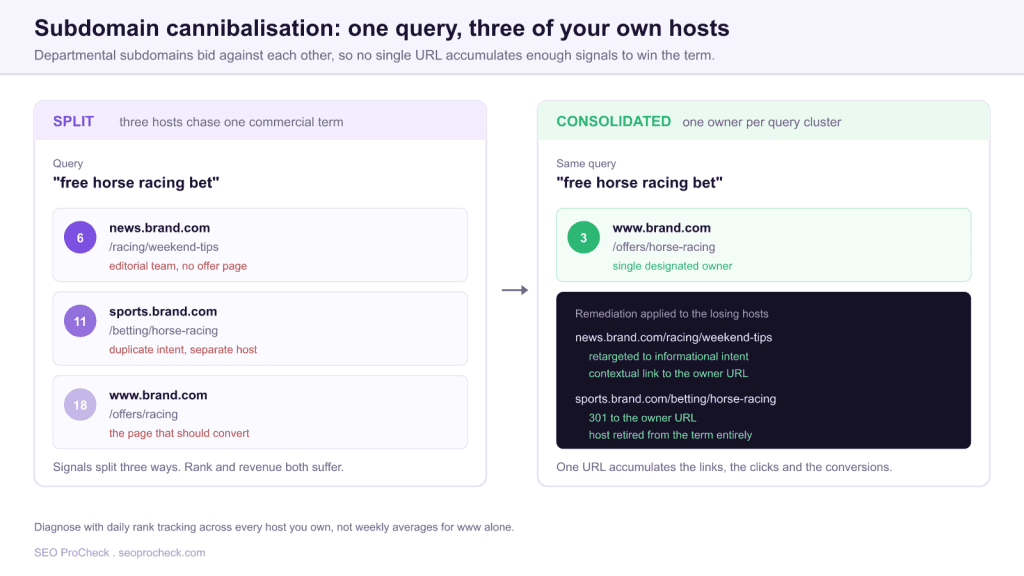
Subdomains split a brand across multiple hosts, and when two or more of those hosts publish pages that answer the same query, they compete with each other instead of with rivals. The fix is not to abolish subdomains but to assign exactly one owning URL per query cluster and retarget or redirect the rest.
- Conflict is invisible in a URL-prefix Search Console property, because that property type excludes other subdomains. Use a Domain property.
- The tell is a single query returning impressions for two or more of your own hosts, usually with both ranking below their potential.
- Departmental ownership causes it: news, editorial, careers and regional teams publish against commercial terms without coordination.
- Remediation is a ladder: retarget intent first, canonical or 301 second, retire the host from the term last.
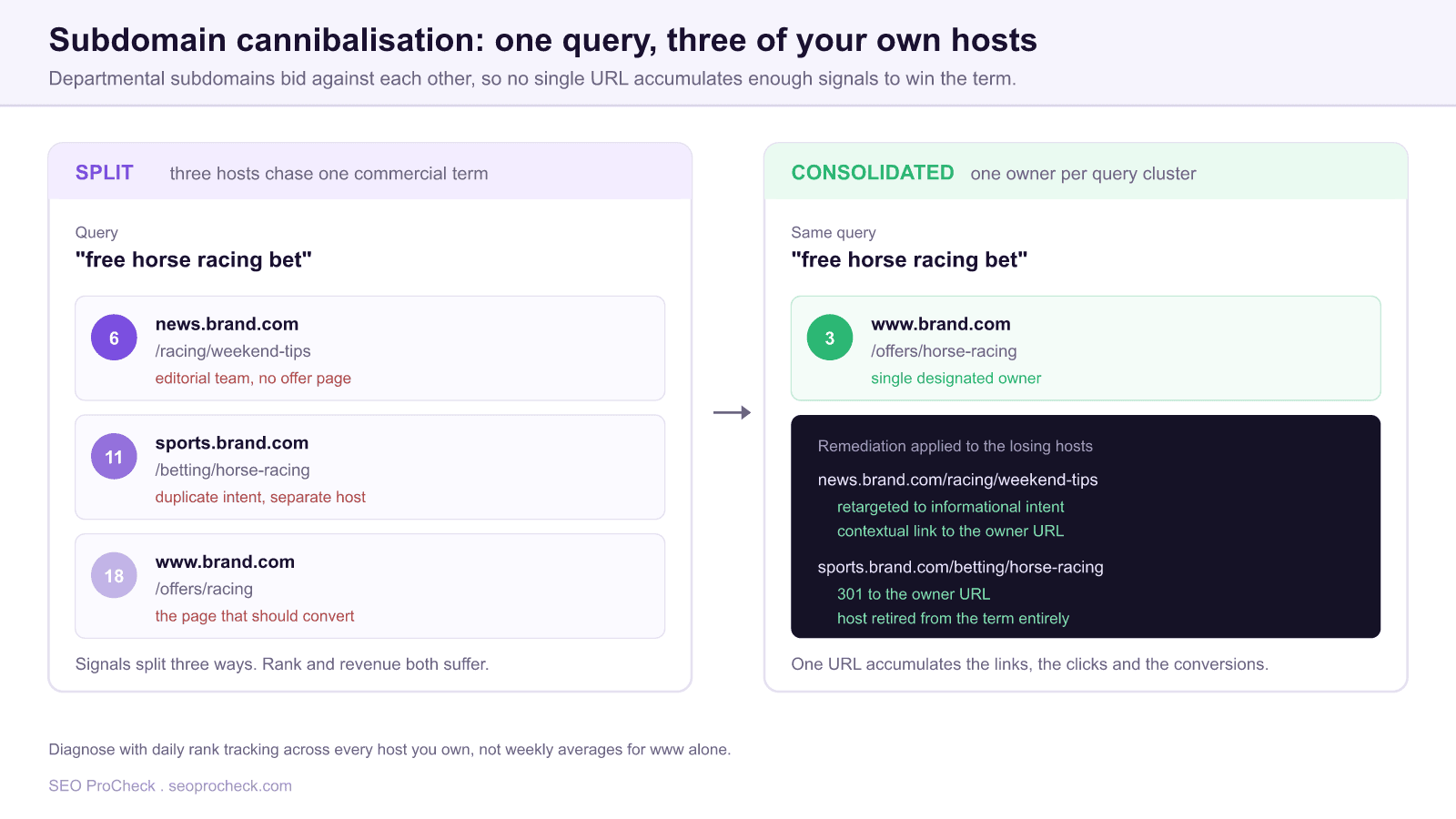
Subdomains almost never start as an SEO decision. They start as an infrastructure or org-chart decision: the editorial team wants its own CMS, the careers team buys a hosted product, the regional office wants autonomy, and each one gets a host of its own. Search engines then evaluate those hosts as related but distinct properties. The moment two of them publish content that answers the same query, the brand stops competing with its rivals and starts competing with itself.
The case study behind this page, from Pi Datametrics, documents that failure mode across four sectors. In gambling, a three-way conflict for the commercial term "free horse racing bet" ran across news and sports subdomains as well as the main site. In finance, a major UK bank's personal banking subdomain conflicted with its own primary domain. In travel, an airline's blog subdomain cannibalised the main site for "Sharm el Sheikh city breaks" and the primary domain lost positions. In fashion retail, a reseller subdomain competed with the retailer's own product pages, and international subdomains surfaced in the wrong geographic markets entirely.
What makes this class of problem expensive is not the ranking loss on its own. It is that the URL which loses is usually the one that converts, and the URL which wins is usually the one that cannot. An editorial tips page outranking your offers page for a bottom-of-funnel term is a revenue transfer from the commercial team to nobody.
Why subdomains fragment your visibility
Google has stated that it can treat subdomains and subdirectories similarly, and in practice it often does. That statement gets quoted as though it settles the argument. It does not, because the consolidation question is not really about how the crawler parses a hostname. It is about four practical effects that follow from splitting a site across hosts.
Signal dilution. Links, engagement and internal link equity accrue to whichever URL earns them. Two pages covering one topic on two hosts each earn a fraction of the links a single page would have earned, and neither reaches the threshold where it wins.
Selection instability. When several of your URLs are plausible answers, the engine picks one, and that choice can flip between crawls. Practitioners see this as a query whose ranking URL changes week to week while the aggregate position drifts down. This is the same mechanism as ordinary content cannibalization, made harder to spot because the competing URL sits on a host nobody on the SEO team monitors.
Governance drift. Separate hosts usually mean separate teams, separate templates, separate analytics and separate release cycles. Nobody owns the overlap, so it grows.
Measurement blindness. This is the one that keeps the problem alive for years, and it deserves its own section.
How to detect subdomain conflict
The single most common reason a team believes it has no subdomain problem is that its Search Console property cannot see one. A URL-prefix property for https://www.brand.com/ reports only URLs beginning with that prefix. Pages on news.brand.com or shop.brand.com are simply absent from the data. If your only property is a URL-prefix property on www, a competing subdomain is invisible by construction.
The first move is therefore to verify a Domain property (DNS-verified, entered without a scheme, for example brand.com). A Domain property aggregates every subdomain and both protocols. From there, the detection procedure is mechanical:
- In the Domain property, open Performance > Search results and set the date range to at least 3 months.
- Export the Queries and Pages dimensions together. The UI caps this, so for a real site use the Search Console API and request
dimensions: ["query","page"], which returns the pairing directly. - Derive the host from each page URL, then group by query and count distinct hosts. Any query with two or more hosts holding impressions is a conflict candidate.
- Rank the candidates by impressions and by commercial value, not by volume alone. A 90-impression conflict on a term that converts outranks a 90,000-impression conflict on a term that does not.
- Confirm with daily rank tracking rather than monthly averages. The source study is emphatic on this point, and it is correct: monthly averages smooth over exactly the URL flip-flopping that identifies the conflict. Track the top 100 positions so you can see the losing URL as well as the winning one.
A regex filter in Search Console is useful for a quick check without an export. Filter Page by a custom regex such as ^https?://(news|shop|blog|careers)\.brand\.com and compare the query list against the same report filtered to www. Overlapping queries are your shortlist.
| Sector pattern | Hosts in conflict | Query character | Commercial consequence |
|---|---|---|---|
| Gambling | News and sports subdomains plus main site | Broad commercial term ("free horse racing bet") | Three-way split on the term most likely to convert |
| Finance | Personal banking subdomain vs primary domain | Product and category terms | Reduced overall search performance for the brand |
| Travel | Blog subdomain vs main site | Destination term ("Sharm el Sheikh city breaks") | Primary domain lost positions to its own blog |
| Fashion retail | Reseller subdomain vs product pages | Product terms | Margin-diluting host outranks first-party product pages |
| Fashion retail, international | Regional subdomains | Localised product terms | Wrong market's host surfaces, wrong currency and stock |
Remediation: assigning one owner per query cluster
Consolidation is a governance exercise before it is a technical one. Build a register that maps each commercially important query cluster to exactly one owning URL, and get the owning team named in writing. Everything downstream follows from that register.
Apply remediation as a ladder, cheapest and least destructive first:
- Retarget the intent. Often both pages deserve to exist, they were just written against the same intent. Rewrite the losing page for the informational variant, change its title and H1, and point a contextual internal link at the owner URL. Nothing is lost and the cluster gets a supporting page.
- Canonical. Where two URLs are genuinely near duplicates and both must remain reachable, set
rel="canonical"on the non-owner pointing at the owner. Cross-host canonicals are respected, but treated as a hint, so verify adoption in the Search Console Page indexing report under "Alternate page with proper canonical tag". - 301 redirect. When the losing page has no independent reason to exist, redirect it. This is the only option that transfers the accumulated signals outright.
- Retire the host from the term. For a systematic offender such as a regional host surfacing in the wrong market, fix targeting at the platform level: correct
hreflangannotation, correct internal linking, and consider whether that market belongs on a subdomain at all. Our comparison of ccTLD vs subdirectory vs subdomain covers that trade-off in full.
Resist the urge to reach straight for a mass migration. Moving an entire blog from a subdomain to a subfolder is a legitimate long-term play, and it usually does concentrate signals, but it is a project with real regression risk. Do the query-level consolidation first. It is faster, reversible, and it tells you how much of the upside was ever available. If you do decide to migrate, plan it against the patterns in our guide to URL architecture for large sites.
What recovery looks like, and how to measure it
Do not measure a consolidation by the owner URL's position alone. That number can improve while total brand visibility for the cluster falls, which happens when you redirect a page that was earning impressions on a long tail nobody mapped. Track four things together:
- Distinct hosts per query. This is the primary success metric. It should fall to one for every cluster in your register. Re-run the detection export monthly.
- Combined clicks for the cluster, summed across every host, before and after. This is what protects you from declaring victory on a cannibalised term whose total traffic dropped.
- Position stability, not just position. Count how many days in a 30-day window the ranking URL changed. A consolidation that works shows one URL holding the slot.
- Conversion attribution for the owner URL, because the entire point was to route demand to a page that can transact.
Expect the timeline to run in weeks rather than days. Redirects and canonicals need recrawl and reprocessing before the engine settles on the new owner, and the deeper the losing URL sits, the longer the tail. Annotate the change date in your reporting so the recovery curve is readable later.
One structural note worth carrying into your next architecture review: none of these brands set out to cannibalise themselves. They set out to give teams autonomy, and the hostname was the cheapest boundary to hand them. If you are designing a new estate, decide the ownership model first and let the site architecture express it, rather than inheriting an architecture and discovering the ownership model afterwards.
Frequently asked questions
Does Google treat a subdomain as a separate website?
Google has said it can treat subdomains and subdirectories similarly for crawling and indexing, and it generally understands that they belong to one organisation. The practical differences show up elsewhere: link equity and engagement accrue per URL, Search Console URL-prefix properties are host-scoped, and separate hosts usually mean separate teams and templates. So the honest answer is that the crawler is not the problem, the fragmentation around it is.
Do subdomains hurt SEO?
A subdomain is not inherently harmful. It becomes harmful when two hosts you own answer the same query, when a subdomain holds content that should be consolidating authority into the main site, or when regional hosts surface in the wrong market. Plenty of subdomains are correct by design, including status pages, developer documentation, user-generated content platforms and genuinely separate brands.
How do I find subdomain cannibalisation in Google Search Console?
Verify a Domain property rather than a URL-prefix property, because the prefix type excludes other subdomains. Then pull query and page dimensions together through the Search Console API, derive the host from each page URL, and count distinct hosts per query. Any query with impressions on two or more of your hosts is a candidate, and you should confirm it with daily rank tracking.
Should I move my blog from a subdomain to a subfolder?
Often yes, but not first. Query-level consolidation is faster, reversible and tells you how much upside actually exists before you commit to a migration. If the blog is systematically outranking commercial pages for commercial terms, that is an intent problem you can fix without moving anything. Migrate when you want the long-term consolidation and you can resource the redirect mapping and regression testing properly.
What is the difference between subdomain conflict and ordinary keyword cannibalisation?
The mechanism is the same, two of your URLs competing for one intent. The difference is detectability and ownership. Ordinary cannibalisation happens inside one site, where your crawler and your Search Console property both see it. Subdomain conflict happens across a boundary that most reporting setups exclude, and the competing page usually belongs to a team with no SEO mandate.
How long does it take to recover after consolidating?
Plan for weeks, not days. Redirects and cross-host canonicals have to be recrawled and reprocessed before the engine settles on the new owning URL, and pages that ranked deep take longest. Track distinct hosts per query and combined cluster clicks throughout, so you can tell a genuine consolidation from a net loss.
Subdomain conflict is one of the few technical SEO problems where the diagnosis is harder than the cure. Once you can see it, most of the remediation is unglamorous editorial and redirect work. The reason it persists at large organisations is that the default reporting setup is built so it cannot appear.
Source: https://www.pi-datametrics.com/blog/identify-seo-sub-domain-conflict-cannibalisation/
Take this with you
The assistant links open with a question about this page already written. Nothing is sent until you press enter.
Claude Vincent is a technical SEO consultant focused on crawlability, rendering, and AI-search visibility. He writes the field guides and case studies at SEO ProCheck, with a bias toward the durable, unglamorous work that decides whether search engines and AI answer engines can actually read and cite a site.
About SEO ProCheck
Technical SEO consulting and GEO strategy with 20 years of enterprise experience. Case studies, resources, and tools for search and AI visibility.
Work With Me
Technical SEO audits, GEO strategy, site migrations, and international SEO. Hourly consulting for teams who need hands-on support, not just reports.
Subscribe to our newsletter!








Recent Posts
- Most Top Sites Never Say Who They Are in Structured Data October 14, 2026
- Homepage Titles Are Mostly Too Short, Not Too Long October 8, 2026
- Who Actually Serves an llms.txt? 184 Top Sites Measured September 29, 2026