

![15 site architecture tips for seo [master guide]](https://seoprocheck.com/wp-content/uploads/15-site-architecture-tips-for-seo-master-guide-1024x576.png "15 site architecture tips for seo [master guide] 3")
AI Summary
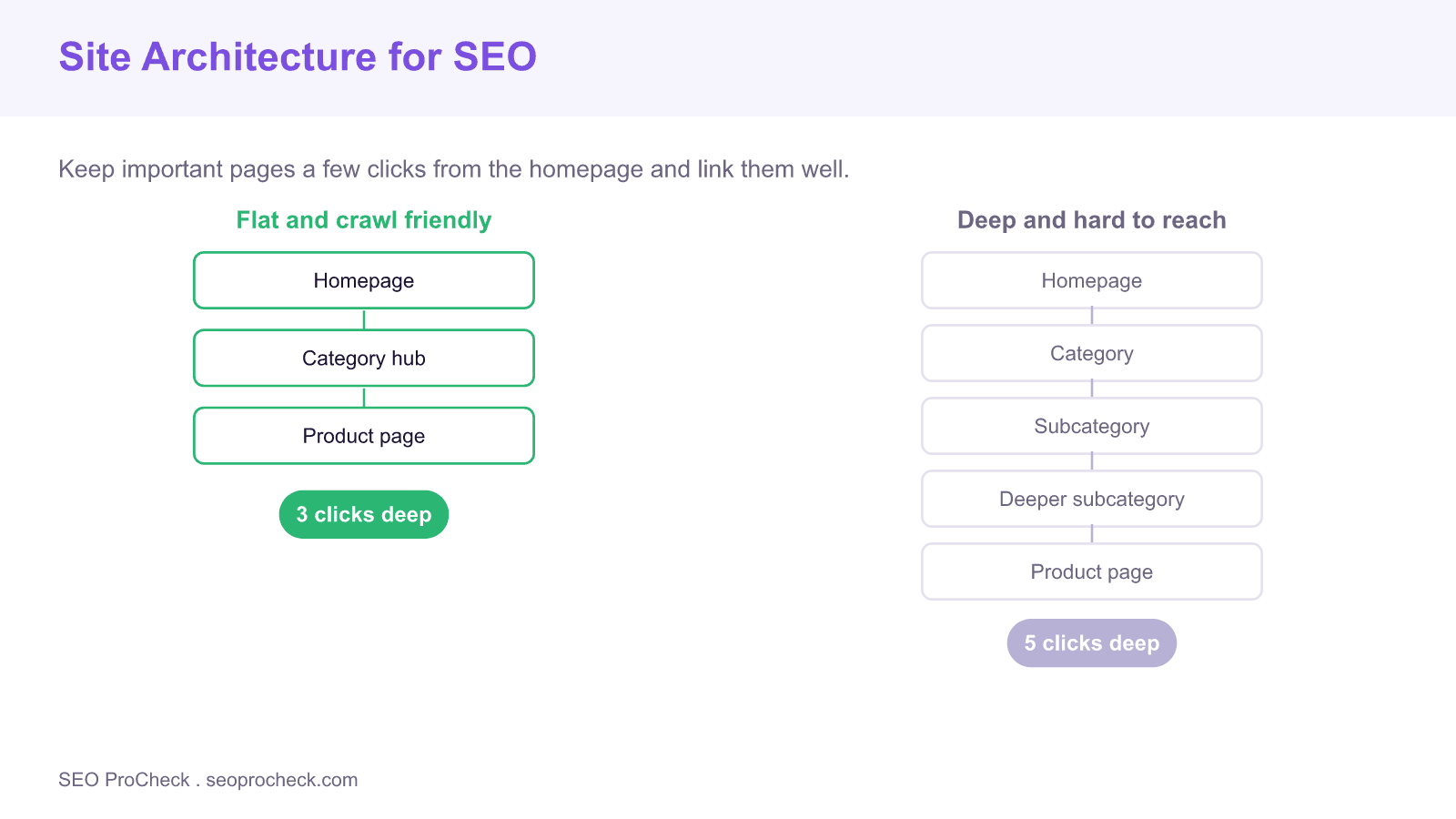
Good site architecture keeps important pages within a few clicks of the homepage, groups related content into clear hub and spoke sections, and uses internal links, breadcrumbs, and descriptive URLs so users and crawlers can reach and understand every page. The payoff is faster discovery, more efficient crawling, and stronger topical relevance that tends to lift a whole section rather than one page.
- Keep key pages within about three clicks of the homepage.
- Group content into hub pages that link to related detail pages.
- Use internal links and breadcrumbs to spread relevance and context.
- Keep URLs shallow and descriptive and remove orphan pages.
This SEO case study documents a successful optimization initiative, providing actionable insights for practitioners. The documented approach demonstrates how strategic SEO implementation drives measurable results.
Initial Situation
Understanding the starting point is essential context for evaluating any case study. This documentation covers the initial challenges, competitive position, and business objectives that shaped the SEO strategy.
Strategy and Approach
The strategic approach combined multiple SEO disciplines to address identified opportunities. Key decisions around prioritization and resource allocation provide a template for similar initiatives.
Implementation
Moving from strategy to execution required specific technical implementations, content development, and process changes. This case study documents the practical steps that translated strategy into action.
Results and Learnings
The outcomes demonstrate effectiveness through measurable improvements in rankings, traffic, and business metrics. Analysis of successes and challenges provides learning value for practitioners.
Case studies like this contribute to the SEO knowledge base, helping practitioners learn from documented real-world experiences.
Source: https://zyppy.com/site-architecture-seo/
15 site architecture tips for SEO
- Keep click depth shallow. Aim to reach any important page within about three clicks of the homepage. Depth is measured by the shortest link path, so a strong internal link can pull a deep page closer without moving it in the URL.
- Design around hubs and spokes. Give each topic a hub page that links out to detailed spoke pages, and have the spokes link back to the hub. This concentrates relevance and gives crawlers an obvious map of the section.
- Group content into clear sections. Organize the site into a small number of top level sections that reflect how people search, not your internal departments. Clear sections make navigation and breadcrumb trails simple.
- Use descriptive, shallow URLs. Keep URLs readable and avoid piling on folder levels. A path such as /running-shoes/trail/ communicates structure far better than a string of numeric IDs.
- Add breadcrumb navigation. Breadcrumbs expose the hierarchy to users and search engines and create consistent internal links up the tree. Mark them up with BreadcrumbList structured data.
- Link with descriptive anchor text. Internal anchor text tells Google what the target page is about. Prefer clear phrases over generic click here so the link passes useful context.
- Eliminate orphan pages. Every page that matters should have at least one internal link pointing at it. Orphans rely on sitemaps alone and tend to be crawled and ranked poorly.
- Control faceted navigation. Filter and sort parameters can spawn millions of thin, near duplicate URLs. Decide which facets should be crawlable and block or canonicalize the rest.
- Build strong category pages. Category and hub pages often win broad head terms that product pages cannot. Give them unique copy and internal links rather than leaving them as bare grids.
- Keep a clean XML sitemap. List canonical, indexable URLs only, keep it current, and submit it in Search Console. The sitemap supports discovery but does not replace internal linking.
- Consolidate duplicate paths. When several URLs reach the same content, pick one canonical version and point the rest at it so ranking signals are not split.
- Mind crawl budget on large sites. On big catalogs, wasted crawling on parameters and dead ends steals attention from pages that matter. Tidy internal linking and parameter handling focus the crawl.
- Use pagination sensibly. For long lists, keep paginated URLs crawlable and self referencing rather than hiding deeper pages behind scripts that block discovery.
- Interlink related content. Connect related articles and products with contextual links so relevance flows between them and users find the next logical step.
- Review architecture as you grow. Structure that suited a hundred pages breaks at ten thousand. Re audit depth, orphans, and internal links whenever the site scales.
How to audit your architecture
Turn the principles above into a repeatable check. Crawl the site with a tool such as Screaming Frog or Sitebulb, then look at three views: the depth report to find pages that sit too many clicks from the homepage, the inlinks column to spot pages with very few or zero internal links, and the list of parameter URLs to see where faceted navigation is multiplying thin pages. Cross reference the crawl against your XML sitemap and your analytics so you can see which valuable pages are both deep and under linked, because those are the fastest wins.
The table below is a practical starting checklist you can score a template against.
| Element | What good looks like | How to audit it |
|---|---|---|
| Click depth | Key pages within three clicks | Crawl depth report in Screaming Frog |
| Internal links | Every key page linked from several others | Inlinks column, find pages with zero |
| URL structure | Shallow, readable, keyword bearing | Scan URL list for depth and IDs |
| Breadcrumbs | Present with BreadcrumbList markup | Rich Results Test on a template |
| Orphan pages | None among pages that matter | Compare crawl against sitemap |
| Faceted navigation | Crawlable facets chosen deliberately | Review parameter URLs and canonicals |
What has changed since this guide
The fundamentals of shallow depth, clear hubs, and strong internal linking have held up well, but two shifts are worth noting. First, Google has grown better at rendering and following links in modern JavaScript frameworks, yet server accessible links and clean URLs remain the safest way to guarantee discovery. Second, as search results increasingly summarize whole topics, a well built hub and spoke structure that demonstrates real topical coverage helps a site be treated as an authority on a subject rather than a scatter of unconnected pages. If you are revisiting an older architecture, prioritize reducing orphan pages, tightening click depth on money pages, and giving category hubs genuine content and links.
For related reading see our website architecture case study library, the crawling and indexing studies, and our meta robots and X Robots Tag reference for controlling what gets crawled and indexed.
Frequently asked questions
What is site architecture in SEO?
Site architecture is the way pages are organized and linked together, including the hierarchy of sections, the internal link paths between pages, and the URL structure. Good architecture helps users and search engines find, understand, and prioritize the pages that matter.
How many clicks deep should a page be?
As a working rule, keep pages you care about within roughly three clicks of the homepage. What matters is the shortest link path rather than the URL folder depth, so a well placed internal link can bring a deep page much closer to the surface.
Does a flat site structure rank better?
Flatter structures usually help because they shorten the path crawlers and users take to reach content and spread internal link value more evenly. The goal is not to remove hierarchy but to avoid burying important pages under many layers of navigation.
What is hub and spoke architecture?
Hub and spoke, sometimes called a topic cluster, is a pattern where a central hub page covers a topic broadly and links out to detailed spoke pages that each cover a subtopic, with the spokes linking back to the hub. It concentrates topical relevance and gives search engines a clear structure to follow.
How do internal links affect SEO?
Internal links pass relevance and authority between pages, help search engines discover new URLs, and signal which pages are most important through how often and how prominently they are linked. Descriptive anchor text adds context about the target page.
What are orphan pages and why are they a problem?
Orphan pages have no internal links pointing to them, so they can only be found through a sitemap or an external link. Search engines tend to crawl them rarely and rank them weakly because the site itself is not signaling that they matter.
Take this with you
The assistant links open with a question about this page already written. Nothing is sent until you press enter.
Claude Vincent is a technical SEO consultant focused on crawlability, rendering, and AI-search visibility. He writes the field guides and case studies at SEO ProCheck, with a bias toward the durable, unglamorous work that decides whether search engines and AI answer engines can actually read and cite a site.
About SEO ProCheck
Technical SEO consulting and GEO strategy with 20 years of enterprise experience. Case studies, resources, and tools for search and AI visibility.
Work With Me
Technical SEO audits, GEO strategy, site migrations, and international SEO. Hourly consulting for teams who need hands-on support, not just reports.
Subscribe to our newsletter!








Recent Posts
- Most Top Sites Never Say Who They Are in Structured Data October 14, 2026
- Homepage Titles Are Mostly Too Short, Not Too Long October 8, 2026
- Who Actually Serves an llms.txt? 184 Top Sites Measured September 29, 2026