

Does redirecting trailing slash URLs to the non-trailing slash equivalent improve organic traffic?
- January 12, 2023
- Website Architecture
AI Summary
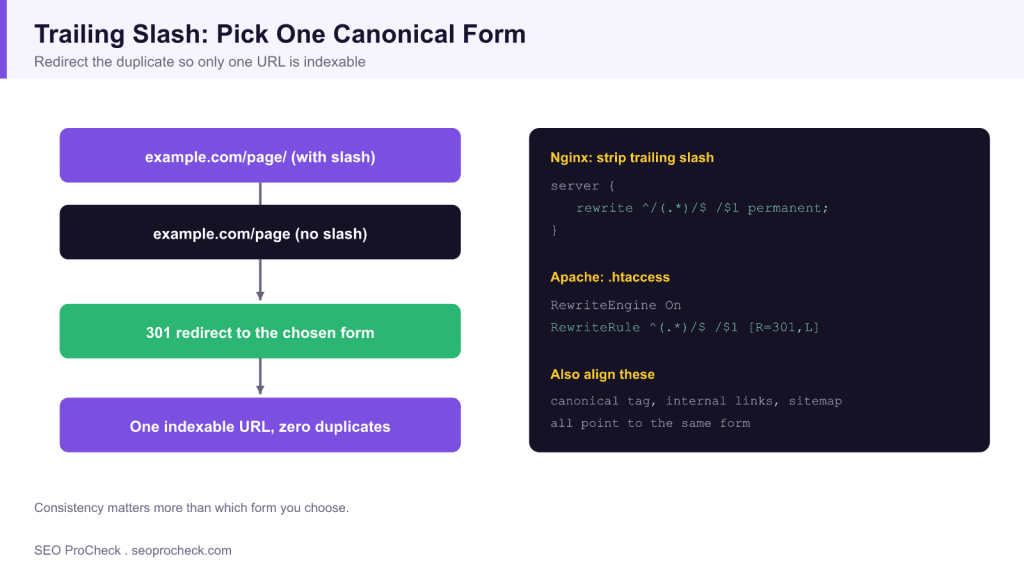
Serving a page at both a trailing slash and a non trailing slash URL creates duplicate URLs that split signals and waste crawl budget. Redirecting one form to the other with a 301, as tested in the SearchPilot split test this page references, consolidates those URLs so a single version is indexed, and the practical win comes from consistency rather than from which form you pick.
- example.com/page and example.com/page/ are different URLs to a crawler.
- A 301 from one form to the other removes the duplicate and consolidates link equity.
- Whether the redirect measurably lifts traffic depends on how much duplication existed before.
- Canonical tags, internal links, and the sitemap must all point to the same chosen form.
Why the trailing slash matters at all
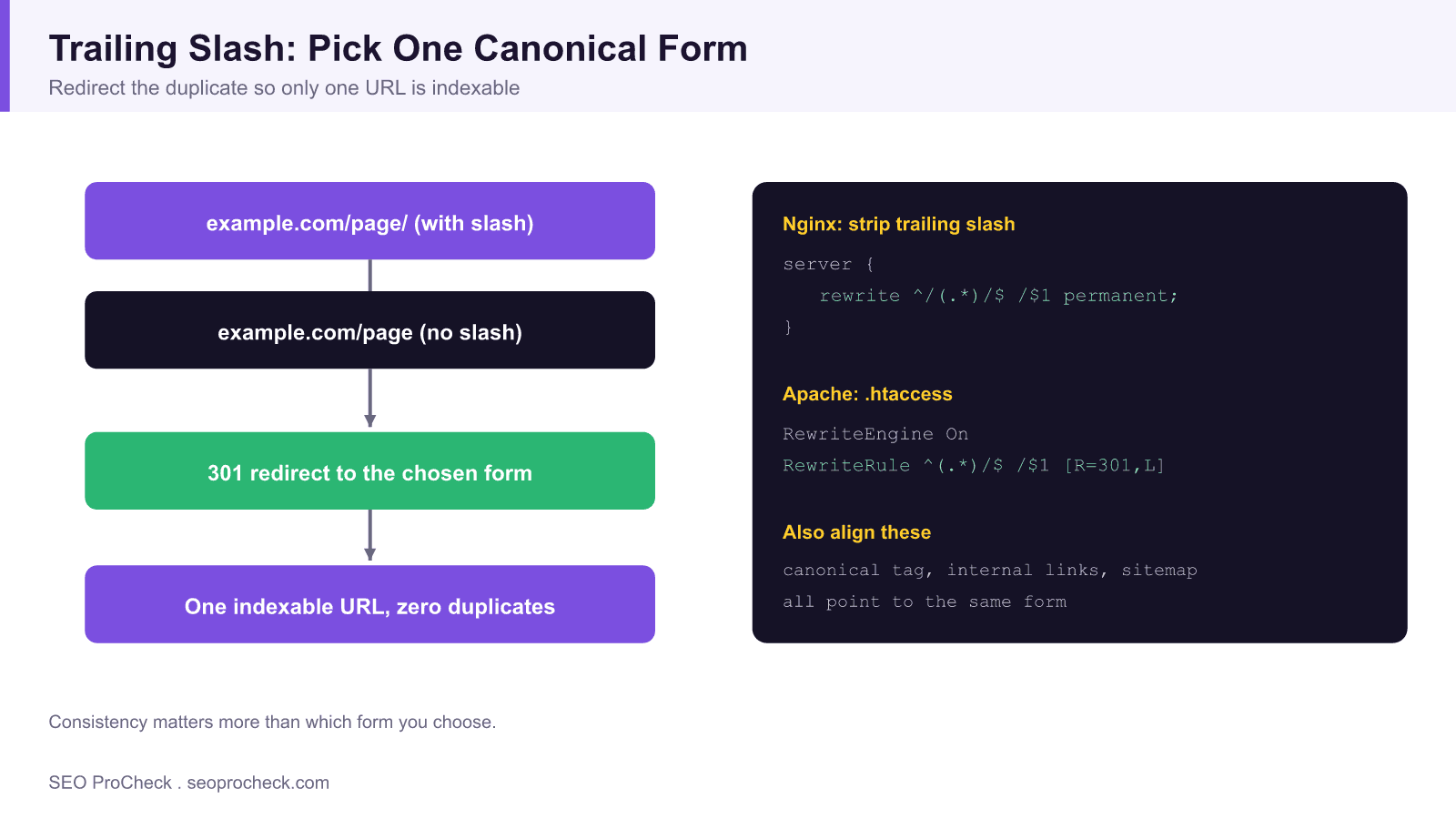
To a browser the trailing slash can feel cosmetic, but to a search engine example.com/page and example.com/page/ are two distinct URLs that can each be crawled, indexed, and linked. When both resolve with a 200 status and serve the same content, you have created a duplicate. Signals that should reinforce one page get divided between two, crawlers spend budget fetching the same content twice, and reporting fragments across two rows. The SearchPilot case study referenced here ran a controlled split test on exactly this question: does redirecting trailing slash URLs to the non trailing slash equivalent improve organic traffic.
The honest expectation to set is that the size of the win scales with the size of the problem. A site where both forms were widely indexed and internally linked has more consolidation to gain than a site that was already mostly consistent. That is why split testing the change on your own templates, rather than assuming a fixed uplift, is the right instinct, and it is what makes SearchPilot style testing valuable.
How to implement it correctly
Pick one form and enforce it everywhere. Most modern stacks default to no trailing slash for file like paths and a trailing slash for directory like paths, so match your platform default to avoid fighting the framework. Then apply a permanent redirect at the server level so the duplicate never returns a 200.
Nginx, strip the trailing slash:
server {
    rewrite ^/(.*)/$ /$1 permanent;
}
Apache, in .htaccess:
RewriteEngine On
RewriteRule ^(.*)/$ /$1 [R=301,L]
The redirect is necessary but not sufficient. Every other signal must agree with the chosen form, otherwise you leave mixed messages that blunt the benefit and can even create redirect chains.
Signals that must all point to the same form
| Signal | Common mistake | Correct state |
|---|---|---|
| Server redirect | Only one direction handled, or a redirect chain | Single 301 straight to the chosen form |
| Canonical tag | Points to the non chosen variant | Self referential to the chosen form |
| Internal links | Mixed slashed and unslashed hrefs | All hrefs use the chosen form |
| XML sitemap | Lists the variant that gets redirected | Lists only the final indexable URL |
| Hreflang and pagination | Reference the wrong variant | Reference the chosen form consistently |
Testing the change before rolling it out
If you have SEO split testing available, treat trailing slash consolidation like any other hypothesis: apply it to a randomized set of pages, hold a control group, and measure the difference in organic clicks rather than eyeballing rankings. This is the method behind the referenced case study, and it protects you from crediting a redirect for a change that was really seasonality or an unrelated update. If you cannot split test, validate mechanically instead: crawl the site and confirm each duplicate returns a single 301 to the chosen form, that no internal link points at a redirecting URL, and that Search Console stops reporting the redirected variant as indexed over the following weeks.
The original resource
AI and generative search optimization represents an emerging frontier for organic visibility. This case study documents approaches to improving visibility in AI-powered search experiences and LLM citations.
AI Search Context
As AI increasingly mediates search, understanding how AI systems select and cite sources becomes strategically important. This case study establishes the AI visibility challenges and opportunities addressed.
Optimization Approach
GEO optimization differs from traditional SEO in key ways. This case study documents specific approaches to content structure, factual density, and authority signals that improve AI citation likelihood.
Implementation Details
Moving from GEO concept to practice requires specific content changes and measurement approaches. This case study covers implementation methodology and how AI visibility was tracked and measured.
AI Visibility Results
Success in AI search manifests as citations, mentions, and referral traffic from AI platforms. This case study quantifies AI visibility improvements and their business impact.
Early GEO case studies like this help practitioners understand the emerging AI search optimization landscape.
Frequently asked questions
Does removing trailing slashes always improve traffic?
Not always. The benefit depends on how much duplication existed beforehand. A site where both URL forms were indexed and linked has real consolidation to gain, while a site that was already consistent may see little change, which is why controlled testing beats assuming a fixed uplift.
Which is better for SEO, trailing slash or no trailing slash?
Neither is inherently better for ranking. Google treats them as equally valid as long as you are consistent. Choose the form that matches your platform default, enforce it everywhere, and do not switch back and forth.
Will a 301 redirect lose link equity?
A single 301 passes the vast majority of signals to the destination, so a clean one to one redirect is safe. The risk comes from redirect chains and from internal links that still point at the redirecting URL, both of which you should eliminate.
Do I still need a canonical tag if I use a 301?
Yes, keep a self referential canonical on the chosen form. The 301 handles requests to the duplicate URL, while the canonical reinforces the correct version for any variant that is discovered through links or parameters.
How do I find trailing slash duplicates on my site?
Crawl the site with a tool that reports status codes and canonicals, then look for URLs that resolve at both forms with a 200, and for internal links that mix slashed and unslashed paths. Search Console index coverage can also reveal both variants being indexed.
Can inconsistent trailing slashes cause redirect chains?
Yes. If some links point to a slashed URL that redirects to unslashed, which then redirects again for another reason, you build a chain that slows crawling and dilutes signals. Aim for a single hop from any duplicate straight to the final URL.
Related reading on seoprocheck.com
Claude Vincent is a technical SEO consultant focused on crawlability, rendering, and AI-search visibility. He writes the field guides and case studies at SEO ProCheck, with a bias toward the durable, unglamorous work that decides whether search engines and AI answer engines can actually read and cite a site.
About SEO ProCheck
Technical SEO consulting and GEO strategy with 20 years of enterprise experience. Case studies, resources, and tools for search and AI visibility.
Work With Me
Technical SEO audits, GEO strategy, site migrations, and international SEO. Hourly consulting for teams who need hands-on support, not just reports.
Subscribe to our newsletter!






Recent Posts
- Can AI Crawlers Actually Read Your Site? I Measured 400 of the Biggest September 5, 2026
- The Pre-Publish Quality Gate for AI-Assisted Content August 6, 2026
- AGENTS.md vs llms.txt vs llms-full.txt: Which Agent File Does What July 18, 2026