

AI Summary
Content cannibalization is when two or more of your own pages compete for the same search intent, so Google splits clicks and ranking signals between them and none reaches its ceiling. The cure is to diagnose each collision in Search Console, then consolidate, differentiate, or canonicalize based on the type, never with one blanket fix.
- Cannibalization is intent overlap, not keyword overlap; shared keywords with different intent do not compete.
- Diagnose in GSC: filter a query, open the Pages tab, and look for two URLs splitting impressions with oscillating positions.
- Match the fix to the type: consolidate true duplicates, differentiate blurred intents, canonical variants, re-aim a blog versus a money page.
- Pick the survivor on links and conversions, not word count, then repoint internal links in the same sprint.
Content cannibalization is when multiple pages on your own site compete for the same query, splitting clicks, links, and relevance signals so that none of them ranks as well as one consolidated page would. It's a self-inflicted wound with a distinctive property: every individual page can be good, and the site still loses.
How it actually happens
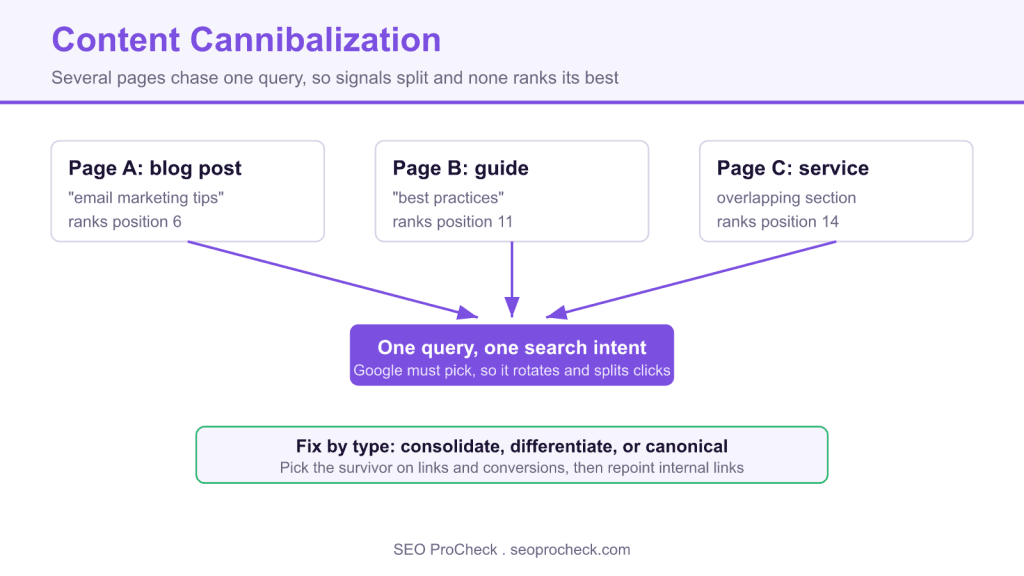
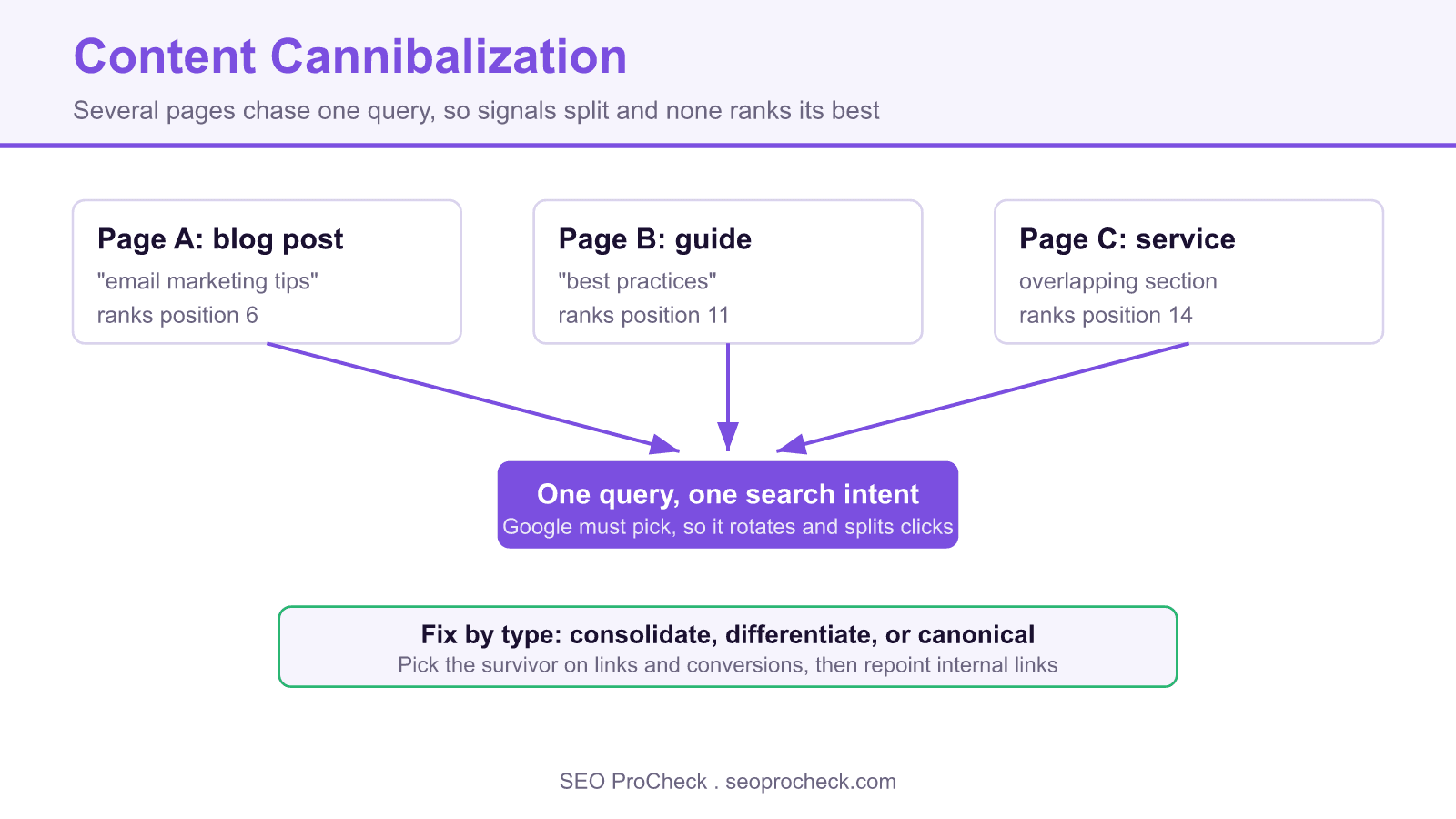
Nobody plans cannibalization. It accumulates. A 2019 blog post targets "email marketing tips." In 2021 someone writes "email marketing best practices" without checking. In 2023 a service page adds a long "our approach to email marketing" section. Three URLs, one intent, and Google now has to guess, so it rotates them, ranks the wrong one, or splits impressions three ways. Multiply by years of publishing and quarterly content sprints run by people who never saw the archive, and mature sites routinely carry dozens of these collisions. The prevention discipline is keyword mapping, one primary query, one URL, tracked in a sheet, but this entry is about the cure.
One precision note: true cannibalization is intent overlap, not keyword overlap. "Best running shoes" (comparison intent) and "running shoe size guide" (informational) share a keyword and compete for nothing. Two pages both trying to be the ranking answer for "how to choose running shoes", that's the problem. Diagnosing by keyword alone produces false positives; diagnosing by query-and-URL data doesn't.
Diagnosis: the GSC method
Search Console gives you the ground truth, because it shows which of your URLs Google actually surfaced per query. In Performance → Search results, filter to a suspect query (exact match), then switch to the Pages tab. One URL with all the impressions: healthy. Two or more URLs each carrying meaningful impressions for the same query, especially with positions oscillating across a date range, is cannibalization in the wild, not in theory. A real case: a query showing URL A at position 6 with 60% of impressions and URL B at position 11 with 40%. Neither cracks the top 5; combined signals plausibly would. That exact consolidation play produced the numbers in this 110% traffic case study, and controlled tests point the same direction, see the cannibalization ranking study.
The fix depends on the type
The biggest mistake in cannibalization work is having one hammer. There are several distinct situations, and each has a different correct move:
| Type | Situation | Right fix | Wrong fix (commonly applied) |
|---|---|---|---|
| True duplicates | Two pages saying the same thing to the same audience | Consolidate: merge the weaker into the stronger, 301 the loser, update internal links | Leaving both and "differentiating" with cosmetic edits |
| Intent drift | Pages that could serve different intents but currently blur together | Differentiate: sharpen each page's angle, retitle, split the query targets, cross-link with descriptive anchors | Merging pages that had legitimately separate audiences |
| Variant pages | Parameter, print, or near-identical product variants both indexed | Canonical: rel=canonical from variant to primary | 301-redirecting variants users still need to reach |
| Blog vs. money page | An informational post outranks the converting page for a commercial query | Re-aim: retarget the post to the informational angle and link it hard to the money page | Deleting the post (and its links and long-tail traffic) outright |
| Stale overlap | Old annual editions ("best tools 2021/2022/2023") each half-ranking | Consolidate to evergreen: one canonical URL, updated in place, old editions redirected | Publishing a new dated URL every year and keeping all of them |
How to check it on your own site
- Export 3 to 12 months of GSC query+page data (API or the export button). In a spreadsheet, pivot queries against distinct landing URLs; sort by queries with 2+ URLs where the secondary URL holds a meaningful share of impressions.
- For each flagged query, check position volatility. Chart the competing URLs' positions over time in GSC; alternation (A up while B down, then swapping) is the classic signature.
- Run a
site:search,site:yourdomain.com "target phrase", to enumerate every page touching the topic. Honest caveat:site:is a debugging view, not a ranking simulation; it over-returns and proves overlap of content, not competition in results. Use it for inventory, GSC for verdicts. - Crawl with Screaming Frog and review titles/H1s. Near-duplicate titles are the cheapest early-warning signal, sort titles alphabetically and collisions jump out.
- Before acting, check each page's backlinks and conversions. The "weaker" page for rankings is sometimes the stronger one for links or revenue. Pick the survivor with full data, then execute the fix from the table.
Common audit mistakes
- Calling every shared keyword cannibalization. Multiple URLs ranking for one query can be legitimate (a brand query, or genuinely different intents on one SERP). Fix: require same-intent evidence plus impression splitting before prescribing surgery.
- Merging by word count. Teams keep the longer page by default and redirect the one with the backlinks and the ranking history. Fix: choose survivors on links, conversions, and query fit.
- Redirecting without updating internal links. Leaving hundreds of internal links pointing through 301s dilutes the consolidation you just did. Fix: repoint internal links to the survivor in the same sprint.
- Fixing pages but not the process. Without a maintained keyword map, the collisions regrow within two publishing quarters. Fix: gate new content briefs against the map.
- Judging results too fast. Consolidations commonly dip for a few weeks while signals reassign. Fix: measure at 4 to 8 weeks, not 4 days.
Frequently asked questions
No. Duplicate content is identical or near-identical text; cannibalization is intent competition, and it happens between pages with completely different wording. You can have either without the other.
Yes, if both sit high and stable (a double-listing is a win), or the query genuinely has mixed intent. It's a problem when neither ranks to potential and impressions split. The data decides, not the rule.
Only for true duplicates and stale editions. Differentiation preserves more total traffic when the intents can actually be separated, that's why the type table matters more than any single tactic.
Typically a few weeks to a couple of months, depending on crawl frequency and how thoroughly internal links were updated. Expect turbulence before the lift.
Same phenomenon, different emphasis, that framing starts from the query side and is covered in what is keyword cannibalization. Either way, the unit of repair is the page.
Claude Vincent is a technical SEO consultant focused on crawlability, rendering, and AI-search visibility. He writes the field guides and case studies at SEO ProCheck, with a bias toward the durable, unglamorous work that decides whether search engines and AI answer engines can actually read and cite a site.
About SEO ProCheck
Technical SEO consulting and GEO strategy with 20 years of enterprise experience. Case studies, resources, and tools for search and AI visibility.
Work With Me
Technical SEO audits, GEO strategy, site migrations, and international SEO. Hourly consulting for teams who need hands-on support, not just reports.
Subscribe to our newsletter!






Recent Posts
- Can AI Crawlers Actually Read Your Site? I Measured 400 of the Biggest September 5, 2026
- The Pre-Publish Quality Gate for AI-Assisted Content August 6, 2026
- AGENTS.md vs llms.txt vs llms-full.txt: Which Agent File Does What July 18, 2026