

AI Search Impact on Informational Content
- February 27, 2026
- AI Overviews and SGE, AI and Search
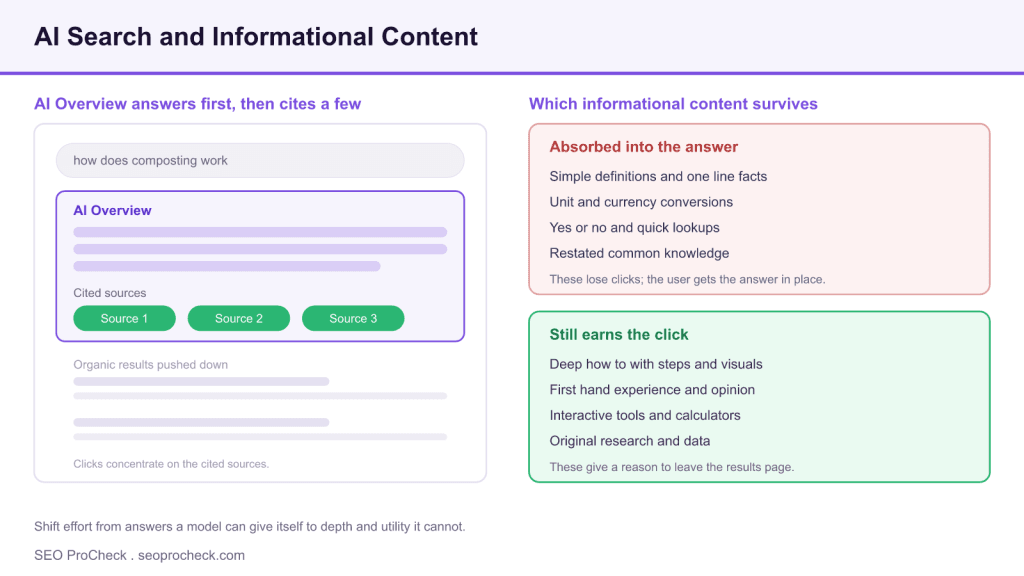
AI Summary
AI Overviews answer many informational queries directly, which reduces clicks to pages that only restate simple facts while concentrating remaining clicks on the few cited sources. Informational content survives by offering depth, first hand experience, interactive tools, and original data that a model cannot generate on its own, and by being structured so the model cites it.
- Simple definitions, conversions, and quick lookups lose the most clicks to AI Overviews.
- Deep how to guides, experience, tools, and original research still pull the click through.
- Being cited in the AI Overview drives qualified traffic, so structure content for extraction.
- Measure impressions against clicks in Search Console to spot queries absorbed by AI answers.

What AI Overviews actually change
An AI Overview is the generated summary that can sit above the organic results for many queries. When it appears, the user often gets the answer without scrolling, and the organic listings move further down the page. For informational content, which exists to answer questions, this is the most significant shift since featured snippets. The honest framing is not that informational content is dead; it is that the value has split. Queries whose answer is a single fact now resolve in place, while queries that need depth, judgment, or a tool still send the click to a page. Your job is to know which of your content sits on which side of that line.
The diagram above shows the split. On the left, the AI Overview answers first and cites a small number of sources, so the clicks that remain concentrate on those cited pages. On the right, the content types that get absorbed into the answer are separated from the ones that still give a user a reason to leave the results page. Plan your informational library around that distinction.
What gets absorbed, and why
Content that only restates knowledge the model already holds is the most exposed. A definition of a common term, a currency or unit conversion, a yes or no fact, a date, a simple formula: the model can produce all of these itself, so it does, and the user never needs your page. If a large share of your traffic came from ranking for such queries, expect impressions to hold while clicks fall, because you still appear in the underlying results but fewer people click through. That gap between impressions and clicks is the clearest signal that a query has moved into answer territory.
This is not a reason to delete those pages, and it is certainly not a reason to noindex a whole section. A thin definition page can be enriched into something a model wants to cite: add a worked example, a comparison table, a common mistakes section, and first hand context. The goal is to move the page from the absorbed column to the cited column, not to remove it.
What still earns the click
| Content type | Why AI cannot replace it | What to add |
|---|---|---|
| Deep how to guides | Needs sequenced steps, screenshots, edge cases | Annotated visuals and troubleshooting sections |
| First hand experience | Model has no lived experience to draw on | Named author, specifics, what actually happened |
| Interactive tools | A calculator or checker does work, not summary | Free utilities users return to and share |
| Original research | Data the model has never seen | Surveys, tests, and datasets with clear charts |
| Current and local detail | Freshness and specificity beat a static answer | Updated figures, dates, and location context |
The pattern across the survivors is that each does something a language model cannot do from its own weights: it applies lived experience, runs a computation, or supplies a fact that did not exist in training data. Lean your informational strategy toward those. A calculator that solves a real problem earns repeat visits and links, and a piece of original research becomes the source the AI Overview cites, which turns the AI surface from a threat into a distribution channel.
Being cited is the new position one
When your page is one of the sources under an AI Overview, you get qualified traffic from users who want more than the summary. Earning that citation depends on the same structure that makes any answer extractable: a clear heading that matches the question, a direct answer in the first sentence, and supporting detail after. Break content into discrete, well titled sections so the model can lift the relevant passage. Add FAQ blocks and tables, because both extract cleanly. A page organized as one long argument is harder to quote than one organized as a set of answered questions.
Structured data helps the machine understand what each block is. FAQPage markup on your question and answer sections, HowTo style structure for procedures, and clean semantic HTML all make the content easier to parse and reuse. None of this guarantees a citation, but it removes friction, and between two equally good pages the more extractable one wins the reference.
A triage workflow for an existing library
If you already run a large informational library, do not rewrite everything at once. Triage it. Pull your top informational pages and sort them into three buckets. Bucket one is pages whose queries are now answered in place and whose topic is genuinely shallow; enrich these with a worked example, a table, and first hand context so they can be cited, or merge several thin ones into a single strong hub. Bucket two is pages that already offer depth or a tool and are simply under structured; here the fix is formatting, adding clear question headings, FAQ blocks, and extractable summaries so they win citations. Bucket three is evergreen winners that need only a freshness pass with updated figures and dates. Work the buckets in order of traffic value, and treat the effort as ongoing maintenance rather than a one time project, because the AI surfaces keep changing which queries they cover.
Measure the impact honestly
Use Search Console to separate the queries that changed from the ones that did not. Sort your informational queries by impressions and watch the click through rate. A query with steady impressions and a falling click through rate is one where an AI answer is likely intercepting the click. Group those queries and decide, page by page, whether to enrich the content so it earns citations, fold it into a stronger hub, or accept that the query is now an answer and move effort elsewhere. Do this with data rather than assumption, because plenty of informational queries still behave exactly as they always did.
For the broader playbook, our guides go deeper on the mechanics referenced here. See how Google AI Overviews selects sources for what drives citation, optimizing content for AI Overview citations for the structural tactics, the featured snippets guide for the extraction patterns that carry over, and SEO vs AEO vs GEO for how these disciplines fit together.
Frequently asked questions
Is informational content still worth creating with AI Overviews?
Yes, but the type of informational content matters more than before. Simple fact and definition content loses clicks because the AI answers it in place, while deep guides, first hand experience, tools, and original data still earn the click. Focus effort on content a model cannot generate from its own knowledge.
Why are my impressions steady but my clicks falling?
That pattern usually means an AI Overview or other answer feature is intercepting the click. You still appear in the results, so impressions hold, but users get the answer without visiting your page. Group those queries in Search Console and decide whether to enrich the page so it earns citations.
Should I delete or noindex pages that lost traffic to AI Overviews?
No. Removing or noindexing thin pages throws away assets you can improve. The better move is to enrich them with worked examples, tables, first hand context, and a common mistakes section so they shift from being absorbed by the answer to being cited by it.
How do I get my page cited in an AI Overview?
Structure the content for extraction: lead each section with a direct answer under a clear heading that matches the question, then add supporting detail. Use FAQ blocks, tables, and clean semantic HTML, and back claims with original data. This makes it easy for the model to lift and attribute your passage.
What kinds of informational content are safest from AI absorption?
Content that does something a language model cannot do on its own: interactive tools and calculators, original research and datasets, first hand experience with specifics, and current or local detail. These give users a concrete reason to leave the results page rather than accept the summary.
Do AI Overviews appear for every informational query?
No. They appear most often for questions with a clear informational intent that can be summarized, and much less for navigational, transactional, or highly specific queries. Check your own query set in Search Console rather than assuming every informational term is affected.
Claude Vincent is a technical SEO consultant focused on crawlability, rendering, and AI-search visibility. He writes the field guides and case studies at SEO ProCheck, with a bias toward the durable, unglamorous work that decides whether search engines and AI answer engines can actually read and cite a site.
About SEO ProCheck
Technical SEO consulting and GEO strategy with 20 years of enterprise experience. Case studies, resources, and tools for search and AI visibility.
Work With Me
Technical SEO audits, GEO strategy, site migrations, and international SEO. Hourly consulting for teams who need hands-on support, not just reports.
Subscribe to our newsletter!







Recent Posts
- Can AI Crawlers Actually Read Your Site? I Measured 400 of the Biggest September 5, 2026
- The Pre-Publish Quality Gate for AI-Assisted Content August 6, 2026
- AGENTS.md vs llms.txt vs llms-full.txt: Which Agent File Does What July 18, 2026