

Optimizing for AI-Generated Search Summaries
- November 16, 2025
- AI Overviews and SGE, AI and Search
AI Summary
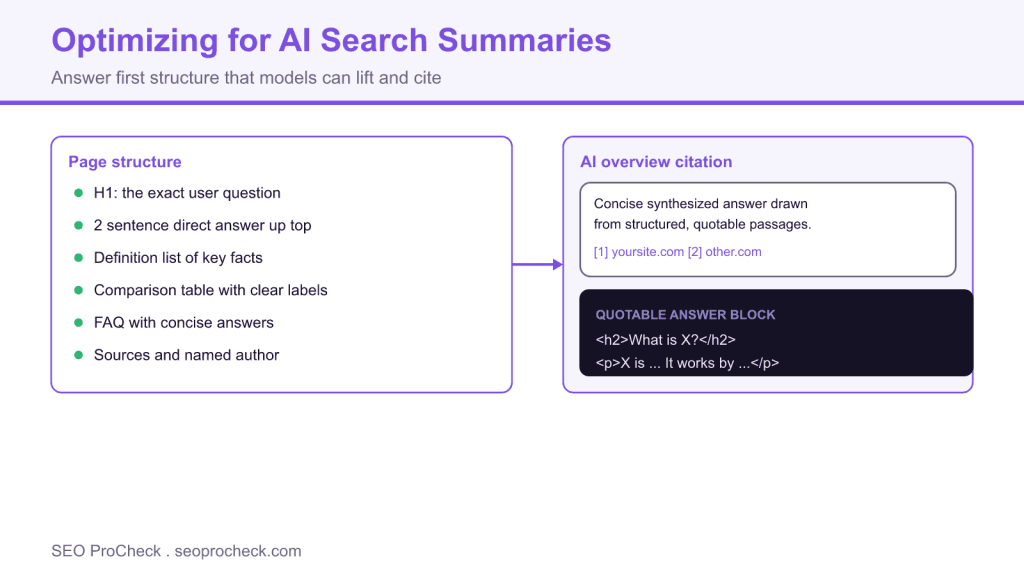
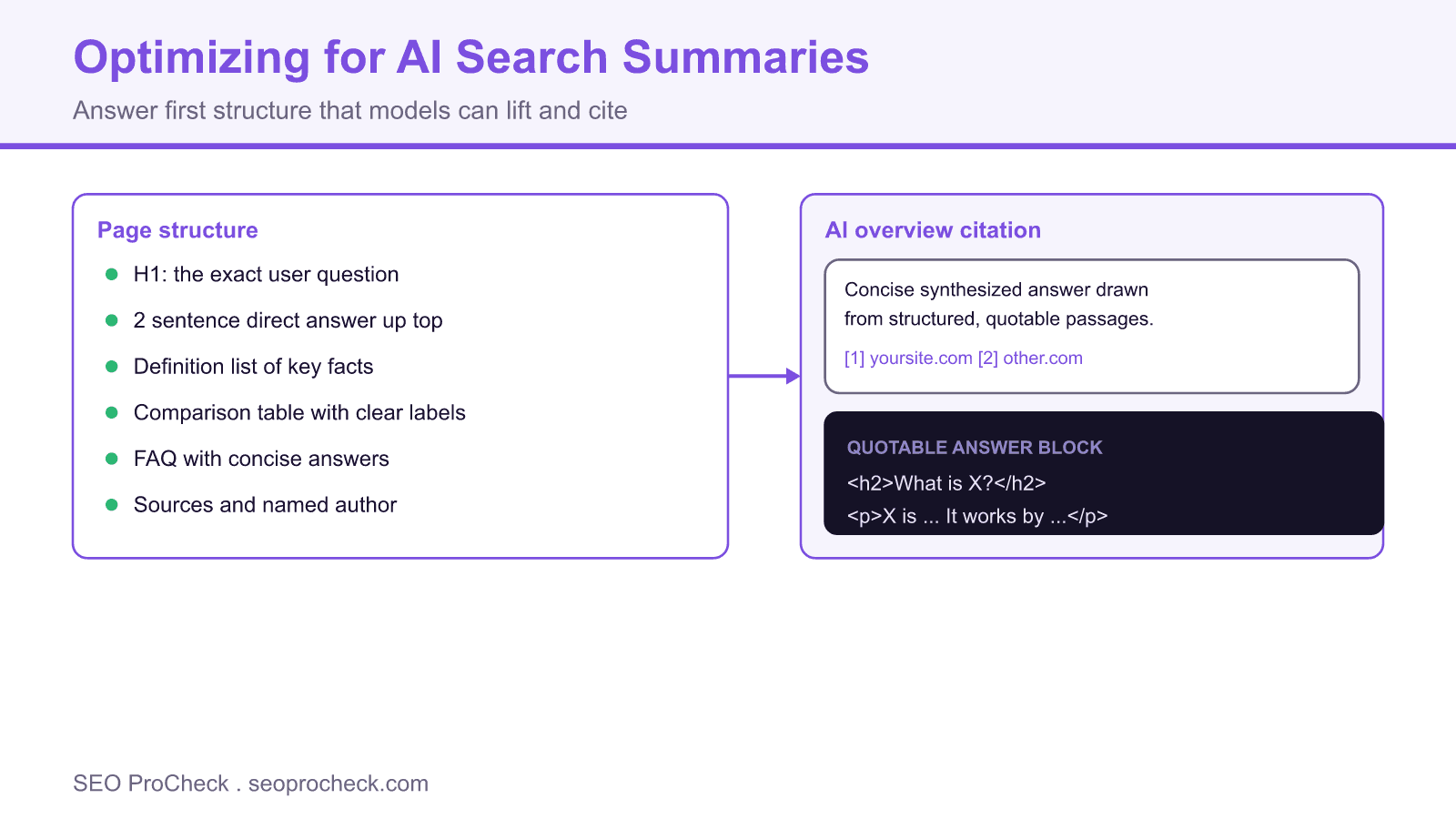
Optimizing for AI generated search summaries means structuring content so large language model powered results can extract a clear, quotable answer and cite your page. Lead with the question as a heading, give a concise direct answer in the first two sentences, and support it with structured facts, tables, schema, and clear entities.
- AI summaries reward answer first writing: state the direct answer before the supporting detail.
- Short, self contained passages are easier for models to lift and attribute than long unbroken prose.
- Structured data, tables, and clear headings help systems identify the exact answer to a query.
- Being cited depends on topical authority and clarity, not on keyword stuffing or length.
How AI summaries choose what to quote
AI generated summaries, including Google's AI Overviews and assistant style answers, are produced by language models that read the top results, synthesise an answer, and cite the sources they drew from. They favour passages that state a claim clearly and completely in a small span of text, because those passages are easy to extract and attribute. That changes how you write. Instead of building slowly to a conclusion, you lead with the conclusion and then support it. A page that answers the question in its first two sentences, under a heading that matches the question, gives the model a clean unit to quote.
The answer first structure
The single most effective pattern is answer first. Put the user's question as an H2, give a direct two sentence answer immediately below it, then expand with detail, data, and examples. This mirrors the way an AI summary is assembled: a concise claim followed by supporting evidence. A quotable answer block looks like this in the markup:
<h2>What is a canonical tag?</h2>
<p>A canonical tag tells search engines which URL is the
preferred version of a page when duplicates exist. It is
placed in the head as rel=canonical and consolidates ranking
signals onto the chosen URL.</p>
<!-- then: how it works, examples, edge cases -->
Notice the answer is self contained. A model can lift those two sentences and attribute them without needing the rest of the page for context. That self containment is what earns the citation.
Techniques that increase inclusion
| Technique | Why it helps AI summaries |
|---|---|
| Question shaped headings | Match the query so the model finds the relevant passage |
| Two sentence direct answers | Provide a clean, quotable unit |
| Definition lists and tables | Expose facts in a structured, parseable form |
| FAQ blocks with schema | Give explicit question and answer pairs |
| Named entities and sources | Signal accuracy and support attribution |
Structure, schema, and entities
Machine readable structure helps a model locate the answer. Use a logical heading hierarchy, add FAQPage and Article schema where relevant, and present comparisons as real HTML tables rather than images of tables. Name the entities you discuss and keep terminology consistent so the system can connect your page to the topic. A short summary block near the top, sometimes written as a TL;DR, gives both readers and models the gist immediately, a pattern covered in TL;DR summary presence. For the full citation playbook, see how to optimize for AI Overview citations.
Authority and trust still decide inclusion
Structure gets you eligible, but the model still prefers sources it treats as credible. First hand expertise, clear authorship, accurate and current information, and a strong topical footprint all raise the odds of being cited. This is where the discipline overlaps with traditional SEO and with the newer answer engine and generative engine optimization framing explained in SEO vs AEO vs GEO. Thin, unsupported, or purely promotional pages rarely get pulled into a summary even when they are structured well, because the model has more trustworthy passages to choose from.
Measuring and iterating
Track which queries trigger an AI summary for your topics, whether your page is cited, and how your click through behaves when a summary is present. Because these surfaces change frequently, revisit your top pages regularly, tighten the answer passages, refresh facts, and keep schema valid. The broader optimization workflow, including monitoring and content structure, is laid out in the AI Overviews optimization strategy guide. Treat AI summary optimization as an ongoing loop of clarify, structure, and verify rather than a one time change.
Frequently asked questions
How do I get my content into AI generated search summaries?
Write answer first: put the question as a heading and give a concise, self contained answer in the first two sentences, then support it with structured facts, tables, and schema. Systems pull passages that state a clear answer in a small span and come from a source they trust, so clarity and topical authority both matter.
What is answer first content?
Answer first content states the direct answer immediately, before the background and supporting detail. It mirrors how an AI summary is built, a concise claim followed by evidence, which makes the passage easy for a model to extract and cite.
Does structured data help with AI summaries?
Yes, indirectly. Schema such as FAQPage and Article, along with clear headings and real HTML tables, exposes your facts in a parseable form that helps a model identify the exact answer. It does not guarantee inclusion, but it removes ambiguity about what your page says.
Do I need to write longer content to be included?
No. Length is not the driver. A short, precise, well structured answer often outperforms a long page because it gives a clean unit to quote. Add depth where it genuinely helps the reader, not to hit a word count.
Why is my page not cited even though it ranks well?
Ranking and being quoted are related but not identical. A page can rank while burying its answer in long prose, giving the model no clean passage to lift. Restructure the relevant section to lead with a concise, self contained answer under a matching heading.
How is optimizing for AI summaries different from normal SEO?
It builds on the same foundations of relevance and authority but adds emphasis on passage level clarity, answer first structure, and machine readable facts. The aim shifts from only ranking a page to making a specific passage easy to extract and attribute.
Take this with you
The assistant links open with a question about this page already written. Nothing is sent until you press enter.
Claude Vincent is a technical SEO consultant focused on crawlability, rendering, and AI-search visibility. He writes the field guides and case studies at SEO ProCheck, with a bias toward the durable, unglamorous work that decides whether search engines and AI answer engines can actually read and cite a site.
About SEO ProCheck
Technical SEO consulting and GEO strategy with 20 years of enterprise experience. Case studies, resources, and tools for search and AI visibility.
Work With Me
Technical SEO audits, GEO strategy, site migrations, and international SEO. Hourly consulting for teams who need hands-on support, not just reports.
Subscribe to our newsletter!








Recent Posts
- Most Top Sites Never Say Who They Are in Structured Data October 14, 2026
- Homepage Titles Are Mostly Too Short, Not Too Long October 8, 2026
- Who Actually Serves an llms.txt? 184 Top Sites Measured September 29, 2026