

How AI Changes Keyword Research Strategy
- April 6, 2024
- GEO (Generative Engine Optimization), AI and Search
AI Summary
AI search does not kill keyword research; it moves the unit of work from single exact match keywords to topics, entities, and the real questions people ask a chat interface. The new goal is topic coverage and citation share inside AI Overviews and chat answers, which you plan by clustering questions, mapping entities, and testing prompts rather than chasing head term volume alone.
- Research topics and entities, not isolated keywords, and group them into clusters that answer a full user journey.
- Harvest natural language questions from People Also Ask, chat logs, forums, and prompt testing.
- Track citation share and coverage, not only ranking position and monthly volume.
- Prioritize question queries where an AI answer is likely to cite a clear, well structured source.
The unit of research changed, not the discipline
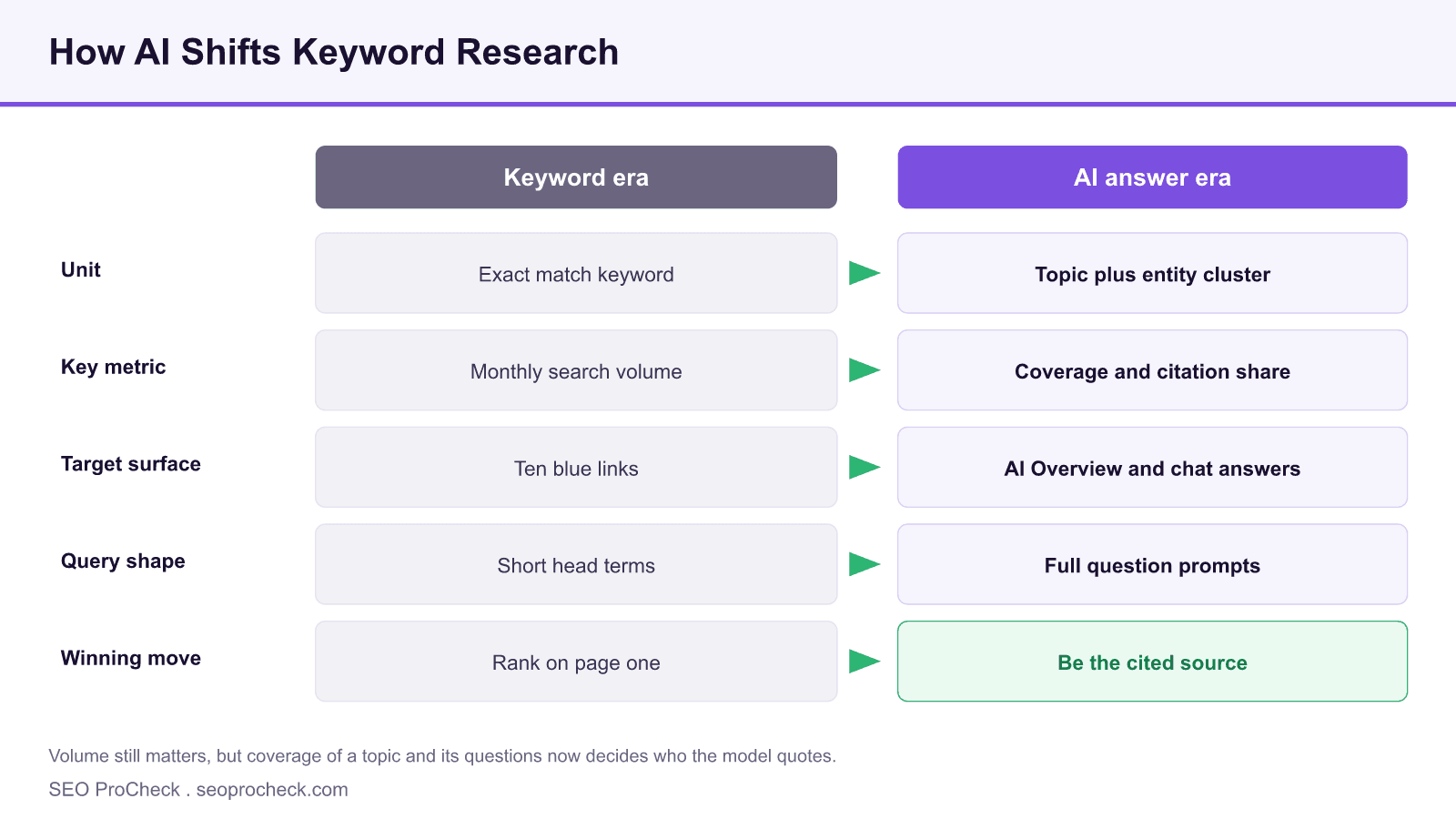
Keyword research is not obsolete in the age of AI Overviews and chat search, but the thing you research has changed. For twenty years the unit was the keyword: a string with a monthly search volume that you mapped to a page and tried to rank. Generative engines flatten many of those strings into a single answer, so optimizing one exact phrase in isolation now leaves value on the table. The productive unit today is the topic and the entities inside it, expressed as the full set of questions a person might ask across a decision.
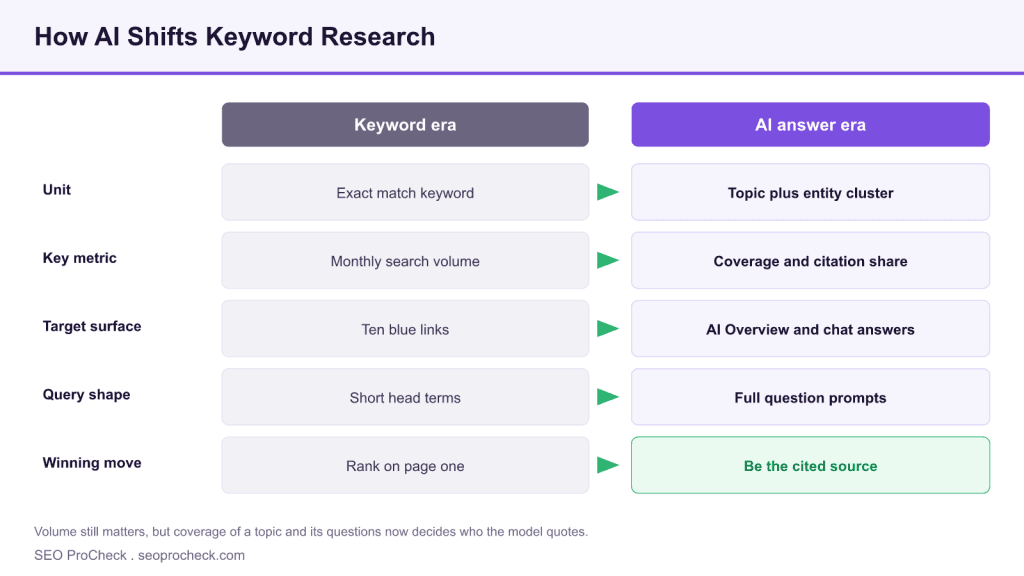
The comparison above frames the shift. You still care about demand, but a topic that resolves into an AI answer needs coverage of its subquestions, clear entity definitions, and content structured so a model can lift a passage and cite it. That is a research problem as much as a writing one, and the research methods change accordingly.
Start from entities and questions, not seed strings
Traditional research starts with a seed keyword and expands it with a volume tool. AI era research starts with the entity map for your topic: the people, products, concepts, and attributes a knowledgeable answer must mention. If you write about running shoes, the entities include cushioning, drop, stack height, pronation, and named models. A model assembling an answer expects those entities to be present and correctly related. Missing entities are the modern version of a thin page.
From the entity map, expand into the questions users actually type or speak. Sources that surface real phrasing include People Also Ask, the autocomplete on Google and YouTube, Reddit and niche forums, your own site search logs, and direct prompt testing in ChatGPT, Perplexity, and Gemini. The point is not volume for each question; it is completeness of the question set so your content answers the whole cluster rather than a single head term.
A workflow you can run this week
| Step | What you do | Output |
|---|---|---|
| 1. Map entities | List the concepts and named things a full answer must cover | Entity coverage checklist |
| 2. Harvest questions | Pull PAA, autocomplete, forums, site search, prompt tests | Question bank grouped by intent |
| 3. Cluster | Group questions into pillar and supporting pages | Cluster map with one page per intent |
| 4. Prompt test | Ask each cluster question in three AI tools, note who is cited | Baseline citation share and gaps |
| 5. Structure for lift | Add clear headings, direct answers, tables, and FAQ blocks | Passages a model can quote |
Step four is the genuinely new one. Prompt testing means running each priority question through the assistants your audience uses and recording which sources they cite and what the answer says. That gives you a baseline citation share and a concrete gap list: questions where a competitor is cited and you are not, or where the answer is wrong in a way your content could correct.
Metrics that survive the shift
Search volume still tells you where demand concentrates, so keep it as one input. What you add is coverage and citation tracking. Coverage asks whether your content addresses every question and entity in a cluster. Citation share asks how often AI answers for your cluster name your brand or link your page. Neither replaces rankings; together they explain visibility that rankings alone now miss, because a page can sit at position four and still be the source the AI Overview quotes, or sit at position one and be ignored.
Prioritize question style queries that carry clear intent and are likely to trigger an AI answer, since those are the queries where being the cited source compounds. Transactional and navigational queries still behave like classic search, so treat them with classic keyword tactics. The judgment call is recognizing which queries have moved into answer territory and which have not.
Tools and where the signal comes from
No single tool gives you the full picture yet, so combine sources. Classic volume and difficulty come from Semrush, Ahrefs, or Google Keyword Planner and still anchor prioritization. Question discovery comes from AlsoAsked and AnswerThePublic for structured People Also Ask trees, plus manual scraping of forum threads where your audience argues in their own words. Entity coverage can be sanity checked with Google Natural Language or by inspecting the entities a top ranking competitor mentions that you omit. Citation tracking is the newest category: dedicated AI visibility tools log which sources assistants cite for a query set, but you can start for free by running a fixed list of questions through each assistant on a schedule and recording the sources by hand in a spreadsheet.
The discipline that ties them together is treating your question bank as a living asset. Rerun the priority prompts monthly, because AI answers are volatile and a citation you held in one month can vanish the next when the model reweights sources. That volatility is exactly why coverage matters: the more completely and clearly your content answers a cluster, the more resilient your citation share is to those reweightings.
Common mistakes to avoid
Three patterns waste effort. The first is chasing high volume head terms that now resolve into a single AI answer, where a thousand impressions convert into almost no clicks because the user never leaves the results page. The second is writing one long page stuffed with every keyword variant, which reads as bloated to humans and gives a model no clean passage to lift; discrete, well titled sections quote better than a wall of text. The third is ignoring the prompt test entirely and assuming a good ranking guarantees a citation, when the two are only loosely correlated. Fix these by prioritizing question clusters, structuring answers into liftable passages, and validating with real prompts before you commit budget.
Where this fits your broader plan
This approach connects directly to intent work and gap analysis. Mapping questions to the right page is the subject of our guide to user intent mapping for content planning, and finding the questions competitors answer that you do not is covered in our content gap analysis methodology. The mechanics of how engines decide which page to quote are explained in how AI engines choose sources, and the long tail questions that dominate chat search are the focus of our long tail keywords guide. Run those together and keyword research becomes topic research without losing the demand signal that made it useful in the first place.
Frequently asked questions
Is keyword research dead because of AI search?
No. The discipline of understanding demand is still essential, but the unit of research shifts from single exact match keywords to topics, entities, and the full set of questions users ask. You still use volume data, you just pair it with topic coverage and citation tracking.
How do I find the questions people ask AI tools?
Harvest them from People Also Ask, Google and YouTube autocomplete, Reddit and niche forums, and your own site search logs, then confirm phrasing by prompt testing in ChatGPT, Perplexity, and Gemini. The goal is a complete question set for a topic, not a volume figure for each one.
What is citation share and how do I measure it?
Citation share is how often AI answers for your topic name your brand or link your page. You measure it by running your priority questions through the assistants your audience uses and recording which sources each answer cites, then tracking that over time against competitors.
Does search volume still matter?
Yes, as one input among several. Volume tells you where demand concentrates and helps prioritize, but it no longer captures the full picture because a page can be cited by an AI answer without ranking first, or rank first and never be quoted.
Should I still build pages around single keywords?
Build pages around a clear intent and the cluster of questions that express it, rather than one keyword string. Generative engines answer the whole question, so a page that covers the full cluster with clear structure is more likely to be the source they cite.
Which queries are most affected by AI answers?
Informational and question style queries with clear intent are the most affected, because those are the ones that trigger AI Overviews and chat answers. Transactional and navigational queries still behave much like classic search, so keep classic keyword tactics for those.
Take this with you
The assistant links open with a question about this page already written. Nothing is sent until you press enter.
Claude Vincent is a technical SEO consultant focused on crawlability, rendering, and AI-search visibility. He writes the field guides and case studies at SEO ProCheck, with a bias toward the durable, unglamorous work that decides whether search engines and AI answer engines can actually read and cite a site.
About SEO ProCheck
Technical SEO consulting and GEO strategy with 20 years of enterprise experience. Case studies, resources, and tools for search and AI visibility.
Work With Me
Technical SEO audits, GEO strategy, site migrations, and international SEO. Hourly consulting for teams who need hands-on support, not just reports.
Subscribe to our newsletter!








Recent Posts
- Most Top Sites Never Say Who They Are in Structured Data October 14, 2026
- Homepage Titles Are Mostly Too Short, Not Too Long October 8, 2026
- Who Actually Serves an llms.txt? 184 Top Sites Measured September 29, 2026