

Content Pruning: Strategic Guide to Removing Low-Value Pages
- May 12, 2024
- Content Architecture, Content SEO
AI Summary
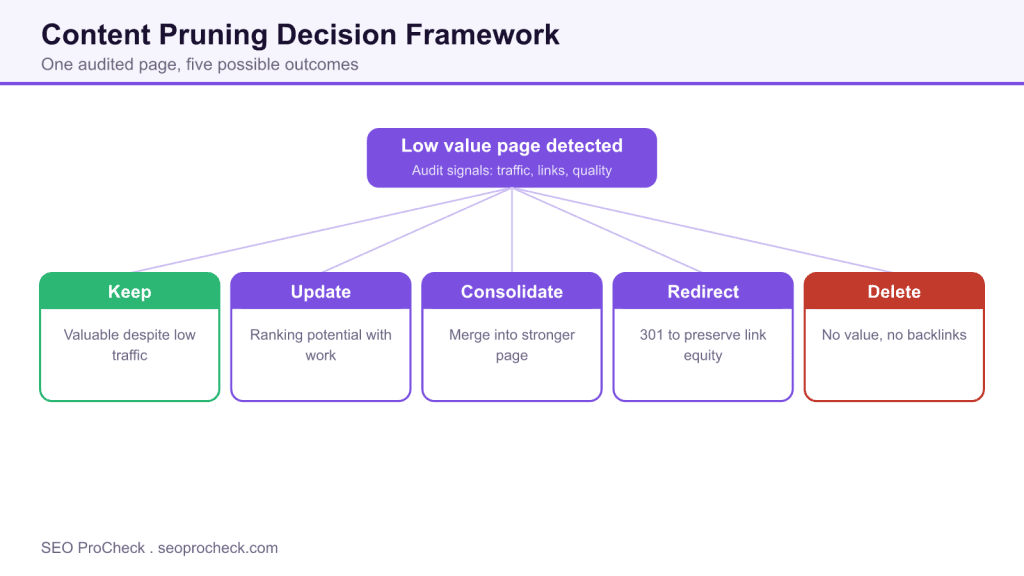
Content pruning is the disciplined removal, consolidation, or improvement of low value pages so the pages that remain earn more trust and crawl attention. Audit every underperforming URL against traffic, links, and quality, then route it to one of five outcomes: keep, update, consolidate, redirect, or delete.
- Never delete on traffic alone; a zero traffic page with backlinks or sales value should be redirected or kept.
- Preserve link equity with a 301 to the most relevant surviving page whenever a URL has referring domains.
- Consolidation only helps if the destination page genuinely absorbs the value, not just the URL.
- Expect organic traffic to dip briefly, then recover and climb over roughly two to four months.
Why Content Pruning Matters
Content pruning involves strategically removing, consolidating, or improving low-performing content to improve overall site quality. Accumulated thin, outdated, or duplicate content dilutes topical authority, wastes crawl budget, and can trigger quality algorithm penalties. Sites that aggressively prune underperforming content often see ranking improvements across remaining pages, as Google can better identify and trust the site's quality content without noise from low-value pages.
Identifying Pruning Candidates
Content audit data reveals pruning opportunities through several signals: pages with zero or near-zero organic traffic over 12+ months, pages with high bounce rates and low time on site, outdated content no longer accurate or relevant, thin content under 300 words without unique value, duplicate or near-duplicate content covering the same topics, pages that have never ranked for target keywords despite optimization attempts, and content that doesn't align with current business offerings or target audience.
| Signal | Threshold | Action Consideration |
|---|---|---|
| Organic Sessions | <50 in 12 months | Candidate for removal or consolidation |
| Backlinks | 0 referring domains | Lower risk of removal, less value to preserve |
| Word Count | <300 words | Thin content unless highly specific topic |
| Content Age | >3 years without update | Review for accuracy, update or remove |
| Bounce Rate | >85% with low time | Content not meeting user intent |
| Keyword Rankings | None in top 100 | Content may lack search demand or quality |
Pruning Decision Framework
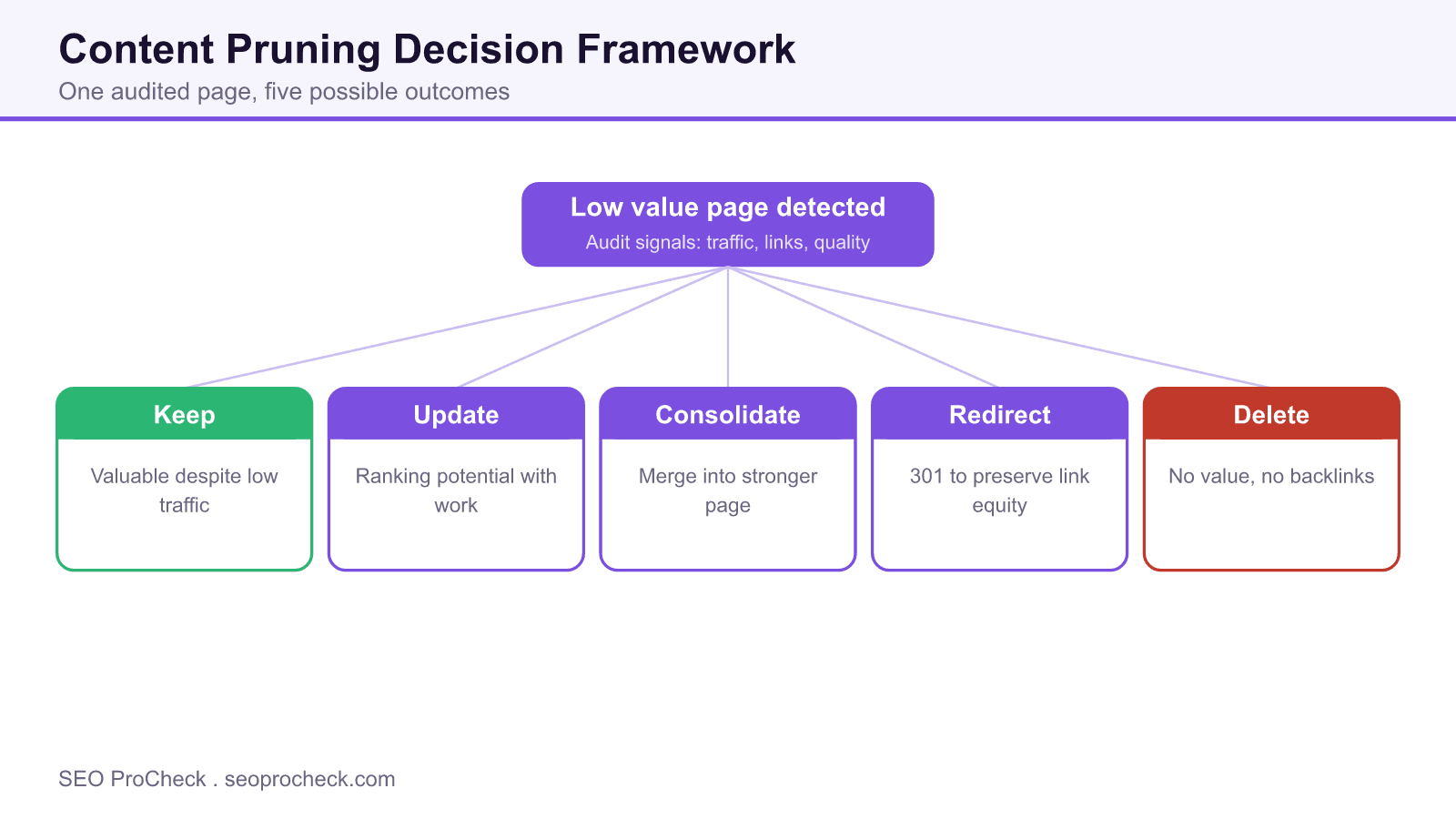
Not all low-traffic content should be removed. Evaluate each piece: Does it serve business purposes beyond organic search (sales enablement, customer support, brand value)? Could it rank with improvements? Is there consolidation potential with related content? For content with backlinks, preserve link equity through redirection. Decisions typically fall into categories: keep as-is (valuable despite low traffic), update (potential with improvements), consolidate (merge with similar content), redirect (remove but preserve backlinks), or delete (no value, no backlinks).
Implementing Content Removal
For deleted content without redirect targets, allow pages to return 404 status. Google will eventually remove them from the index. For faster removal, use the URL Removal tool in Search Console for temporary hiding while returning 404. For content with backlinks, implement 301 redirects to the most relevant remaining page. Track redirected URLs in a spreadsheet to maintain redirect maps long-term. For consolidated content, ensure the destination page genuinely incorporates value from the removed content, not just inherits the URL. Update internal links site-wide to remove references to deleted content.
Measuring Pruning Impact
Post-pruning monitoring should track several metrics: overall organic traffic (may initially dip before improving), rankings for remaining content (should improve over time), pages indexed in Google (should decrease to match intended index), crawl budget efficiency (more crawling of valuable pages), and average quality signals (time on site, pages per session). Typical timeline for seeing benefits is 2-4 months after significant pruning. Document before/after metrics to demonstrate ROI and inform future pruning decisions.
The Prune Decision, Step by Step
Pruning fails when it becomes a delete button. The safe way to run it is as a routing decision made one URL at a time. Pull a single sheet that joins organic sessions over the last twelve months, referring domains, top ranking keyword position, and last meaningful update date. Sort by sessions ascending so the weakest pages surface first, then walk each row through the same question set: does this URL earn traffic, hold links, serve a business purpose, or have a realistic path to ranking with reasonable effort? A "no" to all four is the only clean case for deletion.
The mistake teams make most often is confusing "no traffic" with "no value". A specification page, a support answer, or a comparison table can carry real value while attracting almost no organic clicks. Equally, a page with a single strong backlink is worth a redirect rather than a quiet 404, because throwing away that link equity is a permanent loss. Map each decision explicitly before you touch the CMS.
| Situation | Right Outcome | Why |
|---|---|---|
| Zero traffic, has backlinks | Redirect (301) | Preserves earned link equity |
| Low traffic, ranks page two | Update | Small gains can push it onto page one |
| Two thin pages, same intent | Consolidate | One strong page beats two weak ones |
| Outdated but still visited | Update, keep URL | Refresh accuracy without losing history |
| No traffic, no links, off topic | Delete (404 or 410) | Genuine dead weight, safe to remove |
Executing Removal Without Collateral Damage
When you delete, return a real 404 or 410 so Google drops the URL cleanly, and use the Search Console removal tool only for urgent hiding while the status code propagates. When you redirect, point to the closest surviving match, never a blanket redirect to the homepage, which Google treats as a soft 404. Update internal links site wide so you are not sending users and crawlers through unnecessary redirect hops. Keep a redirect map in a durable spreadsheet, because six months later you will need to know why a URL was retired and where it went.
Consolidation deserves special care. Merging two pages means the destination must actually incorporate the unique passages, examples, and keywords from the source, then the source redirects into it. If you merely redirect without enriching the target, you lose the very content that earned the original rankings.
Pruning as Part of a Bigger Architecture
Pruning is most powerful when it feeds a deliberate structure rather than running as a one time cleanup. As you retire weak URLs, fold the survivors into topic clusters and pillar pages so related content reinforces a single authoritative hub. Before you prune at scale, confirm there is no underlying technical cause for the weak performance by cross checking against a technical SEO audit; pages can underperform because they were never indexable, in which case fixing the block is the better move than deletion. Measured this way, pruning becomes ongoing portfolio management: every quarter you review the tail, promote what deserves investment, and retire what no longer serves users.
Frequently Asked Questions
Does deleting pages hurt SEO?
Deleting genuinely valueless pages that have no traffic and no backlinks typically helps by concentrating quality signals and crawl budget on your strong content. Harm comes from deleting pages that hold backlinks or serve intent without redirecting them, so the routing decision matters more than the delete itself.
Should I 301 redirect or let a page 404?
Redirect with a 301 when the page has backlinks or a close surviving equivalent, so link equity and any residual traffic transfer. Let it return 404 or 410 when there is no equity to preserve and no relevant destination, which tells Google to drop it cleanly.
How much traffic loss is normal after pruning?
A short dip is common as removed URLs leave the index. If your routing decisions were sound, remaining pages usually recover and then exceed the previous baseline within about two to four months as authority reconcentrates.
What word count counts as thin content?
There is no universal threshold, but pages under roughly 300 words with no unique data, examples, or purpose are common pruning candidates. Length is a signal, not a rule: a concise page that fully answers a specific query is not thin.
Can I prune with redirects to the homepage?
Avoid it. Google treats mass redirects to the homepage as soft 404s, so the equity does not transfer. Always redirect to the most topically relevant surviving page instead.
How do I decide between updating and consolidating?
Update when a single page has a realistic path to ranking on its own. Consolidate when two or more pages compete for the same intent, merging their unique value into one stronger page and redirecting the rest into it.
Take this with you
The assistant links open with a question about this page already written. Nothing is sent until you press enter.
Claude Vincent is a technical SEO consultant focused on crawlability, rendering, and AI-search visibility. He writes the field guides and case studies at SEO ProCheck, with a bias toward the durable, unglamorous work that decides whether search engines and AI answer engines can actually read and cite a site.
About SEO ProCheck
Technical SEO consulting and GEO strategy with 20 years of enterprise experience. Case studies, resources, and tools for search and AI visibility.
Work With Me
Technical SEO audits, GEO strategy, site migrations, and international SEO. Hourly consulting for teams who need hands-on support, not just reports.
Subscribe to our newsletter!








Recent Posts
- Most Top Sites Never Say Who They Are in Structured Data October 14, 2026
- Homepage Titles Are Mostly Too Short, Not Too Long October 8, 2026
- Who Actually Serves an llms.txt? 184 Top Sites Measured September 29, 2026