

Image & Video SEO FAQ: Optimizing Visual Content for Search
- August 28, 2023
- Content SEO FAQ
AI Summary
Image and video SEO makes visual content discoverable in Google Images, video carousels, and on page relevance, while keeping Core Web Vitals healthy. The core moves are descriptive alt text and file names, modern compressed formats, explicit dimensions, lazy loading below the fold, and VideoObject schema for every embedded video.
- Write alt text that describes the image in under 125 characters, with keywords used naturally rather than stuffed.
- Default to WebP or AVIF, keep files under roughly 100KB to 200KB, and always set
widthandheightto prevent layout shift. - Add
loading="lazy"to below the fold media, but never to the LCP image above the fold. - Use VideoObject schema and transcripts so search engines can read and rank video content.
Complete guide to image and video SEO. How to optimize visual content for search visibility, improve page speed, and appear in image and video search results.
Table of Contents
- Image SEO Basics
- Image Technical Optimization
- Video SEO Basics
- Video Technical Optimization
- YouTube SEO
- Advanced Visual SEO
Image SEO Basics
Why does image SEO matter?
Images appear in Google Images, image packs in regular search, and contribute to page relevance. Image search drives significant traffic for many industries. Optimized images improve page speed (Core Web Vitals), accessibility, and user experience. Poor images hurt rankings.
What is alt text and why is it important?
Alternative text describing an image for screen readers and search engines. Essential for accessibility (visually impaired users) and helps Google understand image content. Appears if image fails to load. Ranking factor for image search. Required for every meaningful image.
How do I write good alt text?
Describe the image accurately and concisely. Include relevant keywords naturally, not stuffed. Be specific: "golden retriever playing fetch in park" not "dog". Skip "image of" or "picture of" (already implied). Keep under 125 characters. Decorative images can have empty alt (alt="").
Do image file names matter for SEO?
Yes. Descriptive file names help Google understand image content. Use hyphens between words: "blue-running-shoes.jpg" not "IMG_12345.jpg" or "bluerunningshoes.jpg". Include keywords naturally. Rename before upload; changing file names later creates new URLs.
Are image titles important for SEO?
Title attributes (tooltips on hover) have minimal SEO impact. Alt text is far more important. Titles can improve user experience by providing additional context. If used, keep them brief and complementary to alt text, not duplicative.
Does text around images affect image SEO?
Yes. Google uses surrounding text, captions, and page context to understand images. Place images near relevant text. Use descriptive captions when appropriate. Page topic influences how Google categorizes images. Context matters beyond just alt text.
Image Technical Optimization
What image format should I use?
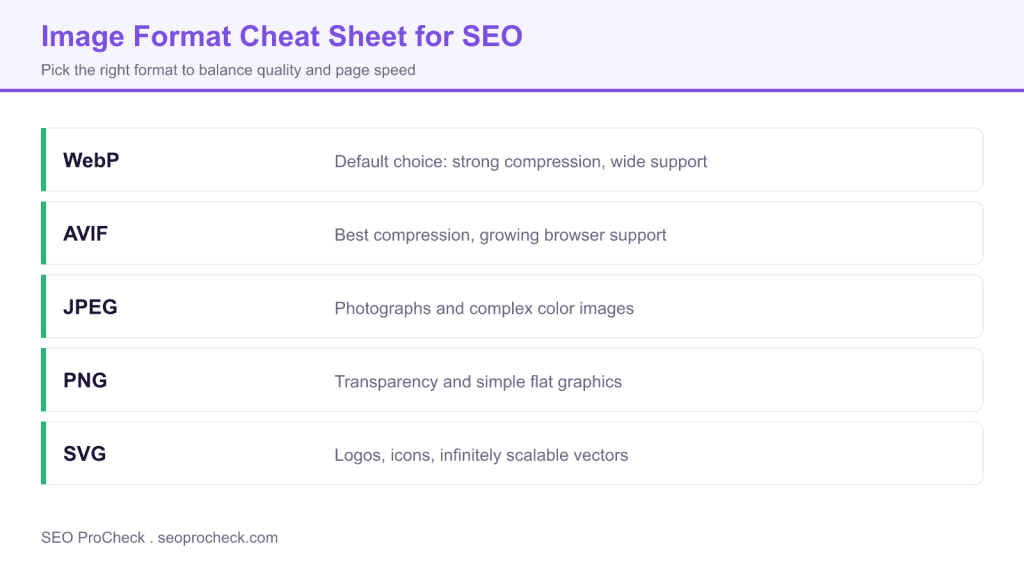
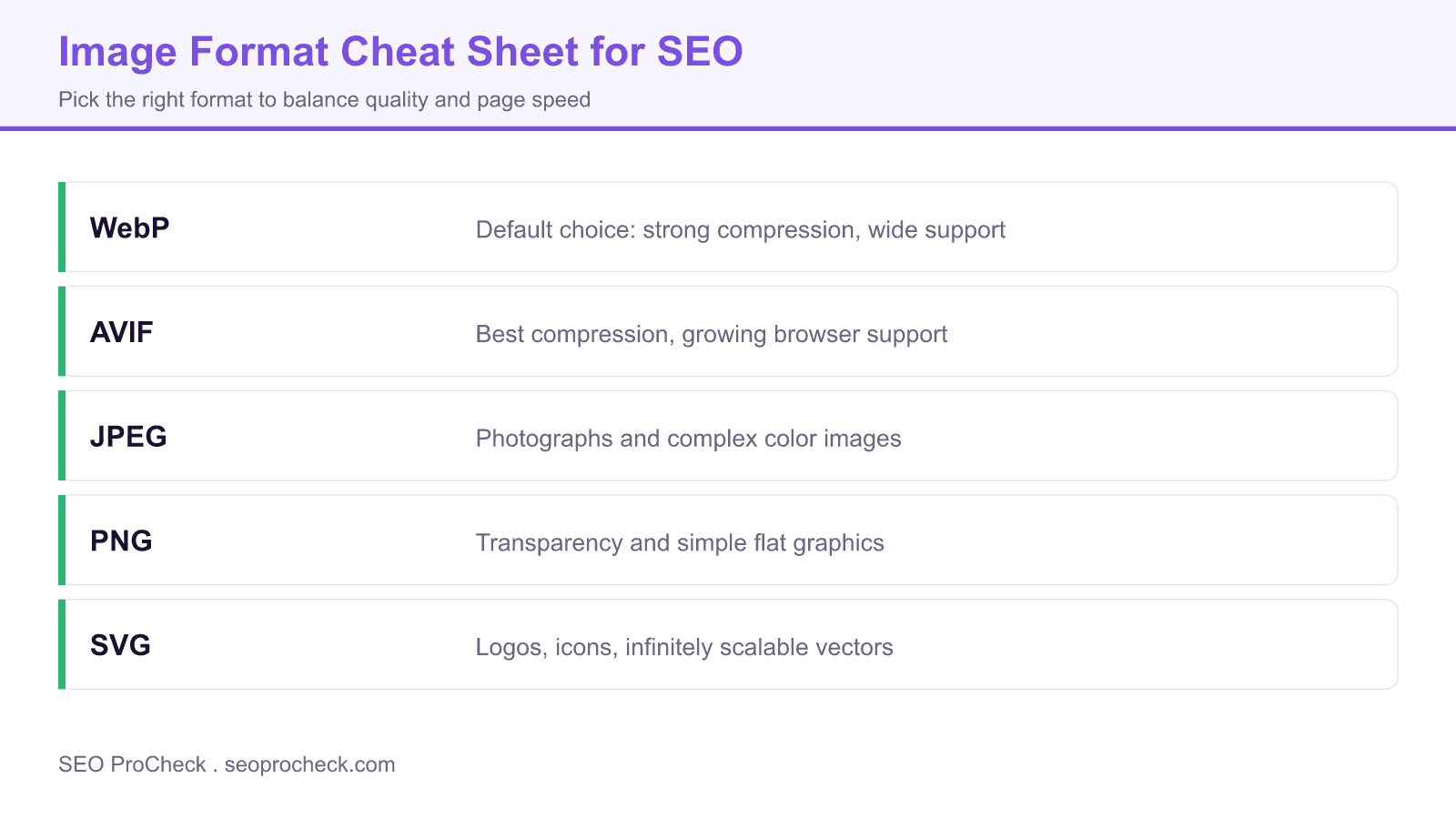
WebP: best compression with quality, widely supported. JPEG: photos, complex images. PNG: graphics with transparency, simple graphics. AVIF: newer format with excellent compression, growing support. SVG: logos, icons, scalable graphics. Use WebP as default with JPEG/PNG fallbacks.
How do I compress images without losing quality?
Use tools: TinyPNG, ImageOptim, Squoosh, ShortPixel. Most images can lose 50-80% file size with imperceptible quality loss. Compress before upload. WordPress plugins can auto-compress. Balance quality and file size. Aim for images under 100-200KB when possible.
Should I specify image dimensions?
Yes. Always include width and height attributes in HTML. Prevents layout shift (CLS) while images load. Browser reserves space before image loads. Critical for Core Web Vitals. Use actual dimensions; CSS can resize for responsive display.
What are responsive images?
Serving different image sizes based on device and screen size. Use srcset attribute to list image variants. Browser chooses appropriate size. Prevents loading huge desktop images on mobile. Improves speed and user experience. Critical for mobile performance.
Should I lazy load images?
Yes, for below-fold images. Native lazy loading: loading="lazy" attribute. Defers loading until image approaches viewport. Improves initial page load speed. Don't lazy load above-fold images (hurts LCP). Modern browsers support native lazy loading.
Should I use a CDN for images?
Yes, especially for global audiences or high-traffic sites. CDNs serve images from locations near users, reducing latency. Many offer automatic optimization, format conversion, and resizing. Cloudflare, Cloudinary, imgix are popular options. Improves speed significantly.
Do I need an image sitemap?
Helpful but not required. Image sitemaps help Google discover images, especially if loaded via JavaScript or behind scripts. Can be separate XML file or include image tags in regular sitemap. Particularly useful for image-heavy sites like photography portfolios or e-commerce.
Video SEO Basics
Why does video SEO matter?
Video appears in search results, video carousels, and YouTube (second largest search engine). Video content ranks for many queries. Engages users longer, reducing bounce rates. Video snippets in SERPs increase click-through rates. Growing importance as consumption increases.
How do videos rank in Google search?
Google indexes video content from YouTube and web pages with video schema. Videos can appear in: main search results, video carousels, "Videos" tab, and featured snippets. Ranking factors include relevance, engagement, structured data, and host page authority.
Should I host videos on YouTube or my site?
Both have advantages. YouTube: massive reach, social features, easy embedding, costs nothing to host. Self-hosted: keeps traffic on your site, full control, no competitor ads. Common strategy: host on YouTube for discovery, embed on your site for engagement. Can do both.
What is VideoObject schema?
Structured data marking up video content: name, description, thumbnail, duration, upload date, content URL. Enables video rich snippets in search results. Required for appearing in Google Video search. Include for any page featuring video content.
How important are video thumbnails?
Critical for click-through rate. Thumbnails appear in search results and video platforms. Create custom thumbnails with clear imagery, readable text, and compelling visuals. High-quality thumbnails dramatically outperform auto-generated frames. Specify thumbnail URL in schema.
Video Technical Optimization
Should I include video transcripts?
Yes. Transcripts make video content accessible and indexable. Search engines can read text, not watch videos. Transcripts provide keyword-rich content, improve accessibility for deaf/hearing-impaired users, and allow skimming for specific information.
Are video captions important for SEO?
Yes. Closed captions improve accessibility (required for some compliance), increase engagement (many watch without sound), and provide indexable text content. Upload custom captions rather than relying on auto-generated. Captions improve both UX and SEO.
How should I embed videos on my site?
Use lazy loading to prevent videos from blocking page load. Include VideoObject schema. Provide descriptive title and surrounding context. Don't autoplay with sound. Consider facade pattern: show thumbnail, load player on click. Balance engagement with page performance.
Do I need a video sitemap?
Recommended for sites with significant video content. Video sitemaps provide: video location, thumbnail, title, description, duration, and other metadata. Helps Google discover and understand videos. Especially important for videos behind JavaScript or complex players.
How do videos affect page speed?
Embedded videos can significantly slow page loads if not optimized. Use lazy loading or facade patterns. Don't auto-load heavy video players. Host on CDN. Consider YouTube embeds (they handle optimization). Monitor impact on Core Web Vitals.
YouTube SEO
How do videos rank on YouTube?
YouTube algorithm considers: watch time, engagement (likes, comments, shares), click-through rate, relevance to search query, channel authority, and recency. Watch time is most important. Creating content viewers watch completely is key to ranking.
How do I optimize YouTube video titles?
Include target keyword near beginning. Keep under 60 characters to avoid truncation. Make compelling and accurate (clickbait hurts watch time). Balance keywords with click-worthiness. Test different title formats. Titles heavily influence both search ranking and click-through rate.
How do I write YouTube video descriptions?
First 1-2 sentences most important (visible before "show more"). Include keywords naturally. Add timestamps for chapters. Include relevant links. Write 200+ words when possible. Descriptions help YouTube understand video content. Don't keyword stuff; write for humans.
Do YouTube tags matter for SEO?
Minor factor. Tags help YouTube understand video content and suggest related videos. Use relevant tags including variations and related terms. Don't overstuff. Tags matter less than title, description, and watch time. Include but don't obsess over them.
How do I create effective YouTube thumbnails?
Use 1280x720 resolution (16:9 ratio). Include faces (creates connection), readable text (large fonts), bright colors, contrast. Consistent branding across channel. Avoid misleading thumbnails (hurts retention). A/B test with YouTube's thumbnail testing feature. Thumbnails heavily impact CTR.
What are YouTube chapters and how do they help SEO?
Timestamps in description creating clickable sections. Format: "0:00 Introduction". Minimum 3 chapters, 10 seconds each. Chapters improve user experience, appear in search results, and can rank individually. Enable viewers to jump to relevant sections.
Advanced Visual SEO
How do I rank in Google Images?
Optimize alt text with relevant keywords, use descriptive file names, compress for fast loading, place images on relevant pages with contextual text, use structured data when applicable, build page authority. Technical optimization plus relevance equals image rankings.
Do image licensing and copyright affect SEO?
Not directly for rankings, but using properly licensed images protects against legal issues. Google supports ImageObject schema including license information. Using unique images (original photos) is better than stock photos everyone uses. Avoid copyright infringement.
Are original images better than stock photos?
Generally yes. Original images are unique to your site, can be optimized specifically, and often appear more authentic. Stock photos appear on many sites, providing no unique value. Original images can rank in image search; duplicate stock photos typically don't.
What are Key Moments in video search?
Timestamps that appear in Google search results allowing users to jump to specific video sections. Generated from YouTube chapters or Clip/SeekToAction schema. Improves click-through by showing relevant sections. Implement via chapters or structured data.
What is visual search and how do I optimize for it?
Search using images instead of text (Google Lens, Pinterest Lens). Optimization: high-quality images, accurate alt text, product images with clear subjects, structured data for products. Growing importance as visual search usage increases. Same fundamentals as image SEO.
Quick reference table
These are the technical wins that carry the most weight for visual content. Pair them with the discovery help in our XML sitemaps FAQ, since image and video sitemaps surface media that loads through scripts, and with our mobile SEO FAQ because oversized images are a leading cause of slow mobile pages.
| Technique | How to apply it | SEO payoff |
|---|---|---|
| Descriptive file name | blue-running-shoes.jpg not IMG_1234.jpg | Helps image search understand the file |
| Alt text | alt attribute under 125 characters | Accessibility plus image search ranking |
| Explicit dimensions | width and height attributes | Prevents layout shift and protects CLS |
| Responsive images | srcset with multiple sizes | Serves the right size per device |
| Lazy loading | loading=lazy on below fold media | Faster initial load and better LCP |
| Video schema | VideoObject with thumbnail and duration | Enables video rich results and key moments |
Frequently Asked Questions
Describe what the image shows, specifically and concisely, and include a relevant keyword only where it fits naturally. Skip phrases like image of or picture of, since that is already implied. Keep it under 125 characters, and use empty alt text for purely decorative images.
Use WebP as your default because it combines strong compression with wide support. Reach for AVIF when you want the smallest files and your audience uses modern browsers, JPEG for photographs, PNG for transparency, and SVG for logos and icons.
Both, in most cases. YouTube gives you reach and free hosting for discovery, while an embed on your own page keeps visitors engaged on your site. Add VideoObject schema to the hosting page either way so the video can appear in search.
Yes. Descriptive, hyphen separated file names give Google another signal about the image subject. Rename files before upload, because changing a name later creates a new URL and drops any accumulated image search value.
Only if you lazy load the wrong images. Deferring below the fold media speeds up the initial paint and helps LCP, but applying it to the main above the fold image delays LCP and can hurt Core Web Vitals. Keep the hero image eagerly loaded.
Combine accurate alt text, a descriptive file name, and fast loading with placement next to relevant on page text. Original images tend to rank where duplicated stock photos do not, and structured data helps for products. Page authority still influences image results.
Take this with you
The assistant links open with a question about this page already written. Nothing is sent until you press enter.
Claude Vincent is a technical SEO consultant focused on crawlability, rendering, and AI-search visibility. He writes the field guides and case studies at SEO ProCheck, with a bias toward the durable, unglamorous work that decides whether search engines and AI answer engines can actually read and cite a site.
About SEO ProCheck
Technical SEO consulting and GEO strategy with 20 years of enterprise experience. Case studies, resources, and tools for search and AI visibility.
Work With Me
Technical SEO audits, GEO strategy, site migrations, and international SEO. Hourly consulting for teams who need hands-on support, not just reports.
Subscribe to our newsletter!








Recent Posts
- Most Top Sites Never Say Who They Are in Structured Data October 14, 2026
- Homepage Titles Are Mostly Too Short, Not Too Long October 8, 2026
- Who Actually Serves an llms.txt? 184 Top Sites Measured September 29, 2026