

Google's UGC Fresh Data Program: Who Qualifies and What It Is Not
- November 6, 2026
- Indexing & Crawl
TL;DR
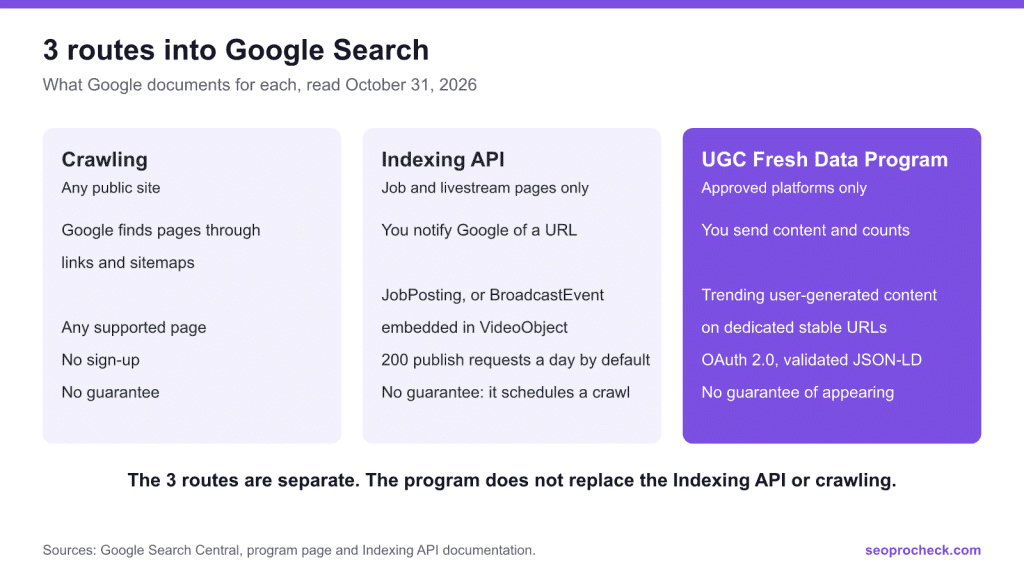
The UGC Fresh Data Program, documented by Google on October 8, 2026, lets approved platforms that mainly host user-generated content send new posts and engagement counts to Search through a dedicated pipeline. It is separate from crawling and from the Indexing API, you apply by form, and approval does not guarantee that anything appears in Search.
- It is for platforms, not for a site with a comment section: public forum or social posts on dedicated stable URLs, each tied to a creator with a public profile.
- You must send content as fresh as possible, ideally within minutes, plus regular engagement counter updates within 72 hours of creation.
- Google answers in 6 to 8 weeks and shares the technical documents only after acceptance.
- The Indexing API's scope has not changed: it still covers only job postings and livestream videos.
What Google published
Google's documentation updates has one short page on the program. It describes a pipeline for approved platforms to send content and interaction signals to Google, so that fresh first-hand posts get processed and updated in Search quickly. Google calls it a specialized pipeline for trending user-generated content, independent of the Indexing API and of ordinary crawling. Its plainest line: "This program doesn't guarantee that content will appear in Search."
3 routes into Search, compared
The question I expect from readers is whether this replaces the Indexing API. It does not, and the 3 routes are easy to separate:
| Crawling | Indexing API | UGC Fresh Data Program | |
|---|---|---|---|
| Who can use it | Any public site | Anyone, but only for the page types below | Approved platforms only |
| What it covers | Any supported page | Pages with JobPosting, or BroadcastEvent embedded in VideoObject | Trending user-generated content on dedicated pages |
| How Google hears about it | Links and sitemaps | You notify Google of a URL | You send content and engagement counts |
| Technical bar | None beyond public pages | API project; 200 publish requests a day by default | OAuth 2.0 and strictly validated JSON-LD payloads |
| Timing Google asks of you | None | When the page is added or removed | Ideally within minutes; counters within 72 hours of creation |
| Guarantee of appearing | No | No: it schedules a crawl | No |
Sources: Google's program page (updated October 8, 2026), the Indexing API quickstart and its quota page (both updated October 16, 2026).
Who qualifies
| Google's requirement | What it asks for | What to check on your platform |
|---|---|---|
| Content focus | Mainly user-generated content, social posts or forum discussions, on dedicated pages with stable URLs. Profile and feed pages do not count | Does each post have its own permanent address? |
| Volume and audience | A high volume of content and a significant user base. No numbers given | You can only judge this by applying |
| Accessibility | Public pages open to Googlebot and users, no login or paywall, every item attributable to a creator with a public profile | Open a thread signed out. Is the author's profile public too? |
| Technical readiness | OAuth 2.0 API authentication, strictly validated JSON-LD payloads, valid on-page schema.org markup | Does a validator pass your thread pages today? |
| Health and moderation | No illegal content, active moderation, a way for users to report | Is the report button on every post? |
| Freshness | Content sent as fresh as possible, engagement counters updated regularly within 72 hours of creation | Can your systems send an update minutes after a post goes up? |
What the page leaves out
- A threshold. High volume and significant user base have no numbers next to them.
- The features. Google says various features on Search, without naming them.
- Ranking. I found no statement that taking part helps or hurts ranking.
- The format. Developer documents come only after acceptance, so nobody outside can tell you what a payload looks like. Be careful with any guide that claims to.
The markup line, checked on real forums
Google gives SocialMediaPosting or DiscussionForumPosting with interactionStatistic as its example of on-page markup. I wanted to know how common that is, so on October 31, 2026 I read one recent thread from each of 5 communities running Discourse software, once with Googlebot's user agent and once with a browser's. Both requests gave the same result.
| Community | Markup type found | interactionStatistic present? |
|---|---|---|
| Discourse Meta | QAPage in JSON-LD | No |
| OpenAI Developer Community | QAPage in JSON-LD | No |
| Shopify Community | QAPage in JSON-LD | No |
| Let's Encrypt Community | QAPage in JSON-LD | No |
| Spiceworks Community | DiscussionForumPosting in microdata | Yes |
1 thread from each of 5 communities, read October 31, 2026. This is a spot check of one kind of software, not a sample of forums. Other forums I tried, including Stack Overflow, Quora, MacRumors and Bogleheads, answered my script with a 403, so they are not counted.
So 4 of 5 threads carried QAPage. That can be right for a forum that is mainly questions and answers, which is when Google's forum markup page says to use Q&A markup instead. It is less clear for general discussion threads. Either way, a platform thinking about this program should look at what its software outputs today, because the example Google names is a different type. Whether QAPage would pass is something I cannot tell you.
If your threads are discussions, this is the shape Google documents. The required fields are the author's name and the publish date, plus text or media. Google supports LikeAction, DislikeAction, ViewAction, CommentAction or ReplyAction, and ShareAction as interaction types. Google says JSON-LD is fully supported on the page, though it recommends microdata or RDFa where possible, so treat this as the content of the markup, not the only format:
<script type="application/ld+json">
{
  "@context": "https://schema.org",
  "@type": "DiscussionForumPosting",
  "headline": "Which router holds up on fiber?",
  "text": "I am choosing between 2 routers for a 1 gig line.",
  "url": "https://example.com/t/which-router-holds-up-on-fiber",
  "datePublished": "2026-10-30T08:34:34-05:00",
  "author": {
    "@type": "Person",
    "name": "Sam Rivera",
    "url": "https://example.com/u/sam-rivera"
  },
  "interactionStatistic": [
    {
      "@type": "InteractionCounter",
      "interactionType": "https://schema.org/LikeAction",
      "userInteractionCount": 27
    },
    {
      "@type": "InteractionCounter",
      "interactionType": "https://schema.org/ReplyAction",
      "userInteractionCount": 14
    }
  ]
}
</script>
If you do not qualify, or would rather not apply
I expect most sites will not qualify, and nothing here changes for them. These are the things that still apply:
- Keep threads public on stable URLs, with accurate dates in your XML sitemaps.
- Use forum or Q&A markup that matches the page. My QAPage notes covers when QAPage fits.
- Moderate. Google's guide on user-generated spam, updated October 26, 2026, now also says to keep shareable or generated pages out of the index unless they are meant for search, with noindex or robots.txt. My notes on the risks of user-generated content go further.
- Do not push forum posts through the Indexing API. Google's docs limit it to the 2 page types above, say all submissions go through spam detection, and warn that abuse can lose you access.
FAQ
Does the UGC Fresh Data Program replace the Indexing API?
No. Google's page says the program is independent of the Indexing API, and the Indexing API documentation, updated October 16, 2026, still limits that API to pages with JobPosting or BroadcastEvent embedded in VideoObject.
Can a small forum apply?
Platforms that fit the criteria can apply, but Google asks for a high volume of user-generated content and a significant user base, without giving numbers. A small forum should expect the normal route, crawling, to stay its route.
Does joining the program improve rankings?
Google does not say so anywhere on the page, and it says the program does not guarantee that content appears in Search. I found no statement about ranking either way.
Does my site need DiscussionForumPosting markup to qualify?
Google asks for valid on-page schema.org markup and gives SocialMediaPosting or DiscussionForumPosting with interactionStatistic as examples. Its wording is for example, so I cannot tell you whether another type, such as QAPage, would pass.
What does a platform send?
Google says JSON-LD payloads, sent through OAuth 2.0 authenticated requests, and engagement counter updates. The technical documents are only shared after acceptance, so the exact format is not public.
How long does an application take?
Google says it responds within 6 to 8 weeks, and that applying does not guarantee participation.
Sources I read
- Google: UGC Fresh Data Program. Last updated October 8, 2026.
- Google: documentation updates. Read October 31, 2026.
- Google: Indexing API quickstart. Last updated October 16, 2026.
- Google: Indexing API quota. Last updated October 16, 2026.
- Google: discussion forum structured data. Last updated September 8, 2026.
- Google: prevent user-generated spam. Updated October 26, 2026.
Take this with you
The assistant links open with a question about this page already written.
Claude Vincent is a technical SEO consultant focused on crawlability, rendering, and AI-search visibility. He writes the field guides and case studies at SEO ProCheck, with a bias toward the durable, unglamorous work that decides whether search engines and AI answer engines can actually read and cite a site.
About SEO ProCheck
Technical SEO consulting and GEO strategy with 20 years of enterprise experience. Case studies, resources, and tools for search and AI visibility.
Subscribe to our newsletter!
Recent Posts
- What's Actually Happening With AI Search, and What You Can Honestly Measure November 16, 2026
- Reddit Voice-of-Customer Analysis, Free and Without an API Key November 14, 2026
- Locked Out of Search Console? Verify Again With a New Account November 12, 2026