

Self-Promotional Listicles in AI Answers: What 3 Studies Actually Measured
- November 8, 2026
- AI Search
TL;DR
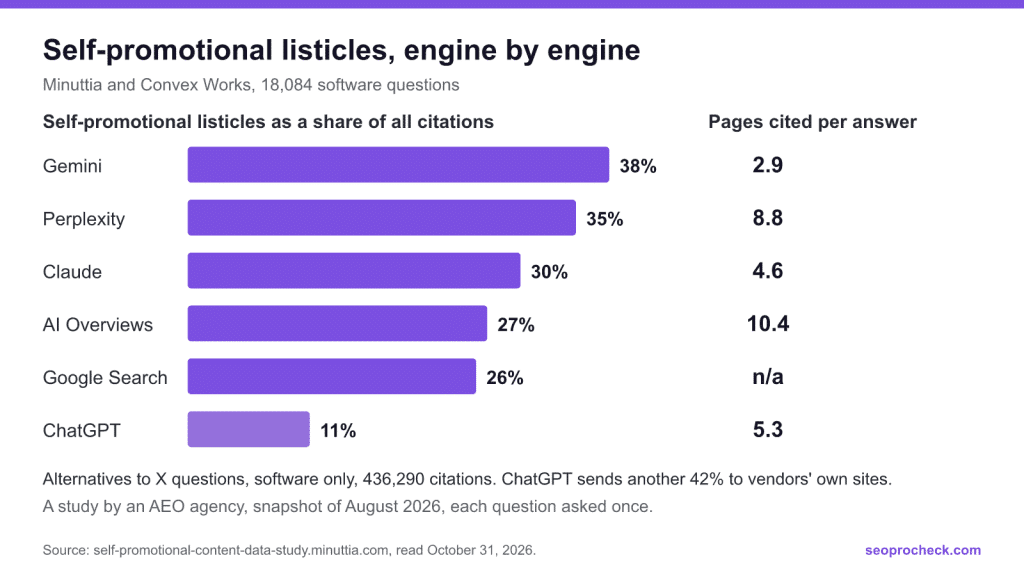
In a study of 18,084 software questions by Minuttia and Convex Works, run in August 2026, 34% to 47% of the listicles cited on alternatives to X questions were vendors listing their own product. That is a share of listicle citations. As a share of all citations it runs from 11% on ChatGPT to 38% on Gemini, and a separate test by Lily Ray suggests a cited list often does not earn its publisher the recommendation.
- Counted by citations to those lists, 93% highlight the vendor's own product, 87% rank it first, and only 16% clearly disclose the vendor.
- Answers cite anywhere from 2.9 pages on Gemini to 10.4 on AI Overviews, so a citation means different things on each engine.
- Peec AI's roughly 11% and Minuttia's 34% to 47% are not in conflict: they divide by different things.
- All of this is software only, and all 3 sources work in this market: Minuttia and Peec AI sell AI search services or tools, and Lily Ray has SEO clients. I have not re-measured any of it.
Who measured what
These 3 sources measure different things, on different prompts, at different times.
| Minuttia and Convex Works | Peec AI | Lily Ray | |
|---|---|---|---|
| When | 2 weeks in August 2026; one ChatGPT re-run in October 2026 | 12 weeks, December 2025 to February 2026 | April to June 2026, updated September 2026 |
| Sample | 18,084 software questions, 5,983 brands, 196 categories; 686,749 citations | 232,000 citations across 13,000 listicles; top 1,000 listicles per week | 100 B2B best software queries, 80 of which showed an AI Overview in the first test |
| Engines | Google Search, AI Overviews, ChatGPT, Gemini, Claude, Perplexity | ChatGPT, Google AI Mode, Perplexity, Copilot, Gemini, AI Overviews | AI Overviews only |
| The share it reports | Of listicle citations, and of all citations | Of all citations | Whether the publisher got named in the answer |
| Who it is | Minuttia is an AEO agency | Peec AI sells AI search tracking | An SEO practitioner with clients, reporting her own test |
Read at Minuttia, Peec AI and Lily Ray's Substack on October 31, 2026. Aleyda Solís shared the Minuttia study on LinkedIn.
The per-engine numbers
The headline range hides how differently each engine behaves. Here are Minuttia's figures for alternatives to X questions, the largest question type at 11,525 questions, taken from its public data page:
| Engine | Listicle citations that are self-promotional | Self-promotional listicles as a share of all citations | Vendor's own website as a share of all citations | Pages cited per answer |
|---|---|---|---|---|
| Gemini | 47% | 38% (6,815) | 3% | 2.9 |
| Google Search | 47% | 26% (25,713) | 6% | Not measured |
| Perplexity | 43% | 35% (35,647) | 1% | 8.8 |
| AI Overviews | 43% | 27% (31,221) | 4% | 10.4 |
| Claude | 36% | 30% (12,266) | 1% | 4.6 |
| ChatGPT | 34% | 11% (6,534) | 42% | 5.3 |
Base: 436,290 citations and 278,636 listicle citations on alternatives to X questions, August 2026. Pages per answer counts only answers citing at least 1 page; Minuttia leaves Google Search out because its results page always lists about 10.
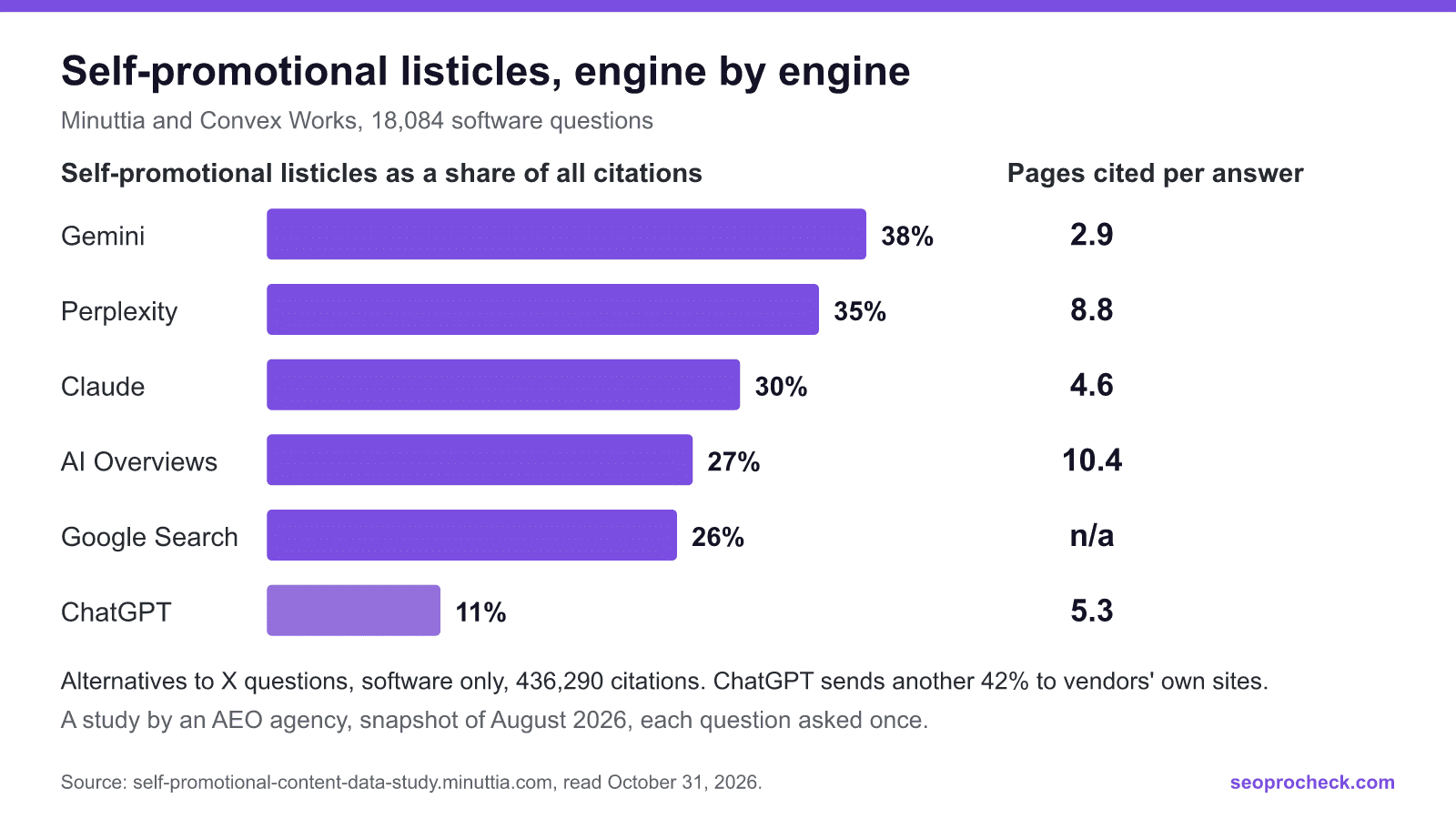
3 things stand out to me. First, ChatGPT is the odd one: 42% of its citations went to the vendor's own website, so its low listicle share is partly a different habit and not a filter. Second, a page cited by Gemini is 1 of about 3, while a page cited by an AI Overview is 1 of about 10, so a raw citation count across engines mixes very different levels of prominence. Third, the same data page says ChatGPT was set to search on every question, so its 100% rate of citing the web is a setting and not a habit.
Minuttia states its own limits: each platform answered each question once, and it is a snapshot of August 2026. Across 177 categories with at least 300 listicle citations, the self-promotional share ran from 12% to 76%, so a single average tells you little about your category.
Why 43% and 11% are both right
Peec AI's March 2026 study says roughly 11% of citations come from self-promotional listicles, with ChatGPT lowest at 3.6%, against 10.3% for Google AI Mode and 10.4% for Perplexity. Next to the 43% of cited listicles Minuttia reports across all software categories, that looks like a contradiction, and it is not one:
- Denominator. Peec AI divides by all citations. Minuttia's 34% to 47% divides by listicle citations only. Minuttia's share of all citations, 11% to 38%, is the fairer comparison.
- Prompts. Peec AI used fixed non-branded software review prompts. Minuttia's alternatives to X questions name a product, which may pull more list pages.
- Detection. Peec AI flags a list when the domain matches a brand promoted in the list. Minuttia labels each page by publisher and type, and checks that the publisher sells in that category and lists its own tool.
- Time. They are 6 months apart, and Peec AI's data ends in February 2026.
Cited is not the same as recommended
This is the finding I would put first. In her June 2026 piece, Lily Ray pulled AI Overview answers for 100 B2B best software queries at 3 checkpoints in April, May and June 2026, and separated 2 things: whether a brand's own list appeared as a source, and whether the brand was named as a pick in the answer.
Of 323 self-promotional listicles cited across the 80 queries that showed an AI Overview, the publishing brand was left out of the recommendation on 224, or 69%. In her October 4, 2026 post she reports the update she ran for September 2026: AI Overviews citing 38% fewer of these lists than in June, and leaving the publisher out 83% of the time.
Treat those as her report, on AI Overviews only, on one query set. She also says, in her February 2026 post, that sites relying on this tactic lost organic visibility in early 2026, and in June says she analyzed over 40 such sites. Those are observed patterns and she says so herself: many factors can drive a drop.
Put next to Minuttia, there is no contradiction here either. Minuttia counts citations. Ray counts names in the answer. A list can keep getting cited while its publisher gets nothing from it, and in that case your citation dashboard looks fine while competitors collect the recommendation.
What I would do with this
- Report cited and recommended as 2 columns. Run a fixed set of questions and record, per answer, whether you were cited, whether you were named, and in what position. Monitoring AI search visibility covers the rest of that routine.
- Quote a study with its denominator. "34% to 47% of cited listicles, on alternatives to X questions, in software" is accurate. "47% of AI citations" is not.
- If you publish a list that includes your product, say so at the top. In Minuttia's data, only 16% clearly disclosed the vendor, counted by citations. That is my recommendation, not a ranking claim.
- Do not scale the tactic. Minuttia's advice leans toward publishing fair lists. Peec AI's advice is not to, for reputational and algorithmic reasons. Ray documents the traffic risk. I side with caution, and my pre-publish quality gate would stop a swap-a-noun list set before it ships.
- Get on independent lists. Minuttia found 53% to 66% of cited listicles on alternatives to X questions were not self-promotional, so third-party lists are still the larger share of cited lists.
How engines pick sources more broadly is in how Perplexity, ChatGPT and Google AI pick their sources, what earns a citation is in how to become a cited source, and the checks I keep for all of this are in the AI readiness checklist.
FAQ
What is a self-promotional listicle?
A software vendor's best-tools list for its own category that includes its own product. That is Minuttia's definition. Peec AI's is close: a brand publishes a best-of roundup and ranks itself at the top.
Why do the studies give such different numbers?
They use different denominators and different prompts. Minuttia's 34% to 47% is a share of listicle citations on alternatives to X questions. Peec AI's roughly 11% is a share of all citations on non-branded software review prompts. Minuttia's own share of all citations is 11% to 38%.
Is Google filtering these lists out of AI Overviews?
The evidence is mixed. Peec AI found no evidence of a correction through February 2026. Lily Ray reports AI Overviews citing 38% fewer of them in September 2026 than in June, on 100 B2B queries. Minuttia still found 43% of AI Overview listicle citations were vendors' own in August 2026, on a different question set.
Does being cited mean the brand is recommended?
No, and that is the main point. In Lily Ray's June 2026 test, the publishing brand was left out of the recommendation on 224 of the 323 self-promotional listicles cited, or 69%. A citation is a source, and a recommendation is a name in the answer.
Do these numbers apply outside software?
No. Minuttia and Peec AI both studied software, a niche with a lot of this content, and Peec AI says its findings are vertical-specific. I would not carry them to other industries.
How many pages does an AI answer cite?
In Minuttia's alternatives to X questions, counting answers that cite at least one page: AI Overviews 10.4, Perplexity 8.8, ChatGPT 5.3, Claude 4.6 and Gemini 2.9. That is one snapshot from August 2026, with each question asked once.
Sources I read
- Minuttia and Convex Works: Self-Promotional Content Data Study. Published on Minuttia's blog; August 2026 data.
- The study's public data page. My source for the per-engine counts.
- Peec AI: self-promotional listicles, 232,000 citations. March 3, 2026.
- Lily Ray: Is Google Finally Cracking Down on Self-Promotional Listicles?. February 3, 2026.
- Lily Ray: Why Calling Yourself the Best Could Be Helping Your Competitors Win in AI Search. June 17, 2026.
- Lily Ray: Prediction, the next massive Google update is around the corner. October 4, 2026.
- Aleyda Solís on LinkedIn. How the study reached me.
Take this with you
The assistant links open with a question about this page already written.
Claude Vincent is a technical SEO consultant focused on crawlability, rendering, and AI-search visibility. He writes the field guides and case studies at SEO ProCheck, with a bias toward the durable, unglamorous work that decides whether search engines and AI answer engines can actually read and cite a site.
About SEO ProCheck
Technical SEO consulting and GEO strategy with 20 years of enterprise experience. Case studies, resources, and tools for search and AI visibility.
Work With Me
Technical SEO audits, GEO strategy, site migrations, and international SEO. Hourly consulting for teams who need hands-on support, not just reports.
Subscribe to our newsletter!
Recent Posts
- What's Actually Happening With AI Search, and What You Can Honestly Measure November 16, 2026
- Reddit Voice-of-Customer Analysis, Free and Without an API Key November 14, 2026
- Locked Out of Search Console? Verify Again With a New Account November 12, 2026