


Conversion rate optimization raises the share of visitors who take a desired action, usually by testing changes to layout, copy, and flow. It is how you stop leaking the traffic that SEO worked to earn, and it pays directly: lifting conversion from 2 percent to 2.5 percent is a 25 percent revenue gain at the same traffic.
- Find the leak first with funnel data, then run a controlled A/B test that changes one variable at a time.
- Calculate sample size up front and run to significance instead of stopping the moment a variant is ahead.
- CRO and SEO can conflict, so reposition ranking copy rather than deleting it and avoid intrusive interstitials.
- Track revenue per visitor as a guardrail, because a cheaper product can lift conversion rate while lowering revenue.
What is conversion rate optimization (CRO)?
Conversion rate optimization is the practice of increasing the share of visitors who take a desired action, buy, sign up, add to cart, usually through testing changes to layout, copy, and flow. The stakes are direct: at the same traffic and margin, lifting conversion from 2% to 2.5% is a 25% revenue increase without spending a cent more on acquisition.
CRO is where SEO's job ends and revenue begins. You can rank a page first and still lose the sale on a slow load, a buried add-to-cart button, or a checkout that asks for too much. CRO is how you stop leaking the traffic SEO worked to earn.
How CRO actually works: test, don't guess
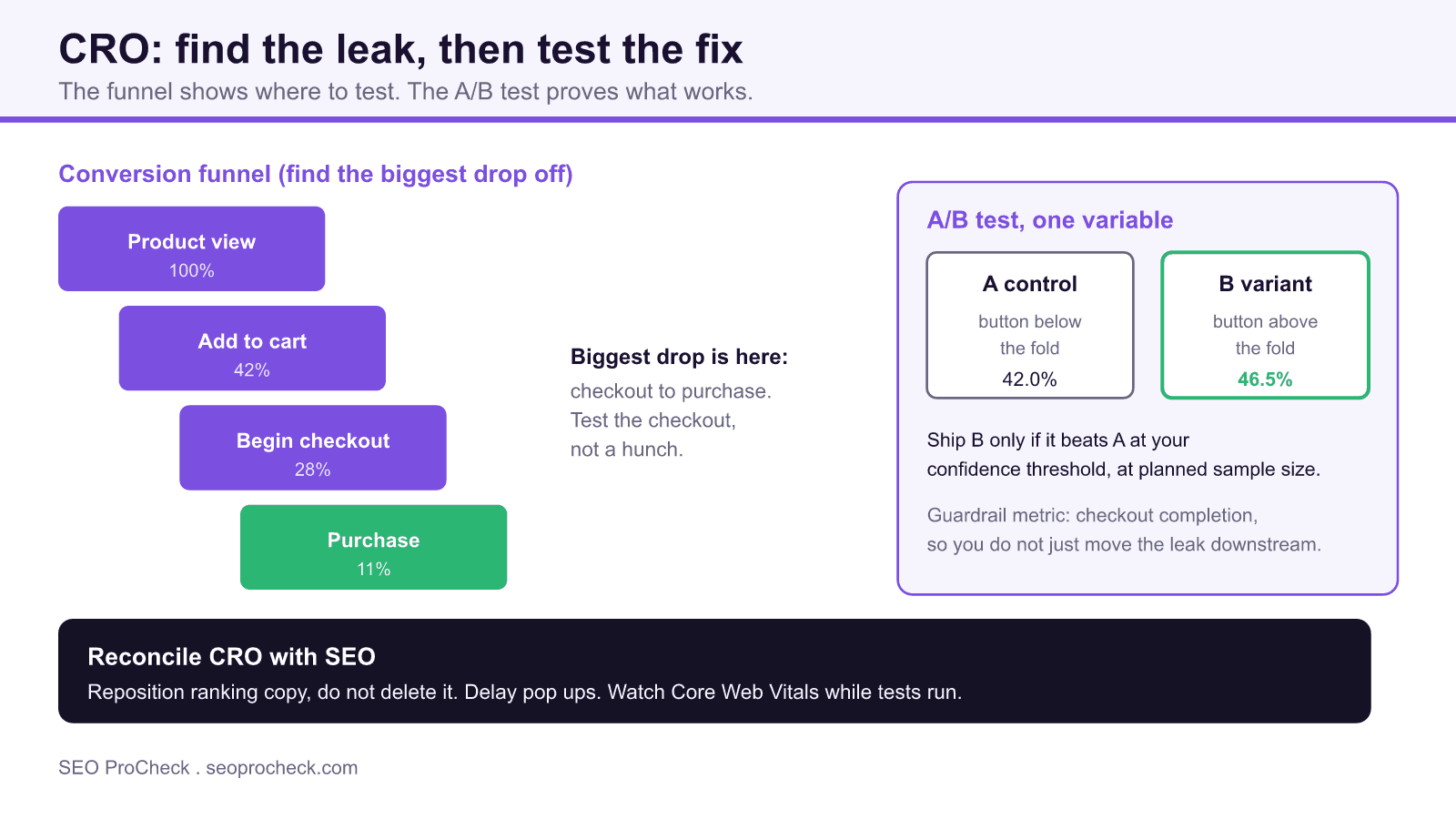
The core mechanic is the A/B test. You show version A (the control) to half your visitors and version B (the variant, with one meaningful change) to the other half, then measure which converts better with enough traffic to be statistically confident. The discipline is changing one variable at a time so you know what moved the number.
A clean A/B test framing looks like this:
- Hypothesis: "Moving the add-to-cart button above the fold will increase add-to-cart rate, because mobile users aren't scrolling to find it."
- Metric: add-to-cart rate (primary), checkout completion (guardrail, make sure you didn't just move the leak downstream).
- Sample size: calculated up front so you don't call a winner on 40 conversions of noise.
- Decision rule: ship B only if it beats A at your confidence threshold; otherwise keep A and learn.
The unglamorous truth: most tests lose or come out flat. That's fine, a flat test still kills a bad idea before it ships to 100% of traffic.
The CRO vs. SEO tension (and how to not shoot yourself)
CRO and SEO pull in opposite directions more often than people admit, and pretending they don't is how sites tank their rankings chasing a conversion bump.
| Change | CRO says | SEO says | The reconciliation |
|---|---|---|---|
| Cut long product descriptions | Less scrolling, faster to cart | That copy ranks for long-tail terms | Keep the copy, move it below the fold / into tabs, not delete it |
| Interstitial email pop-up on entry | Captures leads, lifts signups | Intrusive interstitials can hurt rankings | Delay the pop-up, use exit-intent, avoid full-screen on mobile |
| Infinite scroll / heavy JS for slick UX | Smoother browsing | Can break crawlability and slow LCP | Progressive enhancement; paginate for crawlers, lazy-load for users |
| Aggressive image compression for speed | Faster load, better conversion | Product images also drive the sale | Optimize format/size without gutting visual quality |
Speed is the rare place they fully agree: faster pages both rank better and convert better. Everywhere copy or crawlability is on the table, the rule is reconcile, don't let a CRO win quietly cost you the traffic that fed it.
How to run and check CRO on your own site
- Find the leak first. In GA4, build a funnel: product view → add to cart → begin checkout → purchase. The biggest drop-off between steps is where to test, not wherever you have a hunch.
- Watch real sessions. Use a tool like Microsoft Clarity (free) or Hotjar for heatmaps and session recordings. You'll see rage clicks, dead zones, and where people abandon, qualitative fuel for hypotheses.
- Run a proper A/B test. Use Optimizely, VWO, or GA4 + a testing tool. Calculate sample size before launch, run to significance, and don't peek-and-stop the moment B is ahead.
- Guard your SEO metrics during the test. Watch organic traffic and Core Web Vitals in Search Console while the variant is live. A conversion win that dented rankings is a net loss.
- Ship, document, repeat. Log every test, hypothesis, result, decision, win or lose. The compounding value of CRO is the learning library, not any single test.
Common mistakes and how to fix them
- Calling winners on tiny samples. 15 conversions is noise, not a result. Fix: calculate the required sample size first and run to it.
- Testing five changes at once. You'll never know which one worked. Fix: isolate one variable, or use a properly designed multivariate test with the traffic to support it.
- Optimizing the wrong step. Polishing a product page when the leak is in checkout wastes the cycle. Fix: let the funnel data pick the target.
- Ignoring the SEO cost of a CRO change. Deleting ranking copy or adding intrusive pop-ups can crater organic traffic. Fix: reconcile per the table above and monitor rankings during tests.
- Chasing conversion rate while revenue drops. A cheaper product can lift conversion rate and lower revenue. Fix: track revenue per visitor alongside conversion rate as a guardrail.
FAQ
What's a good ecommerce conversion rate?
It varies wildly by industry, price point, and traffic source, so chasing a universal benchmark is a trap. The number that matters is your own trend line, is this month's rate beating last quarter's on comparable traffic? Optimize against yourself, not a blog's average.
Does CRO hurt SEO?
It can, if you cut ranking content, add intrusive interstitials, or break crawlability chasing a conversion bump. It doesn't have to. Reconcile the two, keep the copy but reposition it, delay pop-ups, and monitor rankings and Core Web Vitals while tests run.
How much traffic do I need to A/B test?
Enough to reach statistical significance for the effect size you care about, often thousands of conversions, not visitors. Low-traffic pages take longer or need bigger, bolder changes to detect a difference. Calculate sample size before you start so you know the test is even feasible.
What's the difference between CRO and SEO?
SEO earns the visit; CRO turns the visit into revenue. SEO optimizes for rankings and traffic; CRO optimizes the on-page experience so that traffic converts. They share the goal of revenue but pull on different levers, and occasionally against each other.
Where should I start with CRO?
Start with your funnel data. Find the step with the biggest drop-off, watch session recordings to understand why, form one hypothesis, and test it. Starting from data beats starting from a checklist of "best practices" that may not apply to your visitors.
Related terms
Related ecommerce terms: Add to Cart Tracking, Shopping Intent, and a real-world case study on Core Web Vitals lifting conversion rate.
Take this with you
The assistant links open with a question about this page already written. Nothing is sent until you press enter.
Claude Vincent is a technical SEO consultant focused on crawlability, rendering, and AI-search visibility. He writes the field guides and case studies at SEO ProCheck, with a bias toward the durable, unglamorous work that decides whether search engines and AI answer engines can actually read and cite a site.
About SEO ProCheck
Technical SEO consulting and GEO strategy with 20 years of enterprise experience. Case studies, resources, and tools for search and AI visibility.
Work With Me
Technical SEO audits, GEO strategy, site migrations, and international SEO. Hourly consulting for teams who need hands-on support, not just reports.
Subscribe to our newsletter!








Recent Posts
- Most Top Sites Never Say Who They Are in Structured Data October 14, 2026
- Homepage Titles Are Mostly Too Short, Not Too Long October 8, 2026
- Who Actually Serves an llms.txt? 184 Top Sites Measured September 29, 2026