

Zero-Click Search: Earning Value When Users Never Leave the SERP
- November 27, 2022
- SEO Strategy
AI Summary
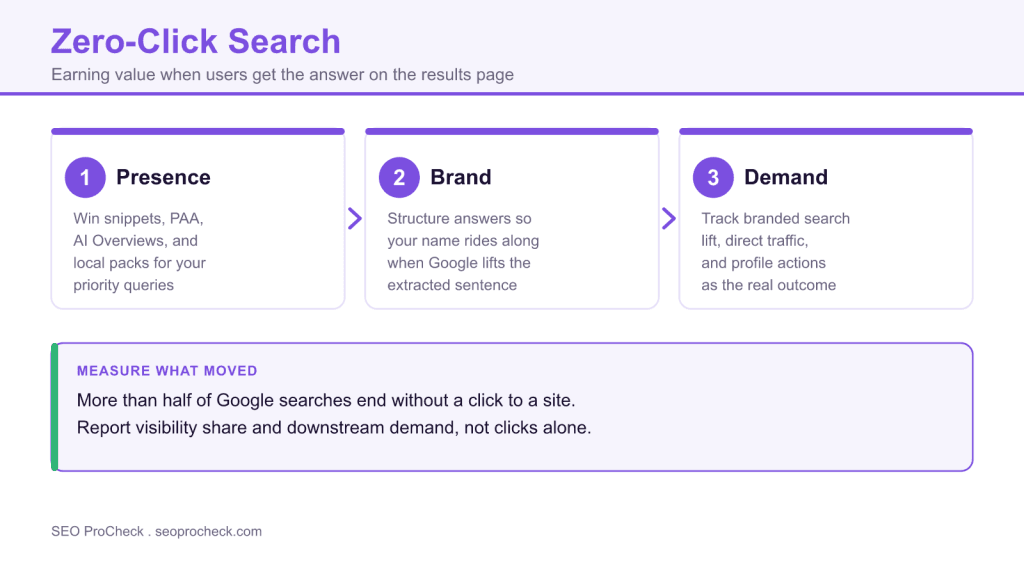
A zero-click search is any query answered directly on the results page, so the user never visits a site. The value does not disappear, it moves into the SERP itself, and your measurement has to follow it there.
- More than half of Google searches now end without a click to any website.
- Separate satisfied-intent queries, which were never your traffic, from answer-extracted ones.
- Measure visibility share, branded lift, and downstream demand instead of clicks alone.
- Structure answers so your brand rides along when Google lifts the extracted sentence.
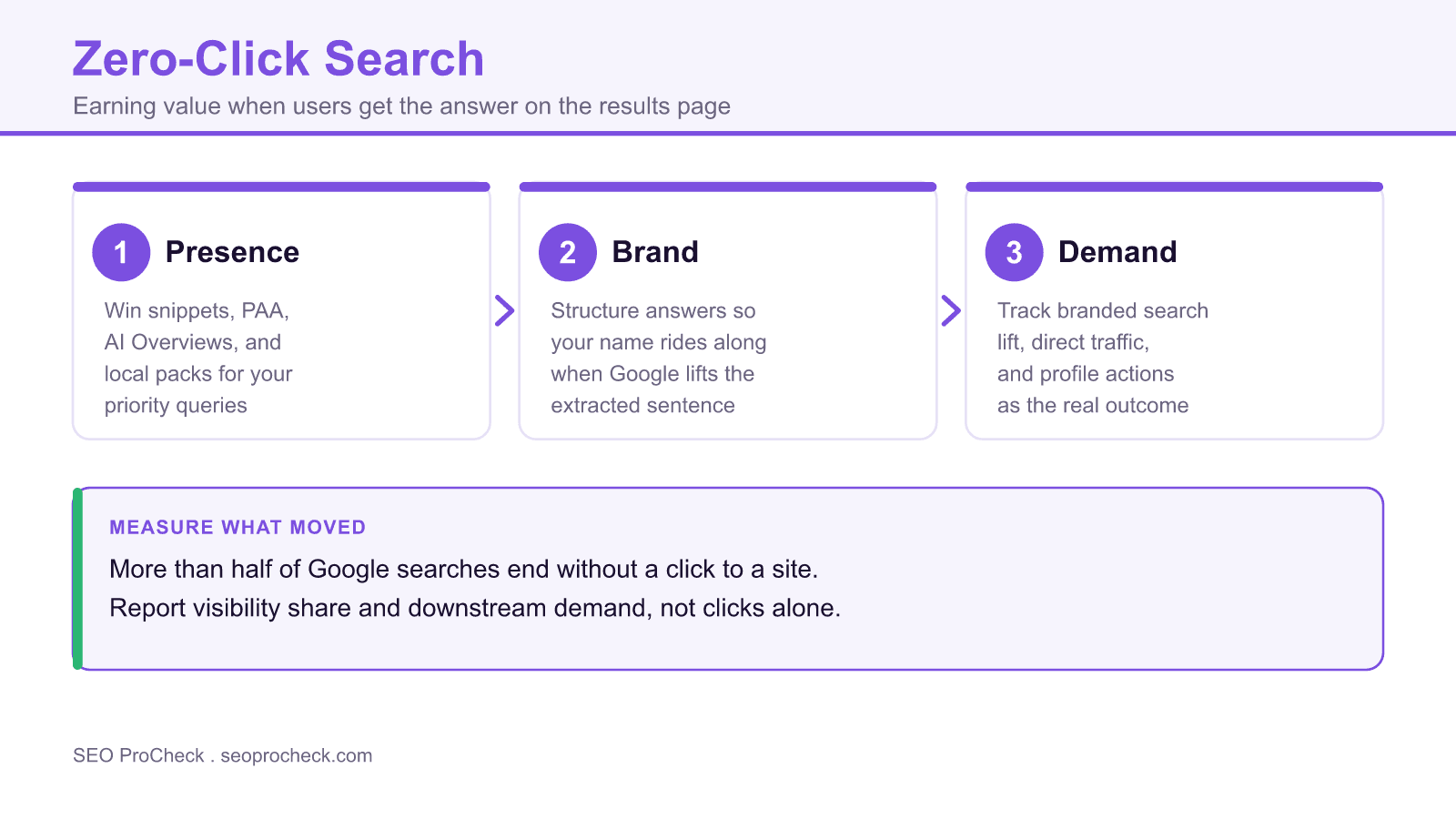
More than half of all Google searches now end without a click to any website. For SEO and marketing teams trained to measure success in sessions and conversions, that's an uncomfortable reality. But "no click" does not mean "no value", it means the value moved upstream, into the SERP itself, and your measurement has to follow it there.
What Zero-Click Search Actually Means
A zero-click search is any query where the user gets their answer directly on the results page and never visits a destination site. This is driven by SERP features that Google builds from web content: featured snippets, knowledge panels, AI Overviews, People Also Ask, instant answers (weather, calculators, definitions), local packs, and rich results like recipes and reviews.
The key distinction most teams miss: there are two flavors of zero-click. The first is satisfied-intent queries, "what time is it in Tokyo," "how many ounces in a cup", where no business ever expected a click. The second is answer-extracted queries, where your content earns the answer box but the user never reaches you. The first was never your traffic. The second is where the strategic work lives, because you are supplying the value and Google is capturing the engagement.
Why "Just Get the Click" No Longer Works
The instinctive response, write content that forces a click by withholding the answer, backfires. Google's systems reward content that comprehensively answers intent, and AI Overviews and snippets synthesize from the sources that answer best. Withholding gets you skipped in favor of a competitor who answers cleanly. The durable strategy is to be the source of the answer and engineer downstream value around that visibility, rather than fighting the format.
Reframing What You Measure
If clicks are no longer the sole proxy for value, you need a measurement model built around impressions, presence, and downstream demand. Here is the hierarchy I use with clients:
- Visibility share, How often you appear in SERP features for your priority query set, not just your blue-link ranking.
- Branded answer presence, Whether your brand name, product, or expert is cited inside the snippet or AI Overview.
- Assisted and delayed conversion, Branded search lift, direct traffic, and conversions that follow exposure but don't carry a search-click attribution.
- Engagement value, For local and entity queries, the actions that happen on the SERP (calls, directions, profile views).
Instrumenting Zero-Click Value in Practice
You can build a credible measurement system from tools most teams already have. The trick is reading them differently.
- Mine Google Search Console for the impression-to-click gap. Filter queries with high impressions and low CTR where you rank in positions 1, 5. A strong rank with suppressed CTR is the fingerprint of a snippet or AI Overview absorbing the click. Track these as a cohort over time, not as failures.
- Segment branded vs. non-branded search. Use the GSC query filter or a regex to split branded queries out. A healthy zero-click strategy shows rising branded impressions and clicks even as non-branded CTR softens, that's the downstream signal that visibility is converting into demand.
- Track SERP feature ownership. Use a rank tracker that records which features each keyword triggers and whether you own them. Your KPI shifts from "average position" to "feature presence rate", the percentage of tracked keywords where you appear in a snippet, PAA, or AI Overview.
- Monitor Google Business Profile insights for local intent. For local businesses, calls, direction requests, and profile interactions are the conversion. Treat GBP insights as a primary revenue dashboard, not an afterthought.
- Watch direct and brand traffic as a lagging indicator. Set a baseline, then correlate increases in direct sessions and branded search volume against periods of strong SERP-feature presence. The relationship is correlational, not click-attributed, accept that and report it honestly.
Capturing Value the User Sees But Doesn't Click
Visibility without a click can still drive revenue if you engineer the SERP appearance to do work. Concrete tactics:
- Lead with your brand inside the answer. Structure content so the extractable answer naturally includes your brand, product name, or a named expert. If Google lifts the sentence, your name rides along. "The [BrandName] method recommends three steps…" survives extraction better than a generic phrasing.
- Use schema to control the rich result. Implement
Product,Review, andOrganizationstructured data so the SERP renders your framing, ratings, price, logo, sitelinks, which builds recognition even on a no-click impression, and keepFAQPageandHowTofor Bing and AI assistants, since Google retired the HowTo rich result in September 2023 and the FAQ rich result on May 7, 2026. - Answer the question, then extend the intent. Give the clean answer up top to win the snippet, then add depth (comparisons, edge cases, tools, calculators) that the SERP can't replicate. Users who need more than the answer click through to the source that obviously has more.
- Build entity authority. A consistent presence in knowledge panels and AI Overviews depends on your brand being a recognized entity. Strengthen your
sameAslinks, Wikipedia/Wikidata presence where legitimate, consistent NAP data, and authoritative mentions across the web. - Optimize the title and snippet copy for the impression. Even a no-click impression is a branding event. Write meta descriptions and titles that communicate authority and value at a glance, because thousands of people are reading them without clicking.
Optimizing for AI Overviews and Answer Engines
AI Overviews and answer engines (including LLM-based search) are the newest and most aggressive zero-click surfaces. They synthesize answers and cite sources. To be one of those cited sources:
- Write in clear, self-contained passages that state a claim and support it, these are easiest for models to extract and attribute.
- Use descriptive headings phrased as the questions users actually ask.
- Include specific, verifiable detail (steps, numbers, named methods). Vague content gets summarized away without a citation; specific content gets cited to you.
- Keep critical facts in text, not locked inside images or scripts a crawler can't read.
Citation in an AI Overview is the new "position one." It drives brand exposure and a qualified click from users who want the full answer, and those clicks tend to convert well because intent is already deep.
Common Mistakes
- Treating every zero-click loss as a problem. Many were never your traffic. Separate satisfied-intent queries from answer-extracted ones before you panic or act.
- Withholding answers to force clicks. This gets you replaced by a competitor and excluded from AI Overviews. Be the best source instead.
- Reporting only on clicks and sessions. If your dashboard can't show impression share, branded lift, and feature ownership, it's blind to where value now accrues.
- Ignoring branded search as an outcome. Rising branded volume is often the clearest proof that zero-click visibility is paying off.
- Skipping structured data. Without schema you forfeit control over how your no-click impression looks and whether it's recognizable as yours.
The Bottom Line
Zero-click search shifts value from the destination to the result page, but it does not destroy value, it relocates it. Teams that win measure visibility and downstream demand instead of clicks alone, engineer their SERP presence to carry brand and intent, and position themselves as the cited source inside snippets and AI answers. The click is no longer the only conversion. Presence, recognition, and the demand they generate are now part of the return.
Want this handled properly on your site?
It is exactly the kind of work an advanced technical SEO audit covers. See how an advanced SEO audit works →
From click metrics to zero-click metrics
| Traditional KPI | Zero-click KPI | Where to find it |
|---|---|---|
| Average position | Feature presence rate | Rank tracker that records SERP features |
| Organic CTR | Impression to click gap cohort | Google Search Console performance report |
| Sessions | Branded search lift | GSC branded query filter or regex |
| Conversions from clicks | Profile actions, calls, directions | Google Business Profile insights |
Frequently asked questions
What counts as a zero-click search?
Any query where the user gets their answer directly on the results page and never visits a destination site. Featured snippets, knowledge panels, AI Overviews, People Also Ask, local packs, and instant answers all produce zero-click results.
Is zero-click search bad for my business?
Not always. Many zero-click queries, like the time in another city, were never going to send you traffic. The strategic concern is answer-extracted queries, where your content earns the answer box but the user never reaches you.
How do I measure value when there is no click?
Track visibility share, branded search lift, direct traffic, and, for local businesses, profile actions like calls and directions. In Search Console, watch the impression to click gap on queries where you rank well but CTR is suppressed.
Should I withhold answers to force a click?
No. Google rewards content that answers intent cleanly, and withholding gets you skipped in favour of a competitor who answers well. Give the clear answer, then add depth the SERP cannot replicate so people who need more click through.
How do I get cited in AI Overviews?
Write clear, self-contained passages that state a claim and support it, use headings phrased as real questions, and include specific, verifiable detail. Keep critical facts in text, not locked inside images or scripts a crawler cannot read.
Take this with you
The assistant links open with a question about this page already written. Nothing is sent until you press enter.
Claude Vincent is a technical SEO consultant focused on crawlability, rendering, and AI-search visibility. He writes the field guides and case studies at SEO ProCheck, with a bias toward the durable, unglamorous work that decides whether search engines and AI answer engines can actually read and cite a site.
About SEO ProCheck
Technical SEO consulting and GEO strategy with 20 years of enterprise experience. Case studies, resources, and tools for search and AI visibility.
Work With Me
Technical SEO audits, GEO strategy, site migrations, and international SEO. Hourly consulting for teams who need hands-on support, not just reports.
Subscribe to our newsletter!








Recent Posts
- Most Top Sites Never Say Who They Are in Structured Data October 14, 2026
- Homepage Titles Are Mostly Too Short, Not Too Long October 8, 2026
- Who Actually Serves an llms.txt? 184 Top Sites Measured September 29, 2026