


AI Summary
Alt text is the written stand in for an image, carried in the alt attribute of an img tag: screen readers speak it, browsers show it when the file fails, and search engines lean on it to understand the image. Good alt text says what you would say describing the image aloud, and decorative images take an empty alt so they are skipped.
- The test: alt text is what you would say when you reach the image reading the page aloud.
- Empty alt and missing alt differ: an empty alt means skip this, a missing attribute makes screen readers read the filename.
- The right alt depends on the image role: product, chart, logo, screenshot, or decorative.
- It is a primary Google Images signal and a baseline WCAG accessibility requirement.
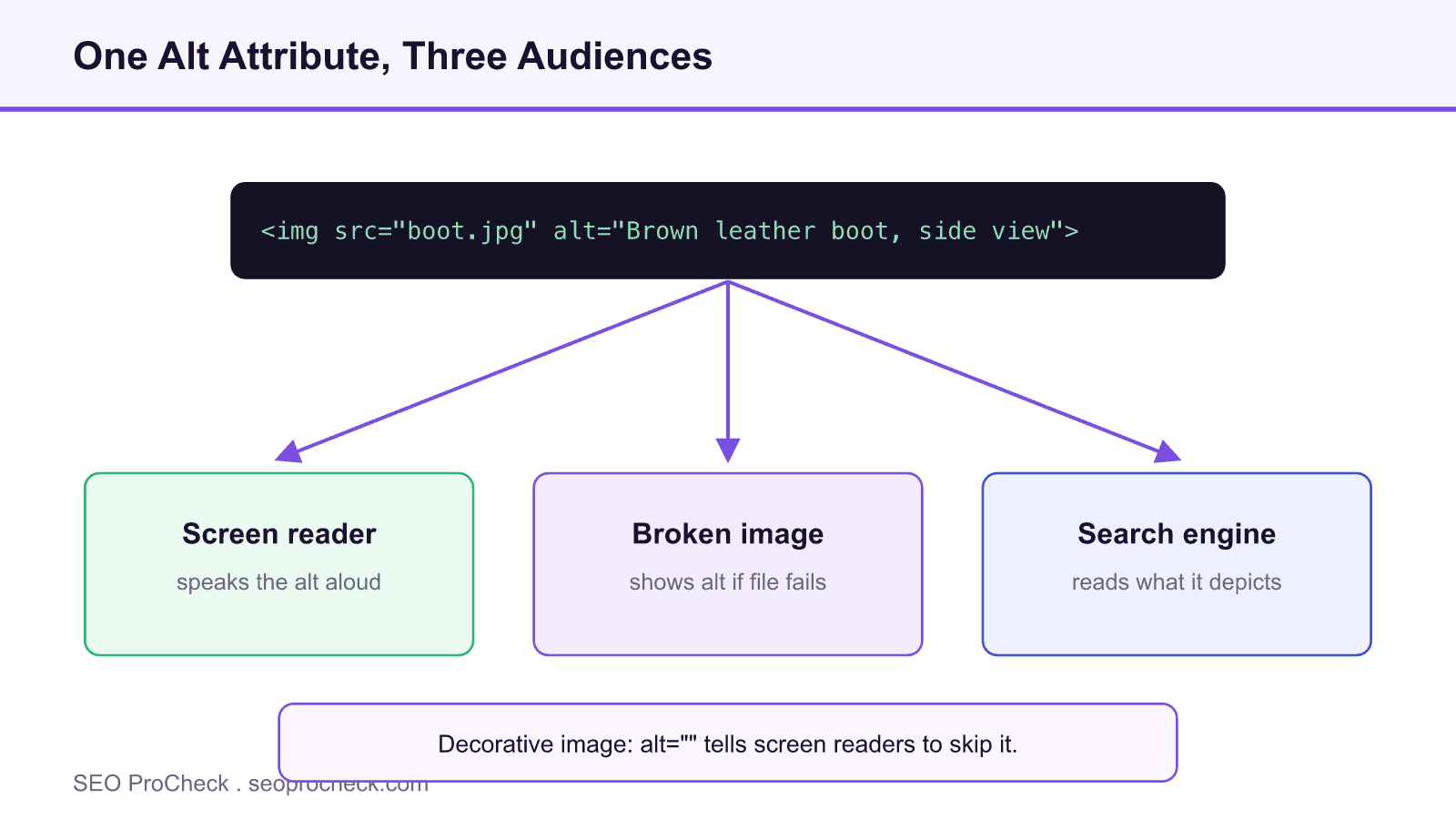
Alt text (the alt attribute on an <img> tag) is the written stand-in for an image: screen readers speak it aloud, browsers show it when the file fails to load, and search engines lean on it to understand what the image depicts. Skip it and you lose on two fronts at once, blind and low-vision visitors hit a dead spot in your content, and Google Images has to guess what your product photos show.
What good alt text actually looks like
The test I use: if you read the page aloud over the phone, the alt text is what you'd say when you reach the image. That framing kills most bad habits instantly. You wouldn't say "image of shoe" to someone on the phone; you'd say "brown leather chelsea boot with a crepe sole, side view." You also wouldn't describe the swooshy divider graphic at all, you'd skip it, which is exactly what alt="" does.
<!-- Bad: filename garbage -->
<img src="IMG_4821-final-v3.jpg" alt="IMG_4821">

<!-- Bad: keyword stuffing -->
<img src="boot.jpg" alt="chelsea boot buy chelsea boots cheap best chelsea boot 2026">

<!-- Good: says what a person would say -->
<img src="boot.jpg" alt="Brown leather chelsea boot with crepe sole, side view">

<!-- Good: decorative image, deliberately silenced -->
<img src="divider-flourish.svg" alt="" role="presentation">
Note that empty alt and missing alt are not the same thing. alt="" is an explicit instruction: "nothing to see here, move on." A missing attribute forces screen readers to improvise, often by reading the filename, which is how a visitor ends up hearing "eye em gee four eight two one final vee three dot jay peg."
Good vs bad alt by image role
Alt text isn't one skill, the right answer depends entirely on what job the image does on the page.
| Image role | Bad alt | Good alt | Why |
|---|---|---|---|
| Product photo | alt="product" | alt="Kalamata olives in brine, 370g glass jar" | The detail is what shoppers search in Google Images |
| Decorative flourish / spacer | alt="decorative swirl graphic element" | alt="" | Describing decoration is noise; empty alt tells screen readers to skip it |
| Chart or graph | alt="chart" | alt="Line chart: organic clicks falling from 1,200/day in March to 300/day in June" | State the takeaway, not the medium; put full data in a table nearby |
| Logo that links home | alt="logo" | alt="Acme Roasters, home" | A linked image's alt becomes the link text; describe the destination |
| Tutorial screenshot | alt="screenshot" | alt="Search Console Page indexing report listing why pages are not indexed" | The reader following along needs to know what state the screen is in |
| Hero / mood image | alt="header image" | alt="Sunrise over terraced olive groves in Provence" or alt="" | Describe it if it carries meaning; silence it if it's pure atmosphere |
How to check it on your own site
- Crawl for gaps. Screaming Frog → Images tab → filter "Missing Alt Text" and "Alt Text Over 100 Characters." Export both lists. Our walkthrough on fixing missing alt text covers triaging the export.
- Spot-check with a screen reader. On a Mac, hit Cmd+F5 for VoiceOver and tab through a key template. Thirty seconds of listening teaches more than any report.
- Run WAVE or axe DevTools on your main templates, both flag missing alts, suspicious alts (filenames, "image of"), and redundant alts that duplicate adjacent captions.
- Query your own database if you're on WordPress:
SELECT COUNT(*) FROM wp_postmeta WHERE meta_key = '_wp_attachment_image_alt' AND meta_value = ''gives you the media-library backlog in one line. - Check Google's view in Search Console → Performance → Search type: Image. Pages with strong image impressions but weak clicks often have technically-present but useless alt text.
Common audit mistakes (and fixes)
Treating alt text as a keyword slot
Stuffing "best cheap chelsea boots 2026" into an alt attribute reads as spam to Google and as gibberish to a screen-reader user. Fix: describe the image honestly; if the natural description contains your keyword, great, and if not, leave it out.
Alt-texting every decorative image
Auditors see "missing alt" counts and demand 100% coverage, so someone dutifully describes 400 divider graphics. Fix: decorative images get alt="", that IS the correct value, and good crawlers distinguish empty from missing.
Starting with "Image of…" or "Picture of…"
Screen readers already announce "image." Your prefix makes it "image: image of a boot." Fix: delete the prefix everywhere; start with the subject.
Duplicating the caption
When alt and <figcaption> are identical, screen-reader users hear everything twice. Fix: caption carries the commentary, alt carries the visual description, different jobs, different text.
Fixing alts while ignoring the rest of image SEO
Alt text alone won't rank images that are unoptimized 3 MB monsters with hash filenames. Pair this work with image optimization and the file-name and lazy-loading practices in image SEO beyond alt text.
FAQ
Is alt text a ranking factor?
For Google Images, clearly yes, it's a primary signal for what the image shows. For regular web ranking it contributes context the way any on-page text does: modestly. The accessibility obligation, meanwhile, isn't optional at all, it's baseline WCAG conformance and, in many jurisdictions, a legal exposure question.
How long should alt text be?
Usually under ~125 characters, because some screen readers historically chunked longer text awkwardly. But length is a symptom, not a rule: say what matters, stop. A complex chart deserves a short alt plus a longer description in the surrounding copy.
Do AI crawlers and LLMs read alt text?
Yes, alt attributes are part of the HTML they ingest, and they're often the only machine-readable account of what an image contains. As AI search summarizes more pages, well-written alts are one more place your actual content survives the extraction.
Can I auto-generate alt text with AI?
As a first pass over a 10,000-image backlog, sure, vision models produce decent literal descriptions. But review anything customer-facing: models miss context (they'll describe your founder as "a man smiling") and invent details. Auto-generate, then human-edit the templates that matter.
What about images that are also links?
The alt text becomes the link's accessible name, so describe the destination, not the pixels: alt="View cart" beats alt="shopping cart icon". An icon link with empty alt is a real bug, the link becomes unnamed and unusable.
Take this with you
The assistant links open with a question about this page already written. Nothing is sent until you press enter.
Claude Vincent is a technical SEO consultant focused on crawlability, rendering, and AI-search visibility. He writes the field guides and case studies at SEO ProCheck, with a bias toward the durable, unglamorous work that decides whether search engines and AI answer engines can actually read and cite a site.
About SEO ProCheck
Technical SEO consulting and GEO strategy with 20 years of enterprise experience. Case studies, resources, and tools for search and AI visibility.
Work With Me
Technical SEO audits, GEO strategy, site migrations, and international SEO. Hourly consulting for teams who need hands-on support, not just reports.
Subscribe to our newsletter!








Recent Posts
- Most Top Sites Never Say Who They Are in Structured Data October 14, 2026
- Homepage Titles Are Mostly Too Short, Not Too Long October 8, 2026
- Who Actually Serves an llms.txt? 184 Top Sites Measured September 29, 2026