

How to use the ICE framework to prioritise technical tickets for SEO - NOVOS
- December 16, 2022
- General
AI Summary
The ICE framework prioritises technical SEO tickets by scoring each one for Impact, Confidence and Ease on a scale of 1 to 10, then ordering the backlog by the combined score. It gives SEO and engineering teams a shared, defensible way to decide what ships first when developer time is scarce.
- ICE stands for Impact, Confidence and Ease, each rated from 1 to 10.
- The ICE score is the average of the three ratings, so a higher number means do it sooner.
- Confidence should be grounded in Search Console and analytics data, not gut feel.
- Re score tickets after every release so the backlog reflects what you actually learned.
What the ICE framework actually does
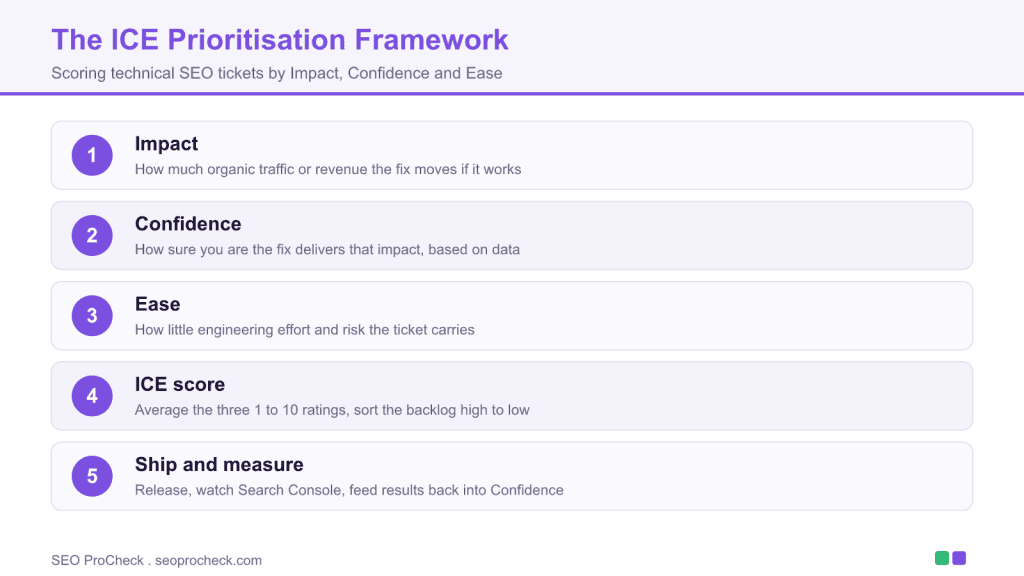
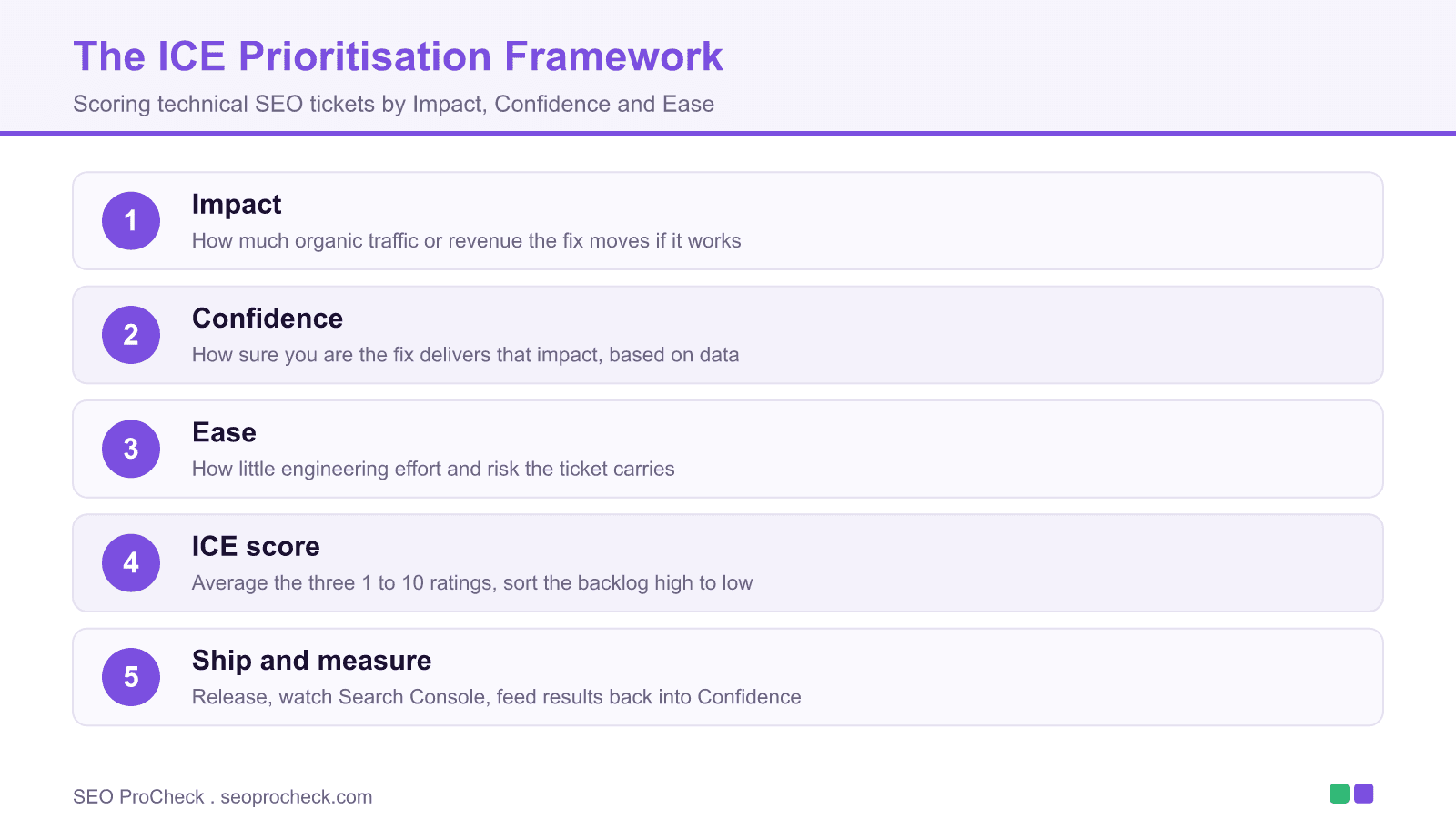
Technical SEO backlogs are almost always longer than the engineering time available to work them. The ICE framework, popularised by growth teams and applied to technical SEO by agencies such as NOVOS, turns that queue into a ranked list by scoring every ticket on three axes: Impact, Confidence and Ease. Each axis gets a rating from 1 to 10, and the ICE score is simply the average of the three. You sort the backlog from high to low and work down the list.
Scoring each axis
Impact asks how much organic traffic, revenue or crawl health the fix moves if it works. A canonical fix that de duplicates a million faceted URLs scores high; a title tweak on one low traffic page scores low. Confidence asks how sure you are that the change will produce that impact, and it should lean on evidence: Search Console data, log files, a documented Google behaviour, or a prior test. Ease is the inverse of effort and risk, so a change that ships in one sprint with no regression risk scores high, while a platform migration scores low.
A worked example
Say you have five open tickets. Score them, average, and rank. The table below shows how a fuzzy backlog becomes an ordered plan. Notice that the flashy idea, rebuilding the faceted navigation, drops below two cheaper wins because its Ease score is low and its Confidence is uncertain.
| Ticket | Impact | Confidence | Ease | ICE score | Rank |
|---|---|---|---|---|---|
| Fix 5xx errors Googlebot hits on category pages | 9 | 9 | 8 | 8.7 | 1 |
| Add canonical tags to sort and filter URLs | 9 | 8 | 7 | 8.0 | 2 |
| Compress and lazy load product images | 6 | 8 | 8 | 7.3 | 3 |
| Add a news style sitemap for the blog | 4 | 6 | 7 | 5.7 | 4 |
| Rebuild faceted navigation from scratch | 9 | 5 | 2 | 5.3 | 5 |
Setting it up in a spreadsheet or Jira
In a spreadsheet, use one column each for Impact, Confidence and Ease, then a formula cell such as =AVERAGE(B2:D2) for the ICE score and sort descending. In Jira, add three numeric custom fields and a calculated field, or export the backlog and score it in a sheet during weekly triage. Keep the rubric visible so scores stay consistent between people. The value of ICE is not mathematical precision; it is forcing an explicit, comparable judgement on every ticket.
Where ICE fits alongside crawl and index work
ICE is most useful when your backlog mixes quick wins with structural projects. Many technical tickets trace back to crawl and index quality, so pair your scoring with a clear view of how Google is crawling the site. Reading a crawl efficacy report and a robots.txt audit before you score gives Impact and Confidence a factual basis. On large stores, the recurring offenders are usually the same five issues covered in our large ecommerce guide, and pagination bloat like the case in our pagination study.
Limitations and alternatives
ICE is subjective by design, so two people can score the same ticket differently. Anchoring Confidence to data reduces that drift. If you want more structure, RICE adds a Reach term and divides by Effort, while PIE scores Potential, Importance and Ease. All three serve the same goal: stop working the loudest ticket and start working the highest value one.
Background reference and source
Technical SEO provides the foundation for content visibility. Without proper technical implementation, even excellent content may fail to rank. This resource covers technical considerations that enable search engines to effectively crawl, index, and rank your content.
Crawlability Essentials
Search engines must be able to discover and access your content. This requires proper robots.txt configuration, XML sitemaps, internal linking, and server reliability. Technical barriers to crawling prevent content from entering the ranking competition regardless of quality.
Indexation Optimization
Not all crawled pages get indexed. Ensuring pages provide sufficient unique value, avoiding duplicate content issues, and using canonical tags appropriately help control what gets indexed. Monitoring indexation status through Search Console reveals issues requiring attention.
Performance and Experience
Core Web Vitals and page speed affect both user experience and rankings. Technical optimizations including caching, compression, image optimization, and code efficiency improve performance metrics. These optimizations serve users while sending positive signals to search engines.
This resource provides guidance for building and maintaining the technical foundation that enables SEO success.
Source: https://thisisnovos.com/blog/how-to-use-the-ice-framework-to-prioritise-technical-tickets-for-seo/
Frequently asked questions
What does ICE stand for in SEO?
ICE stands for Impact, Confidence and Ease. You rate each technical SEO ticket from 1 to 10 on all three, then average them into a single ICE score that ranks the backlog.
How do you calculate an ICE score?
Add the Impact, Confidence and Ease ratings and divide by three. A ticket scored 9, 8 and 7 has an ICE score of 8.0. Sort every ticket from high to low and work the top of the list first.
Is ICE better than RICE for technical SEO?
ICE is faster and works well for small teams triaging a mixed backlog. RICE adds a Reach estimate and divides by Effort, which helps when tickets vary widely in audience size. Neither is objectively correct; pick the one your team will use consistently.
How should I set Confidence?
Base Confidence on evidence rather than opinion. Search Console impressions, log file crawl data, a known Google behaviour or a prior split test all raise Confidence. If you are guessing, the score should be low.
How often should I re score the backlog?
Re score during weekly or fortnightly triage and after any release, because shipping a fix changes what you know. Confidence in particular should move once you have measured the result of a similar change.
Does ICE replace a technical audit?
No. ICE prioritises the findings a technical audit produces. Run the audit first to populate the backlog, then use ICE to decide the order in which you fix what it found.
Take this with you
The assistant links open with a question about this page already written. Nothing is sent until you press enter.
Claude Vincent is a technical SEO consultant focused on crawlability, rendering, and AI-search visibility. He writes the field guides and case studies at SEO ProCheck, with a bias toward the durable, unglamorous work that decides whether search engines and AI answer engines can actually read and cite a site.
About SEO ProCheck
Technical SEO consulting and GEO strategy with 20 years of enterprise experience. Case studies, resources, and tools for search and AI visibility.
Work With Me
Technical SEO audits, GEO strategy, site migrations, and international SEO. Hourly consulting for teams who need hands-on support, not just reports.
Subscribe to our newsletter!








Recent Posts
- Most Top Sites Never Say Who They Are in Structured Data October 14, 2026
- Homepage Titles Are Mostly Too Short, Not Too Long October 8, 2026
- Who Actually Serves an llms.txt? 184 Top Sites Measured September 29, 2026