


AI Summary
An author page is a dedicated bio that proves who wrote your content and why they are qualified, pairing a human readable bio with Person structured data. It matters most on YMYL topics, where Google weighs author trust heavily, and the sameAs array is what ties your byline to a verifiable identity.
- Pair a persuasive bio with matching
Personschema; the two layers must agree. - The
sameAsarray links your byline to real profiles such as LinkedIn, ORCID, and publisher pages. - Attribute advice content to a named human with credentials, never to a generic "Admin".
- Close the loop: every article links to the author page, and the page lists the author's work.
What Author Pages are
An author page is a dedicated page that establishes who wrote your content, what they know, and why they're worth trusting. Done right, it backs up the byline with real credentials, links, and Person structured data, which is exactly the kind of evidence Google's E-E-A-T signals reward. On any site giving advice about health, money, or safety, a hollow author page is a liability you can't afford.
What a real author page contains
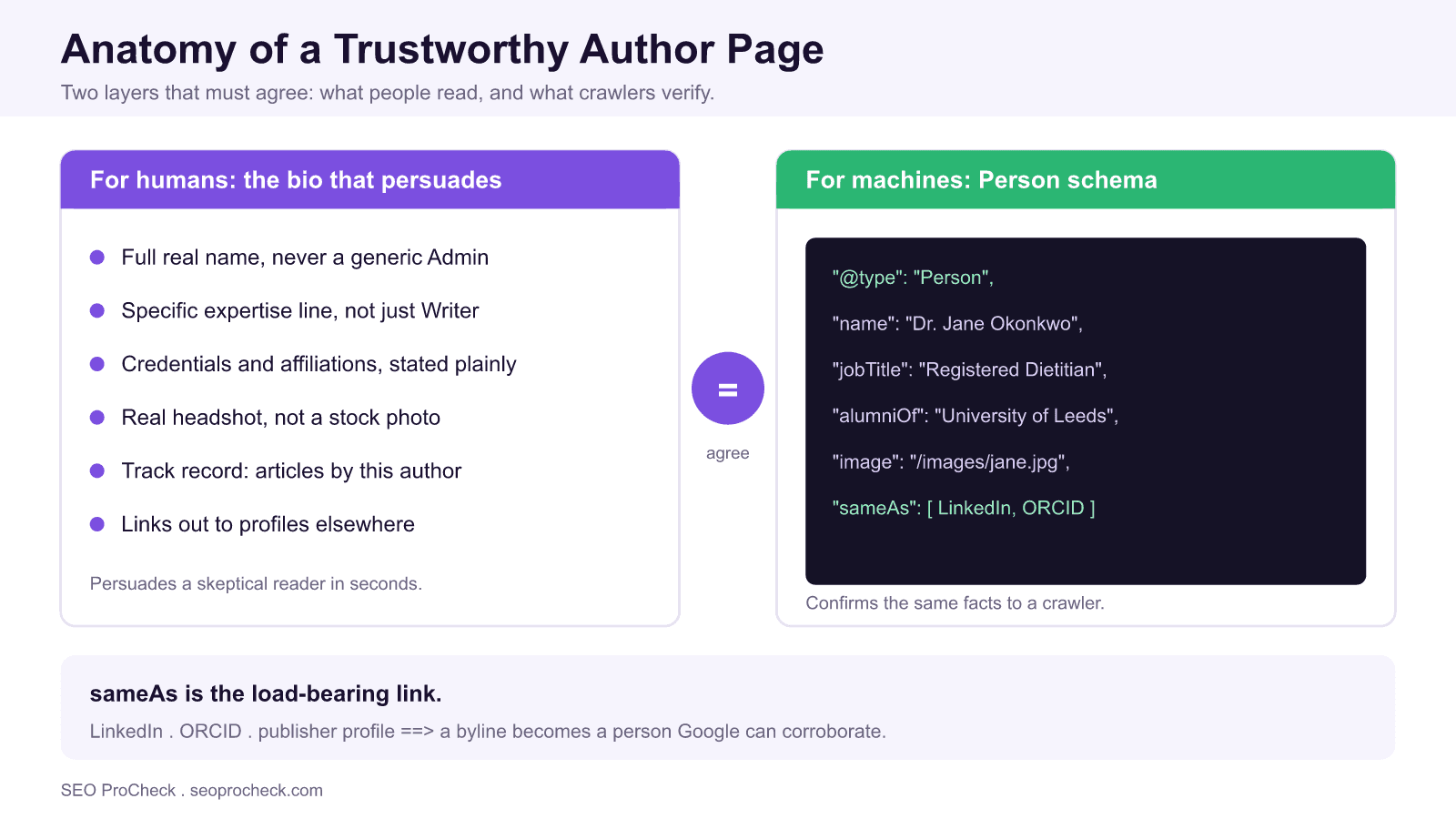
A byline that links to a bio with nothing behind it does no work. A useful author page pairs a human-readable bio with machine-readable proof. On the content side: full name, a specific description of expertise, credentials, a photo, and links to the person's presence elsewhere. On the technical side: Person schema with sameAs links that tie the byline to verifiable profiles.
<script type="application/ld+json">
{
  "@context": "https://schema.org",
  "@type": "Person",
  "name": "Dr. Jane Okonkwo",
  "url": "https://example.com/author/jane-okonkwo/",
  "image": "https://example.com/images/jane.jpg",
  "jobTitle": "Registered Dietitian",
  "description": "RD with 12 years in clinical nutrition and public-health writing.",
  "alumniOf": "University of Leeds",
  "sameAs": [
    "https://www.linkedin.com/in/jane-okonkwo/",
    "https://twitter.com/janeokonkwo",
    "https://orcid.org/0000-0002-1825-0097"
  ]
}
</script>
The sameAs array is the load-bearing part. It connects the name on your site to the same person on LinkedIn, a professional registry, an ORCID, or a publication. That's what turns a byline into a verifiable entity Google can corroborate.
In practice, generate the schema and the visible bio from one source of truth. If you hand-write the JSON-LD separately from the bio, the two drift: someone updates the on-page job title and forgets the markup. Store the author fields once (name, role, credentials, photo, profile URLs) and render both the bio and the Person block from them. That single habit prevents the most common author-page defect, a schema that quietly contradicts the words on the page.
Bio content vs. schema: two jobs, one page
People and crawlers read the page differently. The bio persuades a human; the schema confirms the facts to a machine. You need both, and they should agree.
| Element | Serves humans | Serves search / AI | Why it matters |
|---|---|---|---|
| Full real name | Establishes a person, not a brand | Person.name anchors the entity | Anonymous "Admin" bylines undercut trust on YMYL topics |
| Specific expertise line | Tells readers why to believe them | jobTitle / description | "Writer" says nothing; "Registered Dietitian, 12 yrs" says a lot |
| Credentials & affiliations | Signals qualification | alumniOf, memberOf | Especially decisive for medical and financial content |
| Photo | Puts a face to the work | image | Real photo beats stock; supports the "this is a person" signal |
| External profiles | Lets readers verify independently | sameAs array | The core link between your byline and the wider web |
| Articles-by-author list | Shows a track record | Internal links build topical association | Ties the author to a subject Google can map |
Where sameAs links carry the most weight
Not every profile link is equal. A regulator-backed credential does far more than a social follow. When you build the sameAs array, lead with the profiles a third party controls and can vouch for.
| Profile type | What it proves | Priority for YMYL |
|---|---|---|
| Professional registry or licensing body | A verified credential a regulator stands behind | Highest |
| ORCID or Google Scholar | A published, citable research record | High for medical and academic |
| Employment history and a named identity | Medium, near universal | |
| Publisher or masthead profile | Editorial accountability | Medium |
| Personal site with matching schema | Reciprocal entity confirmation | Supporting |
| Social profiles such as X or Instagram | Reach, not proof of expertise | Low, use sparingly |
How to check it on your own site
- Click a byline on any published article. If it doesn't lead anywhere, you have no author page and that's the first fix.
- Read the bio as a skeptic. Does it say what this person actually knows, or is it three vague sentences? Rewrite for specificity.
- View source on the author page and search for
"@type": "Person". Missing schema means Google is guessing. - Check the
sameAslinks. Each should resolve to a live profile that's genuinely the same person, not a dead or placeholder link. - Run the author page through the Rich Results Test to confirm the
Personmarkup parses cleanly. - Confirm every article by this author links back to the author page, and the author page links out to their work. The loop should be complete.
- For YMYL topics, verify credentials are stated plainly and, where possible, backed by an external registry link.
Field notes from real audits
On live audits the failure is rarely a missing bio; it is a bio with nothing verifiable behind it. A named author with one working LinkedIn link and a plainly stated credential outperforms a lavish bio that links nowhere. When you cannot add a professional registry link, add whatever independent proof exists: a conference talk, a published book, a staff page on an employer site. The point is corroboration a third party controls, not self-description. And resist the urge to spin up ten authors to look bigger; a handful of real, deep author pages reads as far more trustworthy than a roster of stock-photo ghosts.
Common mistakes and how to fix them
- Byline with no page behind it. A name that isn't clickable, or clicks to an empty archive, wastes the signal. Build a real bio page and link the byline to it.
- "Admin" or "Editorial Team" as the author on advice content. Google wants a person it can assess. Attribute to a named human with credentials.
- Empty or fake
sameAslinks. Pointing to profiles that don't exist, or that belong to someone else, is worse than none. Use only real, matching profiles. - Schema that contradicts the visible bio. If the page says "Registered Dietitian" but the schema says "Content Writer," you send mixed signals. Make them match.
- Stock-photo headshots and boilerplate bios reused across ten fake authors. That's a trust red flag. One real person, one real photo, one honest bio.
FAQ
Do author pages directly boost rankings?
There's no "author page ranking factor." They contribute to the trust and expertise signals Google weighs, especially on YMYL content. Think of them as evidence supporting E-E-A-T, not a lever you pull for position.
What is sameAs and why does it matter so much?
It's an array of URLs pointing to the same person elsewhere: LinkedIn, ORCID, a publisher profile. It lets Google connect your byline to a verifiable identity across the web, which is the heart of author trust.
Do I need a photo?
It helps. A real headshot supports the "this is a genuine person" signal and populates the image property. Avoid stock photos, which do the opposite.
Should low-stakes blogs bother with this?
The bar scales with your topic. A hobby blog needs less than a medical site. But even a basic named bio with one real profile link beats an anonymous "Admin" byline.
Where should the author bio live, on a dedicated page or in a byline box?
Give each author a dedicated, indexable page at a clean URL such as /author/name/, then surface a short version in a byline box on every article. The dedicated page is where the full bio, photo, credential links, and Person schema belong, and it gives every byline a single stable target to link to.
How do author pages connect to E-E-A-T?
They're the clearest place to demonstrate the "Experience" and "Expertise" halves. For the full framework see the guide to building author authority pages and the Person schema reference.
Claude Vincent is a technical SEO consultant focused on crawlability, rendering, and AI-search visibility. He writes the field guides and case studies at SEO ProCheck, with a bias toward the durable, unglamorous work that decides whether search engines and AI answer engines can actually read and cite a site.
About SEO ProCheck
Technical SEO consulting and GEO strategy with 20 years of enterprise experience. Case studies, resources, and tools for search and AI visibility.
Work With Me
Technical SEO audits, GEO strategy, site migrations, and international SEO. Hourly consulting for teams who need hands-on support, not just reports.
Subscribe to our newsletter!







Recent Posts
- Can AI Crawlers Actually Read Your Site? I Measured 400 of the Biggest September 5, 2026
- The Pre-Publish Quality Gate for AI-Assisted Content August 6, 2026
- AGENTS.md vs llms.txt vs llms-full.txt: Which Agent File Does What July 18, 2026