

People Also Ask Optimization: Capturing the Expanding Question Box
- October 12, 2024
- On-Page SEO
AI Summary
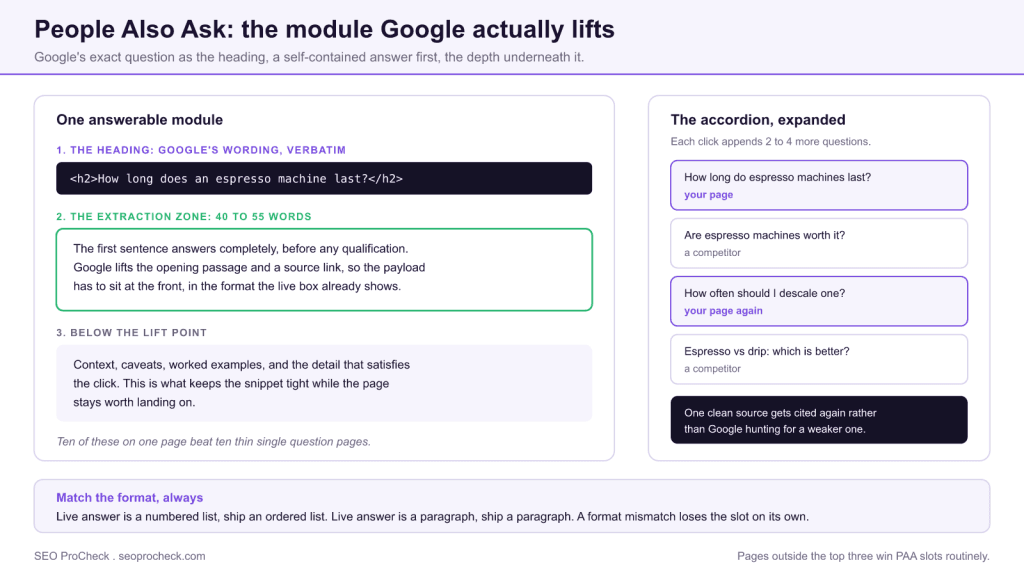
To win People Also Ask slots, harvest the questions Google actually shows for your topic, then answer each one under a heading that uses Google’s exact wording, leading with a 40 to 55 word answer that stands alone. Match the format the live box already displays, whether that is a paragraph, a list, or a table, because a format mismatch loses the slot on its own.
- PAA answers are extracted, not submitted. There is no markup or feed that makes you eligible.
- Ranking position matters far less than for featured snippets: pages well outside the top three supply PAA answers constantly.
- Cluster 8 to 15 question modules on one page. A single strong page gets cited repeatedly across an accordion; ten thin pages do not.
- Put the payload first, then expand below it. A 200 word block is too long to lift.
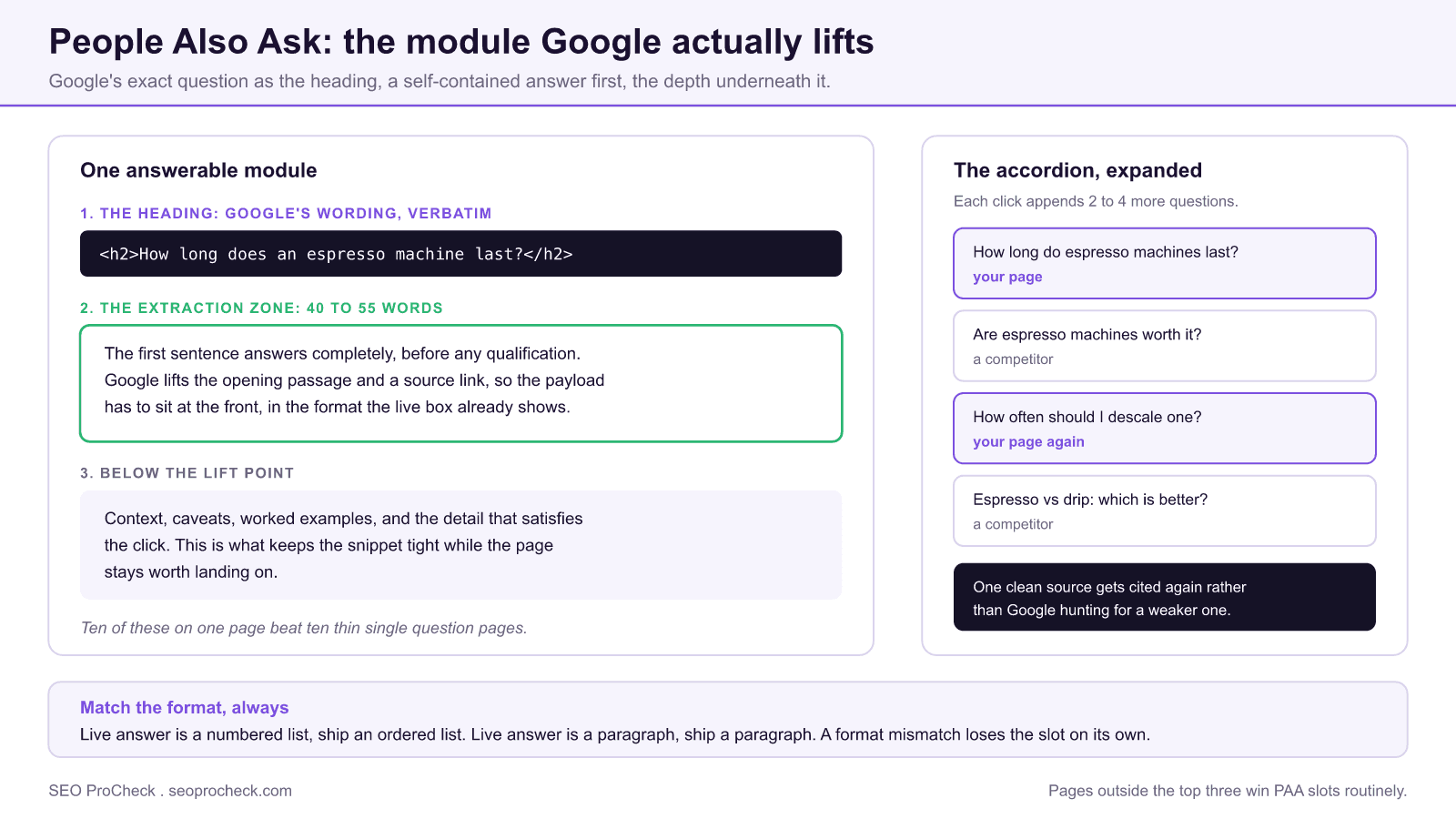
Quick answer: To optimize for People Also Ask, harvest the real questions Google shows for your topic, then answer each one on your page under a heading that uses Google's exact wording, with a 40-55 word direct answer as the first sentence, formatted to match what the live PAA box already displays (paragraph, list, or table). Pages that answer a cluster of related questions this way routinely win multiple PAA slots across dozens of neighboring queries without ranking in the top three for any of them.
People Also Ask (PAA) boxes are the most underexploited surface in Google's results page. They expand on click, regenerate new questions as users dig, and pull answers from pages that may not even rank in the top ten for the seed query. That volatility is the opportunity: a page engineered to answer clusters of related questions can occupy several PAA slots at once and surface across queries it never explicitly targeted.
How the PAA Box Actually Works
Unlike a featured snippet, which shows one answer per query, PAA is an accordion that grows. Each expansion fires a fresh query behind the scenes and appends 2-4 new questions. This means a single page can be cited multiple times within one accordion and across the accordions of dozens of sibling queries.
- Answers are extracted, not authored by you. Google lifts a 40-60 word passage plus a source link. Your job is to make that passage trivially easy to lift.
- Questions are query-derived. They come from real reformulations users type, so the set overlaps heavily across a topic cluster.
- Eligibility is broad. Pages ranking well outside the top 3 regularly win PAA answers, which is why mid-authority sites can compete here when they can't win the snippet.
- The same source can repeat. If your page answers the seed and several follow-ups cleanly, Google will cite it again rather than hunt for a weaker alternative.
Building Your Question Inventory
Optimization starts with harvesting the actual questions Google surfaces, not guessing. Treat this as a data-collection step, not brainstorming.
- Seed and expand. Search your primary query, click each PAA question, and record the new ones that appear. Three or four expansion rounds typically yields 30-60 questions per topic.
- Pull from tools. SERP APIs (DataForSEO's
serp_organic_live_advancedreturns apeople_also_askelement) and keyword tools expose PAA programmatically so you can do this at scale across a cluster. - Cluster by intent. Group questions into definitional (what is), procedural (how do I), comparative (X vs Y), and qualifying (is it worth / how much / how long). Each cluster maps to a content block.
- Note the answer format Google currently shows. Paragraph, list, or table. Match it. If the live PAA answer is a numbered list, a prose paragraph will rarely displace it.
Structuring Content to Win Multiple Slots
The mechanical pattern that earns PAA citations is consistent and repeatable. Build each answerable unit as a self-contained question-and-answer module.
- Use the literal question as an
<h2>or<h3>. Phrase it the way Google phrases it in the box, not a keyword-stuffed paraphrase. Match casing and word order. - Lead with a 40-55 word direct answer. The first sentence must answer completely on its own, before any qualification. Google extracts the opening, so front-load the payload.
- Then expand below the lift point. Add context, caveats, and examples after the extractable passage so the page satisfies the click while the snippet stays tight.
- Format to the intent. Procedural answers get an
<ol>; comparisons get a<table>; definitions get a clean paragraph. The structure signals extractability. - Cluster siblings on one page. Ten related Q&A modules on a single well-organized page beat ten thin pages, because the page accrues authority on the topic and becomes the obvious repeat source for the whole accordion.
Question Pattern to Answer Format: The Matching Table
Most lost PAA slots trace back to a format mismatch. This table maps each recurring question pattern to the answer structure that wins it and the markup that signals it:
| Question pattern | Answer format that wins | Markup |
|---|---|---|
| What is / what does X mean | One tight definition paragraph, roughly 40-55 words, term defined in the first sentence | <h2> question + <p> |
| How do I / how to X | Numbered steps, 5-8 items, each step starting with an imperative verb | <h2> question + <ol> |
| X vs Y / difference between | Two-column comparison, or a paragraph naming the single decisive difference first | <table> or <p> |
| Is X worth it / is X good | Verdict in the first clause, then the one or two conditions that change it | <h3> question + <p> |
| How much / how long / how many | The number or range in the first sentence, then what moves it | <h3> question + <p> |
| Best X for Y / which X should I | Short unordered list of named options with a one-line qualifier each | <h2> question + <ul> |
| Why does / why is X | Cause stated first, mechanism second, exception last | <h3> question + <p> |
Before writing, always check the live accordion: whatever format Google is currently extracting for that exact question is the format to beat, and matching it is the baseline, not the optimization.
The Compounding Effect Across Related Queries
This is where PAA optimization stops being tactical and becomes a visibility strategy. Because the question pool overlaps across a cluster, one comprehensive page can appear in the PAA boxes of the seed query and its sibling queries simultaneously.
Consider a page that thoroughly covers "how long does an espresso machine last." The same Q&A modules become eligible for the PAA accordions on "are espresso machines worth it," "espresso machine maintenance," and "espresso vs drip" because Google generates overlapping follow-ups across all of them. You built the answers once; they surface across an entire query neighborhood. Each additional slot is incremental visibility at near-zero marginal cost, and the impressions compound as you add modules.
Schema and Technical Reinforcement
Structured data does not guarantee PAA inclusion, but it clarifies your content's structure to the parser.
- Use
FAQPageschema only when the Q&A is genuinely visible on the page and not gated behind interaction. Google stopped showing FAQ rich results for all sites on May 7, 2026, but the markup still aids passage understanding. - Keep questions in the DOM on load. Answers hidden inside JavaScript tabs or click-to-reveal accordions risk not being extracted. Render the text server-side.
- Maintain clean heading hierarchy. A logical
<h2>/<h3>nesting helps Google map questions to answers and identify passage boundaries. - Ensure each answer has a stable anchor. Self-referencing IDs on headings give the citation a precise destination and improve click-through from the box.
Measuring and Iterating
PAA wins are partly invisible in standard reporting because impressions roll into the main query line. Build a tracking loop anyway.
- Watch Search Console for impression spikes on low-position queries. A page sitting at position 6-12 that suddenly gains impressions across many related queries is often winning PAA real estate.
- Filter GSC to question queries with a custom regex. In Performance > Query filter, choose Custom (regex) and use
^(what|how|why|is|are|can|does|do|which|when|where|should)\b. The queries this surfaces where your page shows impressions at position 8+ are your strongest PAA candidates; sort by impressions and compare against your harvested question inventory. - Re-scrape the accordion monthly. The question set rotates. New questions are new openings; lost ones tell you a competitor displaced your passage.
- A/B the answer length and format. If you're losing a slot, check the live answer's format and rewrite yours to match it exactly, then wait a crawl cycle.
- Track repeat citations. When one URL wins multiple questions in a single accordion, double down on that page's topic rather than spreading thin.
Reading the signals in Search Console
PAA wins do not appear as a separate row in any report, so you infer them from the shape of the data. These are the patterns worth acting on, and what each one is usually telling you:
| What the data shows | What it usually means | What to do next |
|---|---|---|
| Impressions climbing across many question queries while average position stays around 8 to 15 | You are being surfaced inside accordions rather than climbing the blue links | Add more sibling modules to that page; the neighbourhood is already citing it |
| High impressions and a very low click-through rate on one question query | Your passage is being shown and read inside the box without earning the click | Keep the extract tight but end it on the hook that needs the page: a caveat, a number, a next step |
| A question query that had impressions and now has none | Either the question rotated out of the accordion, or a competitor displaced your passage | Re-scrape the live box. If the question still shows, compare formats and rewrite to match |
| One URL gaining impressions on questions you never targeted | Google is reusing your page as a general source for the topic cluster | Treat that page as the hub and consolidate related modules into it rather than starting new pages |
| Impressions spread thinly across several near-identical pages | You have split one topic across competing pages, so none accrues the authority to be reused | Merge them into a single module-rich page and redirect the rest |
None of this is precise attribution, and it should not be presented as such. It is directional evidence, and it is enough to decide where the next ten modules go. The same passage-level discipline drives citation in AI answers, where the extraction unit is similar even though the surface is not: see structuring content for AI extraction and the wider featured snippets guide for how the same modules earn slots on other surfaces.
Common Mistakes
- Burying the answer. Leading with background before the direct answer forfeits the extraction. Answer first, explain second.
- Paraphrasing the question. Rewriting Google's exact wording into a "better" headline breaks the match signal. Use their phrasing verbatim.
- One question per page. Thin single-question pages can't accumulate the topical authority that makes Google reuse a source across an accordion.
- Over-answering the snippet. A 200-word block won't be lifted. Keep the extractable passage at roughly 40-55 words and put depth below it.
- Ignoring format intent. Submitting prose when the live answer is a list, or vice versa, almost always loses.
- Treating FAQ schema as a ranking lever. It is a comprehension aid, not a shortcut. Faking visible Q&A to deploy markup risks a manual action.
FAQ
Answer a question Google already shows in the box, on a page that ranks somewhere in roughly the top 10-20 for related queries. Use the question verbatim as a heading, lead with a 40-55 word standalone answer, and match the format of the answer currently displayed. There is no submission mechanism; extraction is algorithmic.
No. PAA answers are extracted from page content, and pages without any structured data win slots constantly. FAQPage markup can help Google parse your question-answer structure, but it is a comprehension aid, not an eligibility requirement or a ranking lever.
Less than for featured snippets. Pages well outside the top 3 regularly supply PAA answers, which makes the box one of the few SERP features where a mid-authority site can beat entrenched competitors. You still generally need to rank somewhere for a related query so Google has your passage indexed and scored.
Cluster related questions on one page rather than splitting them: roughly 8-15 question-and-answer modules on a single well-structured page is a practical range. One comprehensive page accrues the topical authority that makes Google reuse it across an accordion; ten thin one-question pages do not.
Usually one of three causes: a competitor published a passage that matches the answer format more cleanly, the question itself rotated out of the accordion, or your page changed and the extractable passage moved or grew past liftable length. Re-check the live box, compare formats, and restore a tight front-loaded answer.
Expanding questions in your own browser generates more questions in your session, which is why it works as a harvesting technique, but it does not seed those questions for other searchers. The question pool is derived from aggregate query reformulations, not individual click behavior.
The accordion rewards the page that answers a cluster of real, harvested questions in the format Google already displays, with the payload front-loaded for clean extraction. Build that page once, structure it for repeat citation, and it becomes a compounding visibility surface that earns slots across an entire neighborhood of queries you never had to rank first for.
Want this handled properly on your site?
It is exactly the kind of work an advanced technical SEO audit covers. See how an advanced SEO audit works →
Take this with you
The assistant links open with a question about this page already written. Nothing is sent until you press enter.
Claude Vincent is a technical SEO consultant focused on crawlability, rendering, and AI-search visibility. He writes the field guides and case studies at SEO ProCheck, with a bias toward the durable, unglamorous work that decides whether search engines and AI answer engines can actually read and cite a site.
About SEO ProCheck
Technical SEO consulting and GEO strategy with 20 years of enterprise experience. Case studies, resources, and tools for search and AI visibility.
Work With Me
Technical SEO audits, GEO strategy, site migrations, and international SEO. Hourly consulting for teams who need hands-on support, not just reports.
Subscribe to our newsletter!








Recent Posts
- Most Top Sites Never Say Who They Are in Structured Data October 14, 2026
- Homepage Titles Are Mostly Too Short, Not Too Long October 8, 2026
- Who Actually Serves an llms.txt? 184 Top Sites Measured September 29, 2026